Zerren
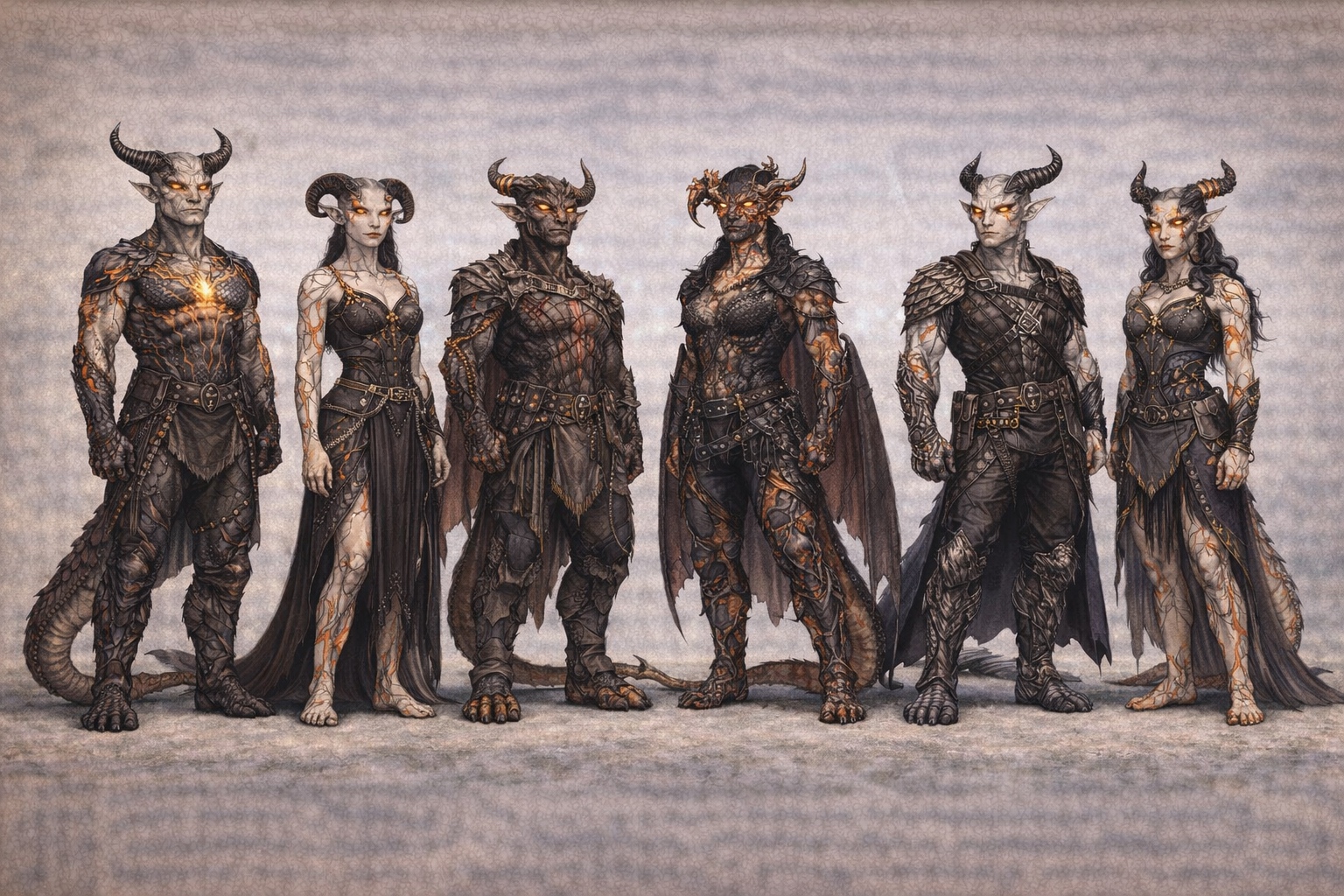
Zerren
Playing a Zerren? Exodus NDS rules: Species of Dort on ix.exodusnds.com, or the free Dort Species Guide from Exodus NDS Sourcebooks. Other systems: see Playing in Dort.
CORE IDENTITY
- Race Name: Zerren
- Plural Name: Zerren
- Adjective Form: Zerren (attributive); Zerric (formal written)
- Alternate Names: The Marked; Pactkin (archaic, considered neutral in older texts)
- Self-Name (Endonym): Zerren; the name predates any outsider use; they were calling themselves this before it became the common term
- Outsider Names (Exonyms): Hellborn (derogatory, widespread); the Scarred (Jazirah); Coalborn (Shoing port slang); Marked Ones (rural Irna; neutral in tone, merely descriptive)
OVERVIEW
Short Description
The Zerren are a people of infernal descent, born of unions between the devil-kind and demon-kind of the Hells and mortal men and women in generations past. Though the gods long ago forbade such congress, the inhabitants of the Hells largely ignored that prohibition and continue to do so, and so Zerren continue to be born into every generation. They carry the Hells in their blood as a tendency, not a sentence: the pull toward control or appetite is present, but not absolute, and the question of what to do with that pull is the central one of Zerren life.
General Reputation
The Zerren are regarded with suspicion across most of Dort. Their fractured skin markings and ember-lit eyes mark them as other in a way that is immediately legible to anyone who knows what they're seeing, and the association with infernal heritage is rarely forgotten once made. In cities and trading centers where different peoples move freely, Zerren are tolerated and sometimes integrated; the wariness rarely fully dissolves, but it can be managed. In more isolated communities, the reaction is more often fear or outright hostility. The assumption that Zerren are more likely to deceive, manipulate, or harm is unfair, contested by many Zerren across every generation, and persistent regardless.
Role in the World
Zerren occupy an outsider's position in nearly every society they inhabit. They are neither rare enough to be curiosities nor numerous enough to carry political weight in most places. Their strongest civilizational roles emerge in the margins: urban networks of mutual support, mercenary companies, diplomatic and intelligence work for those comfortable in uncomfortable spaces, and the specific economy of people who understand how the Hells actually function. They serve as a living reminder that the boundary between the mortal world and the infernal is not absolute, which some societies treat as a warning and others, more quietly, treat as a resource.
PHYSICAL TRAITS
General Appearance
Zerren read as humanoid at a distance. Their silhouette and proportion are close enough to the mortal baseline that they can move through a crowded street without identification, until the markings are noticed, or the horns are visible, or the light in their eyes catches. Their defining features are legible in proximity, not at range.
Size Ranges
- Typical height: Comparable to the human range across Irna and Shoing populations. Neither lineage is reliably taller or shorter as a population.
- Typical weight/build: Variable. Dominion Zerren tend toward lean, controlled builds. Ravage Zerren more often present stocky or irregularly powerful. Neither is universal.
Distinguishing Features
Three features are consistent across all Zerren: fractured skin markings, downward-angled horns, and eyes that hold light from within.
Skin markings run across the body in patterns that recall cracked earth, fault lines in stone, or glass fractured from an impact point. They are present from birth and do not spread or fade over a lifetime, though they deepen in color with age. The fractures do not follow geometric regularity; they branch and terminate unpredictably, with no two Zerren sharing the same pattern. In Dominion Zerren, the fractures have structural coherence: they radiate from consistent origin points, the lines are cleanly edged, and the overall pattern has a quality of organized damage. In Ravage Zerren, the markings are irregular: asymmetric, branching differently on each side of the body, occasionally appearing in unexpected places, with no organizing principle visible even in retrospect.
Horns grow from the skull and angle downward or outward, curving toward the jaw or shoulder rather than skyward. Some terminate in a clean point; others branch once or appear to have fractured at some point and continued growing along the break. In Dominion Zerren, horns form symmetrical matched pairs, smoothly curved and evenly sized. In Ravage Zerren, pairs are commonly mismatched: one longer, one shorter, angled differently, or showing apparent mid-growth fracture.
Eyes glow from within. The light does not project outward the way a lamp does; it is contained inside the iris, visible as an ember banked behind glass. Colors range across deep amber, sulfurous yellow, dull red, and occasionally a cold blue-white that reads as smoldering ash rather than live flame. In full darkness, the glow is perceptible at short range; in daylight, it is only visible when looking directly.
Aging Patterns
Zerren are considered children through their first two decades and pass into adulthood in their early twenties, slightly later than the human average. Visible aging is slow through the middle decades and accelerates around the ninetieth year. Elder Zerren see their markings deepen toward black and their horn structure become rougher or more ridged with accumulated growth. Most Zerren live between 130 and 160 years.
Regional Variation
Zerren who have lived for generations in a given region show modest adaptation in base skin tone and facial structure that mirrors the local population, but the markings, horns, and eyes are invariant regardless of ancestry or environment. A Zerren family established in [Jazirah](Jazirah/Welcome to Jazirah) for three generations will read as Jazirian by feature structure while remaining identifiably Zerren by the marks and horns.
BIOLOGY
Diet
Zerren are omnivorous with no meaningful biological constraints distinct from the humanoid baseline. Some Ravage-lineage individuals report a strong preference for heavily seasoned or intensely flavored food; whether this is physiological or a cultural pattern that traveled with the lineage is debated.
Reproduction Basics
Zerren reproduction follows humanoid norms. Gestation is comparable to the human range. The trait expression in offspring is unusual: two Zerren parents will produce a Zerren child. A Zerren who has a child with a non-Zerren, non-Serren partner will not produce a child with Zerren traits; the child will be, entirely and without remainder, a child of the other parent's people. There are no half-expressions, no partially marked children from such pairings. The heritage is either present or it isn't.
Zerren and Serren cannot produce offspring together.
Within the Zerren lineages: a Dominion and Ravage pairing produces a child with traits from both, more symmetrical than a full Ravage, bearing fracture markings that are irregular but not maximally so. These mixed-lineage individuals are called Shardborn informally within Zerren communities.
Lifespan Ranges
- Typical lifespan: 130–160 years
- Maturity: approximately 20–22
- Elderhood: approximately 110–120
Environmental Adaptations
No significant physiological adaptations beyond the humanoid baseline. Zerren show a modest tolerance for heat and warm environments, likely an echo of infernal origin, though the Hells are not uniformly hot, and this may be a post-hoc cultural explanation for a modest biological fact.
PSYCHOLOGY & CULTURE
Tendencies described here are common patterns, not universals. Individual Zerren vary significantly, particularly across lineages and between those raised in mortal households versus those with an infernal-parent upbringing.
Typical Temperament
Zerren tend toward a carefully managed public presentation: watchful, measured, often more composed in unfamiliar company than the situation seems to warrant. This is partly cultural adaptation to a world that watches them closely and partly an expression of the Dominion lineage's pull toward control. Ravage-lineage Zerren are more likely to be direct to the point of bluntness, with strong reactions and an impatience with performance. Neither description applies universally, and Shardborn individuals often show a more varied baseline.
What is broadly consistent: most Zerren are aware of being watched and have developed a relationship with that awareness. Some resent it. Some use it. Few are indifferent to it.
Cultural Values
- Intentionality: The fear most Zerren live with is becoming what others assume they are. This creates a strong cultural value around deliberate choice, acting with intention rather than impulse. This is not the same as being cold or calculating; it means that when a Zerren is generous, or kind, or angry, they tend to know they are being those things.
- Earned trust: Zerren communities typically weight demonstrated reliability over time above stated character. Trust is not freely extended, partly because it has rarely been freely extended to them.
- Acknowledged heritage: There is a meaningful distinction within Zerren culture between pretending not to be what you are and choosing how to be what you are. The former is viewed as a kind of slow self-erasure. The latter is considered the actual project of a Zerren life.
Taboos
- Concealing lineage from children: A Zerren who hides from their own children what they are is viewed within most Zerren communities as having abandoned them, left them unprepared for what they will face.
- Yielding entirely to the pull: Not all Zerren feel the infernal pull strongly, but those who do and who give themselves to it without resistance are viewed within Zerren communities not with admiration but with something closer to grief. The pull is not shameful. Surrendering to it without effort is.
Social Structures
Zerren have no large-scale independent civilization. Their presence is as a minority within existing societies. In cities, informal networks form around neighborhoods, guilds, and trades where Zerren have concentrated over generations. These networks function as mutual aid systems, information exchanges, and the social infrastructure for people who cannot always rely on outside institutions. In areas where Zerren have faced sustained persecution, the networks develop more formal structure and secrecy.
Family Structure
Zerren families are typically small. The inheritance of lineage runs through blood without exception: two Dominion parents produce a Dominion child; two Ravage parents produce a Ravage child. Because Zerren who pair with non-Zerren will not produce Zerren children, there are communities that value Zerren-Zerren pairing for lineage continuity, but this is cultural preference, not universal practice.
Children raised by an infernal parent who crossed into the mortal world have a different formation than those raised in primarily mortal households. Both exist; both are considered fully Zerren.
Leadership Patterns
In organized Zerren communities, leadership tends to emerge through demonstrated competence and accumulated respect rather than formal hereditary structures. Elders carry weight not from age alone but from what they have navigated. Dominion-heavy communities tend toward more structured governance; Ravage-heavy communities are more fluid about who holds authority at a given moment.
GEOGRAPHIC DISTRIBUTION
The Zerren have no homeland, no continent or region where they form a majority population or hold territorial sovereignty. They exist throughout Dort as a diaspora minority.
Primary Homelands
- [Irna](Irna/Welcome to Irna): The most consistently accepting environment for Zerren in aggregate. Large trading cities on Irna's coasts have established Zerren quarters and neighborhoods, and in these urban centers Zerren are a recognized minority presence. Discrimination exists but is not institutionalized at the civic level in most of these cities.
- [Funta](Funta/Welcome to Funta): Zerren in Funta occupy the margins that conflict and instability create. Some communities have established themselves in places where the broader disorder makes organized hostility toward any specific group less sustainable.
- [Shoing](Shoing/Welcome to Shoing): Presence is scattered, concentrated in port cities and trading stops. The interior is less welcoming.
Secondary Populations (Diaspora)
- [Jazirah](Jazirah/Welcome to Jazirah): The theological frameworks of several Jazirian societies create particular difficulty for Zerren. The markings are legible as infernal to those with religious training, and organized religious hostility toward Zerren is documented in parts of the continent.
- [Antaea](Antaea/Welcome to Antaea): Small, scattered presence. Zerren in Antaea are rare enough to receive curiosity more often than hostility, though the curiosity is not always comfortable.
Migration Patterns
Zerren do not migrate so much as drift: individual and family-level movement toward urban centers, trading routes, and places where difference is more tolerated. Organized expulsions from specific communities have occurred across Dort's history in multiple historical periods; these events are remembered within Zerren communities long after they are forgotten by the societies that carried them out.
Adaptations by Region
Standard adaptation to regional climates in clothing, shelter, and diet follows local norms, with no Zerren-specific traditional material culture in most places. In cities with established Zerren quarters, architectural choices (neighborhoods with fewer open sight lines, buildings facing inward around interior courtyards) reflect practical adaptations to sustained life under watch.
Cultural Differences Between Lands
Zerren in Irna's cosmopolitan centers tend toward integration as a cultural strategy: presenting within local norms, making the markings unremarkable through sheer familiarity. Zerren in more hostile environments develop tighter internal communities and are more guarded with outsiders. The tension between integration and internal community solidarity is live within Zerren culture across all regions and generates genuine disagreement between communities that have made different choices.
Dominion-lineage communities in trading centers have developed a reputation for reliability in contracts and negotiations: partly earned, partly a deliberate strategy of making usefulness outweigh suspicion. Whether this reputation helps Zerren broadly or creates a new kind of pressure on those who don't match it is a source of internal debate.
HISTORY
Origins
The Zerren came into being during a period before the gods formalized their prohibition against infernal congress with mortals. The exact dating varies by tradition, but Zerren as a recognizable bloodline predate the current era by several centuries at minimum. When the prohibition arrived, the Aelar of Paradiso largely honored it. The inhabitants of the Hells did not. They had never taken instruction from the gods as binding, and their ongoing disregard for the prohibition was not an act of rebellion so much as an expression of their foundational relationship to authority outside their own hierarchy. The result was predictable: Zerren continued to be born. They are not a relic of a past age. They are a present one.
Major Turning Points
The most consistent shaping force in Zerren history is not a single event but a recurring pattern: the swing between periods when Zerren communities are permitted to exist and integrate, and periods when organized expulsion, persecution, or worse follows. These cycles are not synchronized across continents; a generation of relative stability in Irna's cities may coincide with active persecution in Jazirah. The cumulative effect on Zerren culture is a kind of historical readiness: the understanding that the current arrangement is not permanent and should not be assumed to be.
Current Historical Posture
Zerren exist in a quiet tension between endurance and visibility. The question of how much to integrate versus how much to maintain distinct community is live in most Zerren networks. There is no unified Zerren political voice, no movement, no homeland project; but there are communities that have survived long enough to develop genuine depth, and within those communities, there is something that functions like quiet pride.
LANGUAGE
Language Name(s)
Zerren have no native language of their own origination. Their primary language is Common, with regional inflection matching wherever they were raised. Some Zerren, those raised by an infernal parent or who have had direct commerce with the Hells, speak the language of the infernal plane, specifically the dialect standard in the devil-ruled upper layers. This is not a Zerren language; it is the tongue of the Hells' inhabitants. It is a prestige marker in some Zerren communities and a warning sign to outsiders who recognize it.
Script
No proprietary script. Common writing systems are used throughout.
Trade Language Status
Common is the operational language. The infernal tongue is used between those who share it and occasionally in specific commercial contexts where dealing with infernal interests is relevant.
Dialect Range
Zerren communities in different regions develop their own speech patterns (borrowed vocabulary, particular idioms, slang that tracks lineage or community history), but these are dialects of Common, not a separate tongue.
Naming Agent Cross-Reference
No dedicated naming agent file yet established.
NAMING CONVENTIONS
Naming Agent Cross-Reference
See _Cannon/Race naming ai agents/Fantasy Name Generator - Infernal.md, Register 3 and the Dort Application: The ZERREN section, for full naming rules and generation guidance. Because Zerren names begin from the region that raised them, generation also requires the relevant register of _Cannon/Race naming ai agents/Fantasy Name Generator - Human.md (or the appropriate race file, for Zerren raised among non-human peoples).
Personal Name Structure
Zerren typically carry a personal name and a family name, following the convention of the region where they were raised. This makes Zerren names highly variable by continent: a Zerren family established in Irna for generations will have Irna-sounding names; one established in Shoing will reflect Shoing conventions.
Zerren with strong connection to an infernal parent more often carry names that echo infernal phonetics: hard consonants, Z, K, and V sounds prominent, short syllables, occasional glottal breaks in Ravage-heritage names.
Infernal-heritage names may bind a given name to a pact-root using one of two connective particles: kal for Dominion lineage, vel for Ravage. A single-element name with no pact-root carries its own meaning: either the root is unknown, or it has been renounced.
Because Zerren are born into every generation in numbers the Serren never approach, Zerren communities have had the density and the time to develop genuine internal naming traditions with recognizable phonetic character. Lineage governs that character, and the distinction is legible to any Zerren who hears it: Dominion names are clean and ordered, Ravage names carry the glottal breaks. Giving a Dominion Zerren a Ravage break is an error others will notice.
Sex and Name Form
For regional names, Zerren sex-marking is inherited from the register that raised them. Infernal-heritage names mark sex weakly and by ending weight rather than by any dedicated suffix: heavy consonant-final endings in -eth, -ath, -an, -ar, -ak, -ix, -rach lean masculine, while sibilant, liquid or short-vowel endings in -is, -as, -ra, -zha, -el, -ess lean feminine. Endings in -ex, -yx, -uz, -oth are genuinely ambiguous and common for both.
The connective particles never inflect; kal and vel are identical for any bearer, unlike the patronymic particles of Jazirah, which are the nearest structural parallel and the most likely source of error. Ravage glottal breaks do not inflect either and may appear in any name of that lineage.
Formal vs. Informal Names
In communities with strong internal culture, an infernal-heritage name is sometimes used within the community while a Common-convention name is used outside it. This is not considered deceptive by those who practice it.
Titles & Honorifics
- Shardborn: Used within Zerren communities to identify Dominion/Ravage mixed-lineage individuals. Informal; not offensive when used by Zerren; occasionally appropriated as a slur by outsiders.
- Marked Elder: An informal honorific for Zerren elders who have navigated enough to be worth consulting. Conferred by community usage, not formal appointment.
Name Examples
- Given names (Dominion-heritage phonetics): Vareth, Kozen, Malgeth, Pyrex, Zethis
- Given names (Ravage-heritage phonetics): Urrath, Bhozan, Teskar, Guzha, Morrach
- Family names: Follow local regional conventions; no standard Zerren family name tradition
- Infernal-heritage full name examples: Vorath kal Dur, Kaszar, Durass vel Molgash
SOCIETY
Common Professions
Zerren appear throughout the trades and professions of the cities they inhabit. The professions where they are disproportionately represented reflect both aptitude and access: Dominion-lineage Zerren have historically been sought for contract work, legal arbitration, and high-stakes negotiation, where a reputation for precision and reliability in structured agreements has created a real niche. Intelligence work and courier networks draw Zerren at higher rates than their population would suggest. Ravage-lineage Zerren appear more frequently in physical trades: security, mercenary work, hunting, extraction industries. Access to certain professions (religious offices, civic administration in several regions, positions requiring public trust) is restricted or practically barred by discrimination in specific places.
Craft Traditions
No unified Zerren craft tradition exists in the way some peoples maintain distinct aesthetic lineages. In cities with established Zerren quarters, metalwork featuring fractured-line etching, asymmetric patterning that echoes the skin markings of Ravage individuals, has emerged organically. Whether this is intentional cultural expression or coincidence is debated within those communities.
Trade Roles
Zerren do not dominate any particular trade good or route, but their reputation for reliability in structured agreements gives them functional roles in trade mediation and arbitration. In some markets, Zerren contract-witnesses are sought for high-value transactions specifically because of this reputation.
Military Tendencies
No unified military tradition. Zerren serve in the military structures of the societies they inhabit, or operate independently as mercenaries. Ravage-lineage individuals have higher representation in mercenary contexts than other Zerren; their comfort with direct confrontation and their relative freedom from institutional belonging makes mercenary work a natural fit for those inclined toward it.
Religious Tendencies
Religious practice among Zerren is as varied as their geographic spread. There are Zerren who practice the civic religion of their home city with full sincerity. There are Zerren who maintain private household observances that acknowledge infernal heritage: not worship of infernal powers, but acknowledgment of what they carry and where it comes from. There are Zerren who want nothing to do with organized religion, having found most of it views them with suspicion regardless. What is broadly absent: any organized Zerren religious movement or theology.
INTERACTIONS
Relations with Other Races
- Serren: The opposite-heritage counterpart is known to most Zerren, but the individual Zerren-Serren relationship varies enormously. The impossibility between them (they cannot produce offspring) is a fact most Zerren are aware of, and the cosmic opposition of their origin planes creates ideological tension that some individuals reproduce personally and others deliberately set aside.
- Humans: The most frequent relationship, given that Zerren exist primarily within human-majority territories. The baseline is managed coexistence shading toward discrimination in most places.
- Vaelhari: In regions where both are present, there is sometimes a mutual recognition between minority peoples: not solidarity as a rule, but a familiarity with the experience of being watched and categorized that sometimes creates openings for more than the usual stranger-caution.
Stereotypes (Given and Received)
- Stereotypes about them: That Zerren are naturally deceptive (common; mostly false: there is no biological predisposition to deception, though the Dominion pull toward manipulation is real for some individuals); that Zerren cannot be trusted in binding agreements (ironic and broadly false; Dominion Zerren have a genuine cultural emphasis on reliability); that Ravage Zerren are dangerous and unpredictable (partially true in that the Ravage pull exists; false in that most Ravage Zerren manage it, and the management is the point of a great deal of their inner life).
- Stereotypes they hold: That outsiders will eventually find a reason to be suspicious of them regardless of behavior. That Dominion-heritage Zerren are more trustworthy than Ravage-heritage, a stereotype Ravage individuals push back against within Zerren communities with considerable force.
Cooperation Patterns
Urban environments where difference is normalized create the most productive conditions for cooperation with other peoples. Dominion-lineage Zerren have the strongest track record of forming durable alliances through demonstrated reliability. Mercenary companies serve as a different kind of cooperation framework for Ravage-lineage individuals.
Conflict Patterns
Organized religious hostility, particularly in parts of [Jazirah](Jazirah/Welcome to Jazirah). Periodic civic expulsions when a community's tolerance is reversed by a change in local leadership or a triggering event. The standing assumption of infernal nature creating preemptive conflict even where no individual Zerren has provided any basis for it.
VARIANTS
Physical / Regional Variants
Dominion Zerren
- Defining traits: Symmetrical throughout: matching horns, fracture markings that radiate from consistent origin points and resolve cleanly on both sides of the body, contained ember-glow eyes. Physical presentation is structured and reads as controlled even to observers who don't know what they're looking at.
- Range / location: Present across all regions where Zerren exist; disproportionately represented in urban trade and administrative contexts.
- Notes: Their symmetry makes them slightly less immediately identifiable as Zerren to those unfamiliar with the full range of Zerren appearance. This has contributed to their ability to function in mercantile and administrative roles where Ravage Zerren face more resistance on appearance alone.
Ravage Zerren
- Defining traits: Asymmetrical throughout: mismatched horn pairs, fracture markings that vary across both sides of the body without mirroring, irregular physical proportions. The asymmetry reads as unresolved rather than grotesque.
- Range / location: Present across all regions; disproportionately represented in physical trades and mercenary contexts.
- Notes: More immediately identifiable as Zerren to those who know what Zerren look like. Their visibility means they often bear the weight of anti-Zerren sentiment even in communities where Dominion individuals have been successfully integrated.
Shardborn (Mixed Lineage)
- Defining traits: Features from both Dominion and Ravage parents: more symmetrical than pure Ravage, less perfectly ordered than pure Dominion. Fracture markings are irregular but not maximally so. Horns may be mismatched but coherently so.
- Range / location: Present wherever both Dominion and Ravage Zerren coexist.
- Notes: Sometimes less fully accepted by the more homogeneous Dominion or Ravage communities. Often more self-aware of the tension between lineage pulls by virtue of having navigated both from childhood. Neither fully committed to either pull's characteristic expression.
DEVELOPMENT NOTES (Author use only, not canon)
Story Hooks
- A Dominion Zerren who has built a genuine reputation as a contract arbitrator faces circumstances that activate their infernal pull at exactly the moment when yielding to it would be most profitable, and most justifiable.
- A Ravage Zerren mercenary encounters an infernal being who claims to be their ancestor and wants something specific from them.
- A Zerren community in a Jazirian city that has maintained stability for three generations faces a new religious authority that wants them expelled. The community must decide whether to fight, disperse, or negotiate, and with what.
- Shardborn twins (one leaning Dominion, one leaning Ravage) whose difference strains the relationship as they grow into adults in a city that treats them as interchangeable.
Unresolved Lore / Open Questions
- Are there any regions or cities where Zerren have achieved genuine civic equality rather than merely tolerance?
- Do the Tempters have specific relationships with Zerren bloodlines, given that the Tempters predate the current Hells hierarchy and have been working in the mortal world throughout the period of Zerren's existence?
- How do Zerren with direct Hells contact understand their relationship to the soul coin system: do they have a stake in it, or are they outside it?
- Is there any organized Zerren political presence anywhere, or has it always been informal and reactive?
Development Notes
- Color palettes for skin markings, horn coloration, and eye glow not yet established; flag for update when palettes are finalized.
- Geographic distribution values in the Races & Lands table are approximate estimates; review against more detailed continent lore when available.
- Naming conventions for non-infernal-heritage Zerren need regional examples by continent.
- The Tempters cross-reference is worth developing; whether any specific Tempter has a historical or ongoing relationship with Zerren bloodlines is unresolved and potentially rich.
- Cross-link with The Hells and The Tempters when those entries are finalized.
Race Template v2.0, Dort World Races