Anshun
Anshun: The Town Along the Chandu
"The river does not hurry. Neither do we. The rice arrives when it arrives. The barge arrives when it arrives. Gwajin's merchants have been trying to put us on their schedule for two hundred years. The Chandu is patient with them."
Governor-Prefect Mori Hagane, to a Gwajin Ministry of Commerce efficiency review delegation
At a Glance
| Continent | Shoing |
| Region / Province | Southeast Shoing, Gwajin Realm: Chandu River, southeast foothills |
| Settlement Type | Town |
| Population | ~6,400 |
| Dominant Races | Human (majority), Smaling (barge community) |
| Ruler / Leader | Governor-Prefect Mori Hagane |
| Ruling Body | House Hagane, hereditary prefecture under Gwajin Realm authority; the Governor-Prefect title reflects the administrative (Prefect) and military (Governor) dual function |
| Primary Deity | Bridhel (rivers, movement, and seasonal renewal) |
| Economy | Rice cultivation, Chandu River barge trade, silk thread production, river-fish preservation |
| Known For | The most productive rice cultivation in the southeast foothills; the Chandu River barge network's inland terminus; the rice wine that the Gwajin court buys under a specific vintage designation |
First Impressions
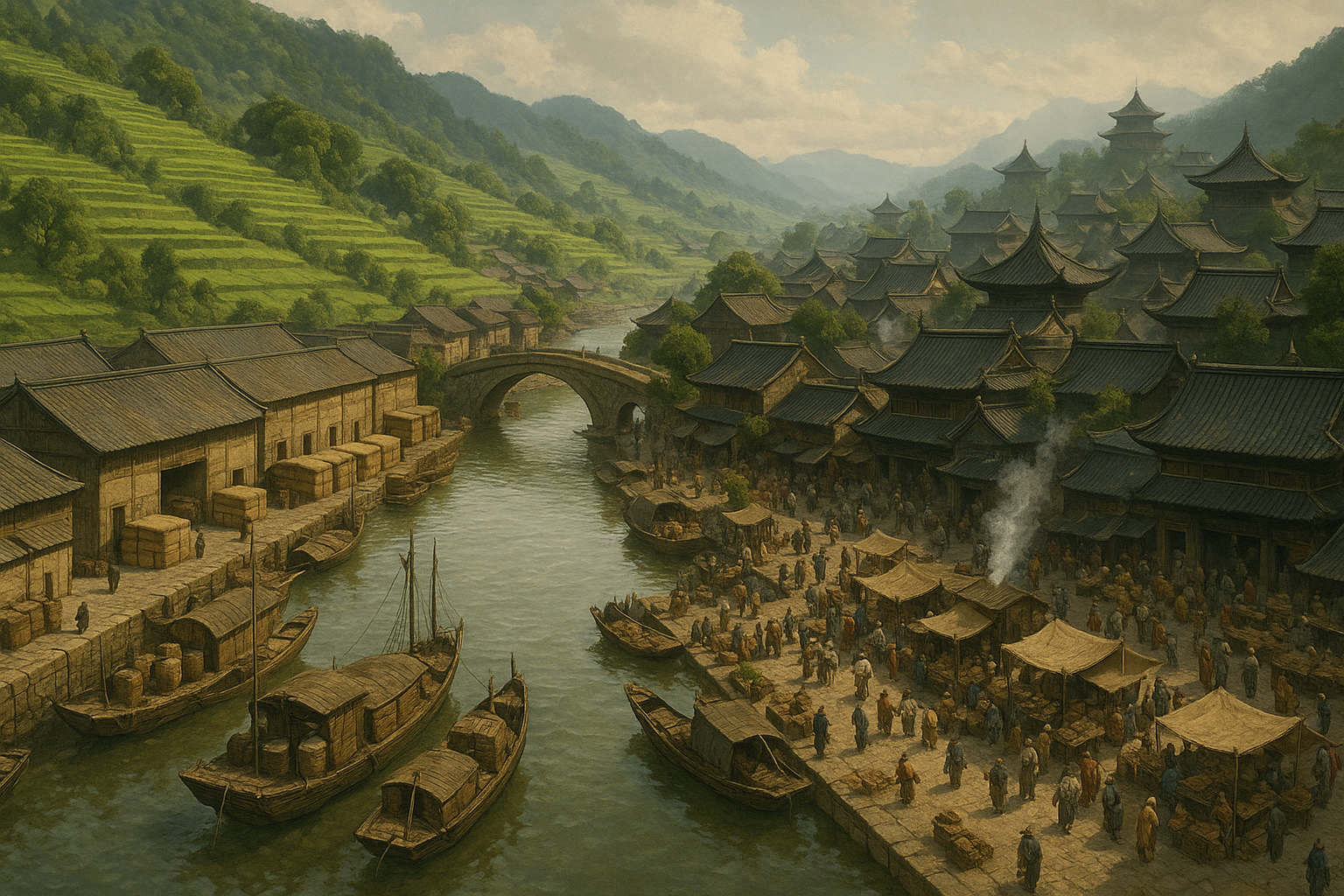
The Chandu River arrives at Anshun broad and slow; the foothills have taken the mountain speed out of it, and by this point in its course it moves with the patient weight of a large thing that has been moving for a long time. Rice paddies begin before the town does, terraced into the lower foothill slopes and extending across the river-fed plain in a pattern that the aerial view, unavailable to most visitors, would reveal as an extraordinarily intricate system of water management channels.
Anshun occupies the river's east bank where a slight elevation keeps the residential areas above the flood season's normal reach. Deliberately, the dock district is on the lower ground: the Chandu's seasonal rise is managed rather than avoided, and the dock structures are built to accommodate it. Here the Smaling barge community lives and works, in buildings that sit on piling foundations the way that river communities learn to build.
Rice wine production facilities are in the middle district; the large ceramic fermentation urns are the most visually distinctive element of the town's architecture after the rice paddies themselves. The smell of active fermentation is present for much of the year and is, to Anshun residents, the smell of prosperity.
Geography & Setting
Anshun occupies the Chandu River's course through the southeast foothills, where the river has deposited centuries of highland silt into the plain that gives the town's rice cultivation its specific fertility. Foothill terrain provides the elevation variation that the terrace cultivation requires; the paddies are stepped into the lower slopes above the flat plain, each step managing water flow to the step below. Several generations old, the engineering of this system is maintained with the precision that its function requires.
Upstream, the Chandu leads to the mountain interior and, eventually, to the Karubo Highlands region. Downstream, the river continues toward the Gulf of Siem and Gwajin's harbor complex. Anshun's position on this corridor, at the point where the foothill barge route meets the river plain barge route, gives it a commercial transit function alongside its agricultural production.
The People
Demographics
Anshun is predominantly human with a significant Smaling presence in the river barge operations. The Smaling community has been here for multiple generations, and their navigation expertise on the Chandu is specific to this river's character: the seasonal variation, the specific shoal patterns, the management of the foothill-to-plain transition in the channel depth. The expertise is the product of generations of observation and cannot be quickly replicated.
Economy
Rice is the foundation. The Chandu-plain rice variety, benefiting from the specific silt content and the careful water management, produces both yield and flavor that Gwajin's court buyers distinguish from other Shoing rice production. The rice wine derivation of this variety has received a specific vintage designation from the Gwajin Ministry of Commerce that allows it to be sold at premium prices in the court luxury market.
The barge trade is the second pillar. Anshun serves as the inland terminus for the downriver barge traffic; goods from the highland interior and the foothill producers arrive here for transshipment to the larger barges that carry them downstream to Gwajin. Together, the town's dock facilities and the Smaling barge community's operational expertise make this function commercially significant.
Primary Exports
- Anshun rice: The court-designated variety; premium market in Gwajin; volume production for general markets
- Anshun rice wine: Vintage-designated; the premium expression of the rice production; sold by the ceramic jug to the Gwajin court wine buyer and to the commercial luxury market
- Silk thread: Secondary to the rice; the foothill mulberry cultivation produces thread that the Gwajin silk district uses
- Preserved Chandu river fish: The river fish variety specific to this section; dried and preserved; consistent trade good
Key Industries
- The Rice Cultivation Cooperative: The water-management authority and the collective marketing of the production; the most significant organizational structure in the town
- The Barge Cooperative: Smaling-majority; manages the Chandu River transit traffic
- The Rice Wine Producers: Several family operations; the vintage designation applies collectively; quality standards maintained by the cooperative's assessment
Food & Drink
Anshun eats rice in the most developed expression of what rice-centered cooking can be, because the town has access to the best rice in the southeast and has been developing recipes for it across generations. The Chandu fish, which appears in several preserved forms throughout the year and fresh in season, is the primary protein complement. The cooking tradition is southeast Shoing's humid-climate version: lighter than the mountain cooking, more herb-forward, more focused on the precision flavoring that premium rice preparation rewards.
Rice wine is drunk locally and enthusiastically, at a quality level that the court wine buyer is always mildly surprised to encounter given the town's modest size.
Culture & Social Life
Anshun's culture is built around the agricultural calendar and the river's seasonal behavior. The honor tradition of eastern Shoing is present; the specific emphasis here is on the collective responsibility of the water-management system; a family whose paddies are not properly maintained affects the paddies downstream and is held accountable in the specific social way of a community that understands interdependence at a hydraulic level.
Smaling barge culture is distinct: focused on the river's practical demands, on the navigation knowledge that is their professional expertise, and on the specific community solidarity that comes from working in conditions where individual competence affects collective safety. Interaction between the two communities is functional and warm in the day-to-day sense.
Festivals & Traditions
The Water Opening
At the beginning of the rice cultivation season, when the water management channels are opened for the year's first flooding of the paddies, the Governor-Prefect performs a formal acknowledgment at the primary channel head. The town's agricultural families participate. The Smaling barge community provides the water-level readings that determine when the channel opening is safe.
The Harvest Float
At the peak of the harvest season, the rice wine producers float the first cask of the new vintage down the river on a decorated barge. The barge pauses at the town's central dock for a tasting ceremony before continuing downriver to Gwajin. The ceremony began as commercial theater for the Gwajin buyers and has become a town festival.
Music & Arts
The river music tradition is developed here; the Smaling barge community's vocal and instrumental tradition and the human agricultural community's field songs have blended over generations into a style that southeast Shoing traveling musicians specifically seek out. The rice paddy songs, originally functional rhythm-keeping for coordinated planting work, have developed artistic dimensions that the general cultural tradition now preserves alongside the working practice.
Religion
Primary Faith
Bridhel is honored as the river's patience and the season's turning made sacred. The temple is built to accept partial flooding at peak season as an admission that the Chandu's authority exceeds architecture.
Secondary / Minority Faiths
Ryujin is respected by the barge community and river pilots as the conscious will of water and safe passage. Talbar maintains a small Exchange shrine in the market district for rice contracts and barge freight terms. Kraut is honored at paddy margins in planting rites. Household ancestor altars are everywhere; where the practice is formalized, it is explicitly under Shen-Li as keeper of lineage, record, and remembered obligation.
Secret or Forbidden Worship
Death in Shoing is not hidden, but it is controlled. Shinigami's monks appear when drownings, bandit-killings, or epidemic deaths threaten to produce restless dead or delayed rites.
History
Founding
The Chandu River plain's agricultural potential was recognized long before the current town's governance structure. The water management channel system predates the Hagane family's prefecture by approximately one hundred years; it was built by an earlier governing family whose line ended without a clear successor. The Gwajin Realm's administrative authority appointed the Hagane ancestor as Governor-Prefect approximately one hundred fifty years ago.
Key Events
The Vintage Designation (approx. 60 years ago)
The Gwajin Ministry of Commerce's formal recognition of the Anshun rice wine's distinctive quality, granting it a specific vintage designation that allows premium pricing in the court luxury market. The designation required a multi-year advocacy campaign by the Hagane family and the wine producers' collective. It is the most significant commercial achievement in the town's recent history.
The Great Flood (approx. 25 years ago)
A Chandu River flood of unusual severity inundated the lower dock district and damaged significant portions of the water management channel system. The reconstruction, which took three seasons, was funded jointly by the Gwajin Realm's administrative budget and the town's own reserves. The new channel infrastructure is more robust than the old, and the dock district's rebuilding incorporated flood-management improvements that the Smaling barge community's engineers specified.
Current State
Anshun is agriculturally productive and commercially functional. The rice cultivation is consistent. The vintage designation is maintained. The barge cooperative is well-managed. Governor-Prefect Mori is in his fifties, experienced, and specifically resistant to the Gwajin Ministry of Commerce's efficiency review process, which he considers an attempt to impose production schedules that the Chandu River will not respect. He is correct about the river, and the Ministry is correct that his production reporting is less detailed than they prefer.
Leadership & Governance
House Hagane: Overview
The Hagane family holds the Governor-Prefectship under Gwajin Realm appointment. The governance is agricultural administration and river-commerce facilitation: the water management system, the cultivation cooperative's oversight, and the barge trade's regulatory function are all within the Prefect's authority. The military governor function is minimal in practice; the southeast foothills have been stable for a generation.
Governor-Prefect Mori Hagane
Human, Male; mid-fifties
Mori has been in the role for nineteen years and has spent them defending the town's agricultural practices against the Gwajin Ministry's scheduling expectations, which he considers incompatible with how rice cultivation actually works. He is effective at the agricultural administration, competent at the river-commerce function, and politically aware enough to have survived the Ministry's repeated efficiency reviews without conceding anything that would damage the cultivation system.
Notable Figures
Head Water-Master Suki Chanda: Irrigation System
Human, Female; sixties; the water management channels
Suki manages the water management channel system and is the person whose assessment of the seasonal water levels determines the cultivation calendar. Her family has managed the system for four generations. She is the practical authority on the Chandu River's behavior in this section and her readings are the inputs that the Harvest Float ceremony's timing is based on.
Barge-Captain Tori Westwick: Smaling, Cooperative Lead
Smaling, Male; forties; the barge cooperative
Tori manages the barge cooperative's operations and is the Smaling community's primary liaison with the town governance. He is effective and has a specific commercial problem: the Chandu's upriver barge route is losing volume to an overland alternative route that the Gwajin Ministry has been developing, and the volume loss is approaching the threshold where the cooperative's economics become marginal.
Key Locations
Seat of Power
- The Hagane Prefecture House: On the east bank elevation; the administrative and residential center; the water management system's primary monitoring equipment is maintained in the adjacent outbuilding
Houses of Worship
- The Bridhel River Temple: At the river's edge; partially flooded at peak season; the flood-mark record carved into the temple's stone pillar goes back two hundred years and is the town's most complete historical document
Inns & Taverns
- The Chandu House Inn: The primary accommodation for visitors; the rice wine vintage is available here at the producer price rather than the Gwajin luxury markup, which visitors who know to ask find significant
The Market
- The River Market: On the east bank below the Hagane house; the primary commercial space; rice, wine, preserved fish, and general goods
Secrets, Rumors & Hooks
- The Chandu River's upriver cargo volume reduction, which Tori Westwick is tracking, is not explained by the Gwajin Ministry's overland route development alone. A significant portion of the missing cargo is goods that have been rerouted through a less-monitored channel by producers who want to avoid the Prefecture's inspection requirements. What is being avoided is not clear; the goods' category is not obvious from the available records.
- Head Water-Master Suki's flood-mark record on the Bridhel temple pillar includes, in the oldest section, markings that are not water levels. They are in a notation system that Suki cannot read and that her family's oral tradition identifies as "the old keeper's marks." She has been trying to find someone who can interpret them for three years and has not yet found a scholar willing to visit Anshun specifically for this purpose.
- The Gwajin Ministry of Commerce's efficiency review delegation, which Mori Hagane has been resisting, includes one member who is not there for efficiency review purposes. Their actual assignment is to assess whether the rice wine vintage designation should be renegotiated under terms more favorable to the Gwajin buyers' association, which has been lobbying to reduce the premium. The assessment is not official; it is a personal commission from a Ministry official who benefits from the buyers' association's gratitude.