Baoji
Baoji: The Town on the Forest Shelf
"The plateau gives us the timber and the resin. The resin gives Galshi its ships. The ships give Galshi its wealth. We have not asked for the acknowledgment that this chain of provision implies. We have asked for the price we agreed."
Duke-Factor Lena Corda, at the annual Galshi trade commission review
At a Glance
| Continent | Shoing |
| Region / Province | West-northwest Shoing, Galshi Western Coast: cool forest plateau above the Malaea Sea |
| Settlement Type | Town |
| Population | ~4,200 |
| Dominant Races | Human (majority), Gnome (significant presence in processing operations) |
| Ruler / Leader | Duke-Factor Lena Corda |
| Ruling Body | House Corda, hereditary governance under Galshi Western Coast political authority; the "Duke-Factor" title is specific to Baoji, a hybrid of noble rank and commercial designation that the Galshi court recognizes but finds mildly eccentric |
| Primary Deity | Talbar (deity of commerce and precision exchange) |
| Economy | Shipbuilding timber, structural resin extraction, highland hardwood production, specialty wood goods |
| Known For | The tar-resin that waterproofs Galshi's fleet and is unavailable from any other source; the highland plateau hardwoods that produce Shoing's finest structural timber; the Duke-Factor title that the Galshi court has been meaning to formalize for sixty years |
First Impressions
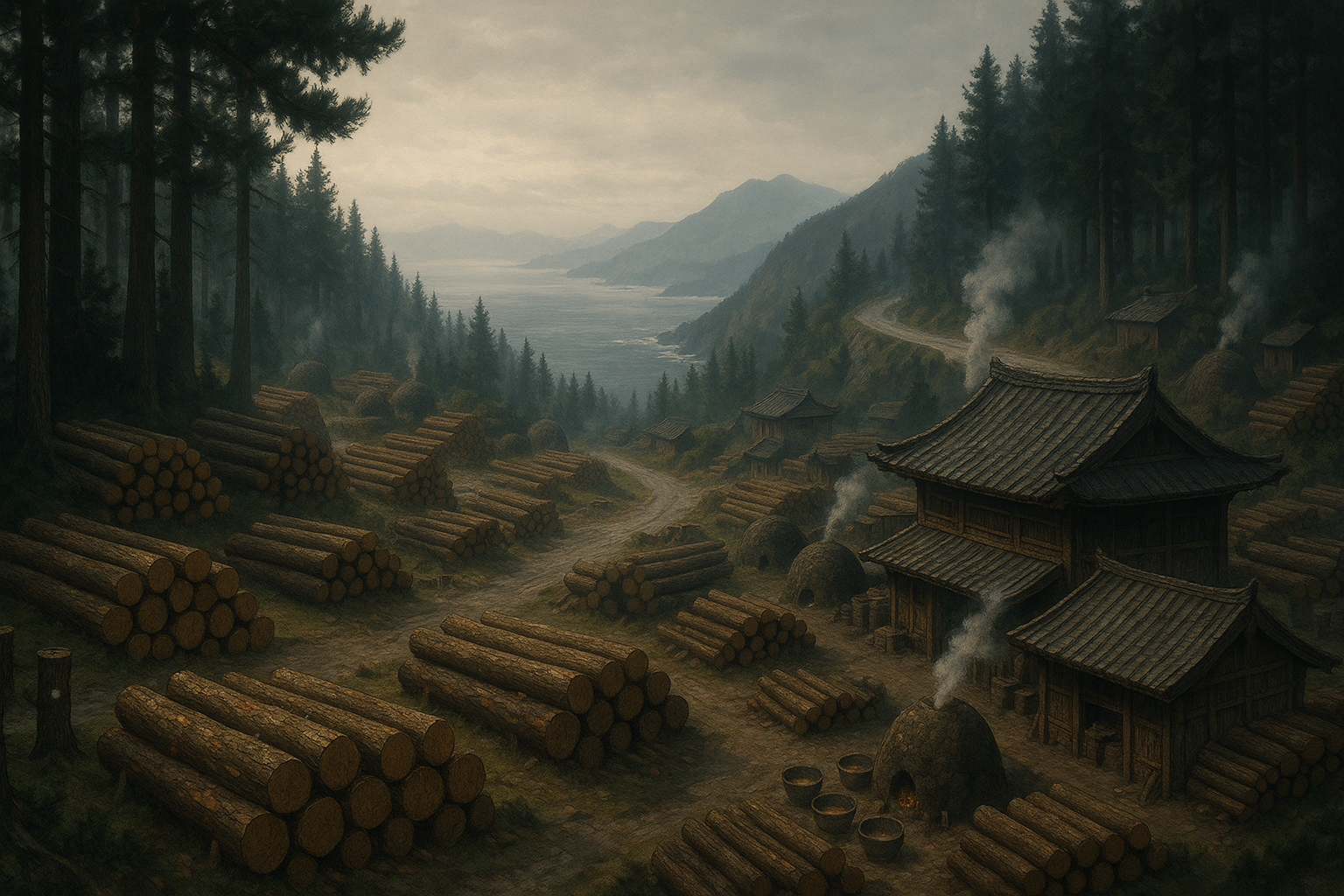
The plateau edge gives Baoji its most characteristic view: westward, over the forest that drops toward the Malaea Sea coast, with Galshi visible on clear days as a pale smudge on the horizon. Baoji sits in a cleared space on the plateau's interior face: not at the edge, where the slope is too steep and the wind too constant, but set back enough to use the forest as a windbreak. Architecture is timber-framed and generous with the material, which is the one resource Baoji has in surplus.
The smell of the town is resin. Extraction operations that produce the tar-resin Galshi's shipbuilders require run year-round, and the processing involves heat that volatilizes the compounds in ways that spread through the immediate area. Residents consider this normal. Visitors experience it as distinctive and occasionally overwhelming.
The timber yards are visible from the approach road: long rows of felled and trimmed logs at various stages of seasoning, arranged by species and grade. That scale is larger than the town's population would suggest, because Baoji's timber operation employs workers from several smaller plateau settlements who travel for the work season.
Geography & Setting
Baoji occupies a cleared plateau section in the cool forest belt of northwest Shoing, approximately thirty miles inland from Galshi's coast and at a moderate elevation that keeps the temperature below the maritime coast's range. Conifer and highland hardwood mixed, the forest extends in all directions from the cleared settlement area. The plateau itself is relatively flat, which makes the extraction operations logistically manageable.
The resin comes from a specific highland conifer variety found only on the plateau at this elevation range. The trees produce the resin as a natural defense compound; the extraction taps them in a managed rotation that the Corda family's foresters have been refining for generations. They are not cleared; they are maintained as the productive resource they are. Separate stands serve the timber operation, managed on a harvest-replant cycle.
Water on the plateau is supplied by highland springs and several small streams. There is no significant river access, which is the town's primary geographic limitation: the timber and resin must be transported overland to Galshi's port for waterborne distribution. The road is maintained to a high standard as a result.
The People
Demographics
Baoji is predominantly human with a significant gnome minority concentrated in the resin processing and precision woodworking operations. The gnomes arrived in the second generation of the Corda family's governance, when the resin processing required more chemical precision than the initial operation could achieve, and their combination of analytical approach and patience with iterative technique improved the output quality substantially. They have been integrated into the town's craft tradition since.
The population includes a seasonal component, highland workers who come for the timber season and return to their home settlements when the season ends. Permanent population is smaller than the working population during peak timber season.
Economy
The tar-resin is the foundation. Galshi's shipbuilders specify Baoji resin for hull sealing and waterproofing, and the compound's properties, specifically its resistance to the cold-water cracking that affects other caulking materials, make it the preferred product for Malaea Sea vessels that operate in the northern current zones. The Corda family's extraction operation holds the managed forest rights and is the sole commercial supplier.
Structural timber is the second industry. The highland hardwoods of the plateau, specifically the varieties that the cool altitude and specific soil produce, are the preferred material for construction beams, ship frames, and precision woodworking across the western Shoing region. Quality is consistent and the supply, under the Corda rotation system, has been sustainable for a century.
Primary Exports
- Tar-resin: The defining product; exported exclusively to Galshi's shipbuilding operations; annual volume negotiated by contract
- Highland structural timber: Hardwood beams, ship frames, precision lumber; exported by the load to Galshi and onward
- Specialty wood goods: Finished items produced by the precision woodworking operations; a smaller commercial line but high-value
- Highland herbs: Medicinal varieties specific to the plateau elevation; a modest but consistent secondary trade
Primary Imports
- Food staples: The cleared plateau area has agricultural capacity but not full self-sufficiency; grain and preserved goods from the coast
- Metal goods: Tools, fittings, hardware; the town has a small smithing operation but depends on coastal supply for most metalwork
- Luxury goods from Galshi: The Corda household's commercial position includes regular access to Galshi's imported goods
Key Industries
- The Corda Forest Operations: The managed extraction of resin and timber under the family's forest rights; the largest single employer in the town
- The Resin Processing Works: The chemical reduction and packaging operation that turns raw resin into the sealed casks that Galshi receives; gnome-supervised
- The Timber Yards: The seasoning, grading, and transport preparation operation; the largest physical footprint in the town
- The Precision Woodworking Cooperative: Independent craftspeople producing finished goods from the specialty wood grades that don't go to structural timber
Food & Drink
Baoji eats simply. The highland plateau cooking tradition is practical rather than sophisticated; the cool climate and the physical demands of the timber work produce a preference for dense, caloric preparations. Preserved meats from highland game, root vegetables from the plateau's agricultural plots, highland grain varieties. The cooking uses the resin-tree's byproducts in unexpected ways: a specific smoked preparation of fish and meat uses the resin-wood chips as flavoring smoke, producing a characteristic taste that other Shoing regions sometimes describe as "the plateau smoke" and that Baoji residents consider ordinary.
The drink of the town is a highland grain spirit and a cold stream water that the gnome community has been insisting is the best drinking water in western Shoing for generations. Galshi merchants who visit regularly have started agreeing.
Culture & Social Life
Baoji's culture is the western Shoing character modified by the specific economics of resource extraction and supply. The honor framework is present but the Corda family's "Duke-Factor" title reflects a genuine cultural emphasis: commercial precision is as much an expression of honor here as military courage or genealogical standing. A factor who delivers the agreed quantity at the agreed quality on the agreed schedule is considered honorable in the fullest sense.
The gnome community's influence on the culture is visible in the town's orientation toward quantification and precision: the forest rotation schedules, the resin processing parameters, the timber grading standards are all documented with a specificity that western Shoing's less analytically inclined towns find slightly exhausting.
The Galshi Western Coast political relationship is substantive rather than nominal. The Corda family participates in the western coast political structure, attends the relevant noble assemblies in Galshi, and is genuinely integrated into the political hierarchy. Commercially, the Baoji-Galshi relationship is too important to both parties for the political relationship to be merely formal.
Festivals & Traditions
The Tap Opening
When the resin extraction season begins, the spring warming that makes the plateau's highland conifers productive, the Corda family formally opens the tapping. The foresters mark the first trees, the processing works confirm readiness, and the Duke-Factor performs a brief Talbar acknowledgment. This is commercial ceremony, not primarily spiritual, but it is taken seriously by the workforce.
The Timber Weighing
At the end of the timber season, the full year's production is formally inventoried and graded. The results are read publicly and compared against the prior year. In good years, this is celebratory; in poor years, it is sobering. The practice has been continuous for as long as the Corda family has governed the operation.
Music & Arts
The gnome community's precision woodworking includes instrument-making, specifically small string instruments whose resonant quality benefits from the highland hardwood varieties. These instruments have found their way into the broader western Shoing musical tradition, where they are recognized as having an unusual tonal quality attributed vaguely to "the plateau wood."
The human community's artistic tradition is primarily practical, the carving and decoration of functional objects using the off-grade wood that doesn't make the timber standards. Quality of these objects is high because the material, even at off-grade, is excellent.
Religion
Primary Faith
Talbar is Baoji's defining god: precise exchange, long contracts, and the idea that honest measure is a form of honor. The market temple doubles as the arbitration room where resin volumes and timber grades become binding truth.
Secondary / Minority Faiths
Caminus is strong in the precision woodworking cooperative and the gnome-run processing works; tools are blessed, and flawed work is treated as shame. Cameth is a practical household faith in a cold plateau town where shelter is not a metaphor. Ancestor shrines are maintained with unusual documentation rigor, and Shen-Li is invoked by name in the gnome families' records work as often as in human household rites. Martus is common in the timber season's wages, wagers, and risky hauling runs.
Secret or Forbidden Worship
A few private circles experiment with resin-drunk trance and pain-rites, but Baoji does not sustain a stable underground cult economy; the forest rotation schedules make secrecy hard. When accidents turn fatal, Shinigami's rites are brought in to ensure the dead are properly ended and the plateau does not become haunted by neglect.
History
Founding
Baoji predates the Corda family's governance by an unknown period; the plateau has been used for timber harvesting since before the current settlement's formal organization. The Corda family arrived approximately one hundred eighty years ago, formalized the forest rights arrangement with Galshi, and established the governance structure. The "Duke-Factor" title was created at the Corda founder's insistence: she argued that the role required both noble standing (for the governance authority) and commercial designation (for the trade authority that was the role's primary function). Galshi found this argument unconventional and has been about to standardize the title for sixty years.
Key Events
The Resin Contract of Long Standing (approx. 150 years ago)
The formalization of the multi-decade exclusive supply arrangement between the Corda operation and the Galshi shipbuilders. The contract's original terms (which included a quality guarantee, a volume floor, and a specific price escalation formula) are the legal foundation of both parties' commercial relationship. The current version has been renegotiated six times; the core structure has not changed.
The Gnome Integration (approx. 100 years ago)
The arrival and integration of the first significant gnome craftspeople into the resin processing operation. The processing quality improvement in the decade following their integration is documented in the Galshi shipbuilders' quality records. The Corda family at the time treated the gnome integration as a commercial decision; the result was a cultural shift that has been permanent.
Current State
Baoji is commercially productive and stable. The forest rotation is well-managed. The resin contract is current. The Corda household is in good standing with Galshi's political structure. Duke-Factor Lena is in her forties and has been in the role for twelve years; her two children are being prepared for the eventual succession. The active concern is the supply road, which is in adequate condition but requires significant maintenance investment that the town is managing without external assistance. Lena has been considering whether to make the road a formal request to Galshi's infrastructure commission.
Leadership & Governance
House Corda: Overview
The Corda family holds the Duke-Factor position by Galshi recognition and hereditary claim. Their governance is primarily commercial and forest-management: the forest rights, the resin contract administration, and the timber operation are all within the family's formal authority. The political functions (representation at Galshi assemblies, tax administration, minor judicial authority) are secondary in daily practice but taken seriously.
Duke-Factor Lena Corda
Human, Female; mid-forties
Lena has been Duke-Factor for twelve years, following her father's retirement. She is commercially competent and politically effective in the Galshi Western Coast context. She manages the resin contract negotiations personally and has twice improved the pricing terms against experienced Galshi commercial negotiators. She is also the person who knows that the plateau's accessible conifer stands (not all of them, but the highest-elevation zone that produces the most resin-rich trees) have been showing reduced yields for three seasons. She is investigating whether this is a management issue or an environmental one.
Notable Figures
Master Processor Finn Trell: Gnome, Resin Works Lead
Gnome, Male; fifties; the processing works
Finn has been supervising the resin processing operation for twenty years and is the person whose quality approval the Galshi shipbuilders require before accepting a shipment. His family has been in Baoji for three generations. He is aware of the yield reduction in the high-elevation stands and has been running analysis on the resin chemistry from different elevation zones to determine whether the reduction is also affecting resin quality.
Master Forester Hako Vend: Plateau Operations
Human, Male; sixties; the forest
Hako manages the forest rotation and is the person responsible for the long-term health of the productive stands. He has been in the role for thirty years and has seen yield variations before; he considers the current situation within the range of normal cycle variation. Finn Trell disagrees with this assessment. The two have been having the same professional disagreement for three years.
Road-Keeper Saya Corda: Infrastructure
Human, Female; mid-twenties, Duke-Factor's daughter
Saya manages the supply road maintenance operation and has built a detailed case for the road's infrastructure investment needs that she has been presenting to her mother and to Galshi's relevant commission. The presentation is thorough, the data is accurate, and neither audience has yet committed to the investment.
Key Locations
Seat of Power
- The Corda Compound: Set back from the plateau edge in the forest clearing; the administrative and residential center; the compound's timber construction is the finest example of the precision woodworking tradition in the town
Houses of Worship
- The Talbar Weighing Temple: Named for the trade scales that are the temple's primary symbol; in the market district; the annual audit of the town's commercial records is performed here as a form of religious practice
Inns & Taverns
- The Forest Shelf Inn: The primary accommodation for visitors and visiting workers; positioned at the plateau road's arrival point; the common room has a view over the western slope toward the coast
- The Resin House: A tavern in the processing district; primarily for workers; the highland spirit is available here at working-class prices; Finn Trell is a regular
Shops & Services
- The Precision Woodworking Collective: Where the finished specialty wood goods are produced and sold; the gnome craftspeople's output is available here alongside the human practitioners' work
- The Corda Forest Office: Where timber contracts and resin supply arrangements are negotiated; not retail
The Market
- The Plateau Market: Open three days per week; primarily local goods, highland herbs, food staples, and off-grade wood goods; the visiting seasonal workers are the primary consumer base during the timber season
Other Points of Interest
- The High-Elevation Resin Stands: The upper plateau zone where the most resin-productive trees grow; accessible by a maintained path; visitors need forest authority permission; the yield-reduction issue is visible in the thinning output from this zone
- The Timber Yards: The largest open space in the town; the scale of the operation relative to the settlement is striking
Secrets, Rumors & Hooks
- The high-elevation resin stand yield reduction is not a management cycle variation. The soil chemistry in the upper plateau has been changing; something in the underlying geology has shifted in a way that Finn Trell's chemical analysis is beginning to confirm. If the trend continues, the Baoji resin's distinctive properties will diminish within a generation. The Galshi contract's quality guarantee clause would then become unenforceable, with significant consequences.
- Hako Vend knows more than he is saying about the yield reduction. He has found evidence in the oldest forest records that a similar reduction occurred approximately two hundred years ago, reversed within a decade without intervention, and is considered by him to be a known cycle that should not alarm anyone. He has not shared the historical record with Finn Trell because Finn would want to intervene, and Hako believes intervention would make it worse.
- The gnome community's senior members have been conducting a parallel analysis of the plateau forest that is not connected to the Corda operation's official monitoring. Their findings, which Finn Trell is aware of but has not shared with the Duke-Factor, include evidence of a subterranean feature beneath the high-elevation stand zone that may be related to the yield change.
- Saya Corda's road infrastructure report, which she has shared with the Galshi commission in draft form, contains a section that does not appear in the version she gave her mother. The additional section documents a series of traveler disappearances on the plateau road's interior section over the past five years that the town has attributed to weather incidents but that Saya believes requires a different explanation.