Baoshan
Baoshan: The Town in the Jade Hills
"The mountain gives what it gives. Some years it is generous. Some years it is not. We have learned that patience in this matter is not optional; it is what the work requires."
Baron Kenji Ishida, addressing a delegation of Gwajin buyers expecting a guaranteed supply volume
At a Glance
| Continent | Shoing |
| Region / Province | Northeast Shoing, Higatomo Northern Provinces: forested interior hills |
| Settlement Type | Town |
| Population | ~3,400 |
| Dominant Races | Human (majority), Dwarf (significant minority in the mining operations) |
| Ruler / Leader | Baron Kenji Ishida |
| Ruling Body | House Ishida, hereditary governance in the minor noble tradition of eastern Shoing; subject to Higatomo's regional authority |
| Primary Deity | Caminus (craft and finishing work); Talbar (trade and valuation) |
| Economy | Jade extraction and finishing, semiprecious stone trade, specialty mineral supply to eastern Shoing craftspeople |
| Known For | The only significant source of Shoing jade in the northeast; the mineral pigments that Higatomo's ink-makers specify; the Ishida family's long-running feudal relationship with the Murano Barons of Higatomo |
First Impressions
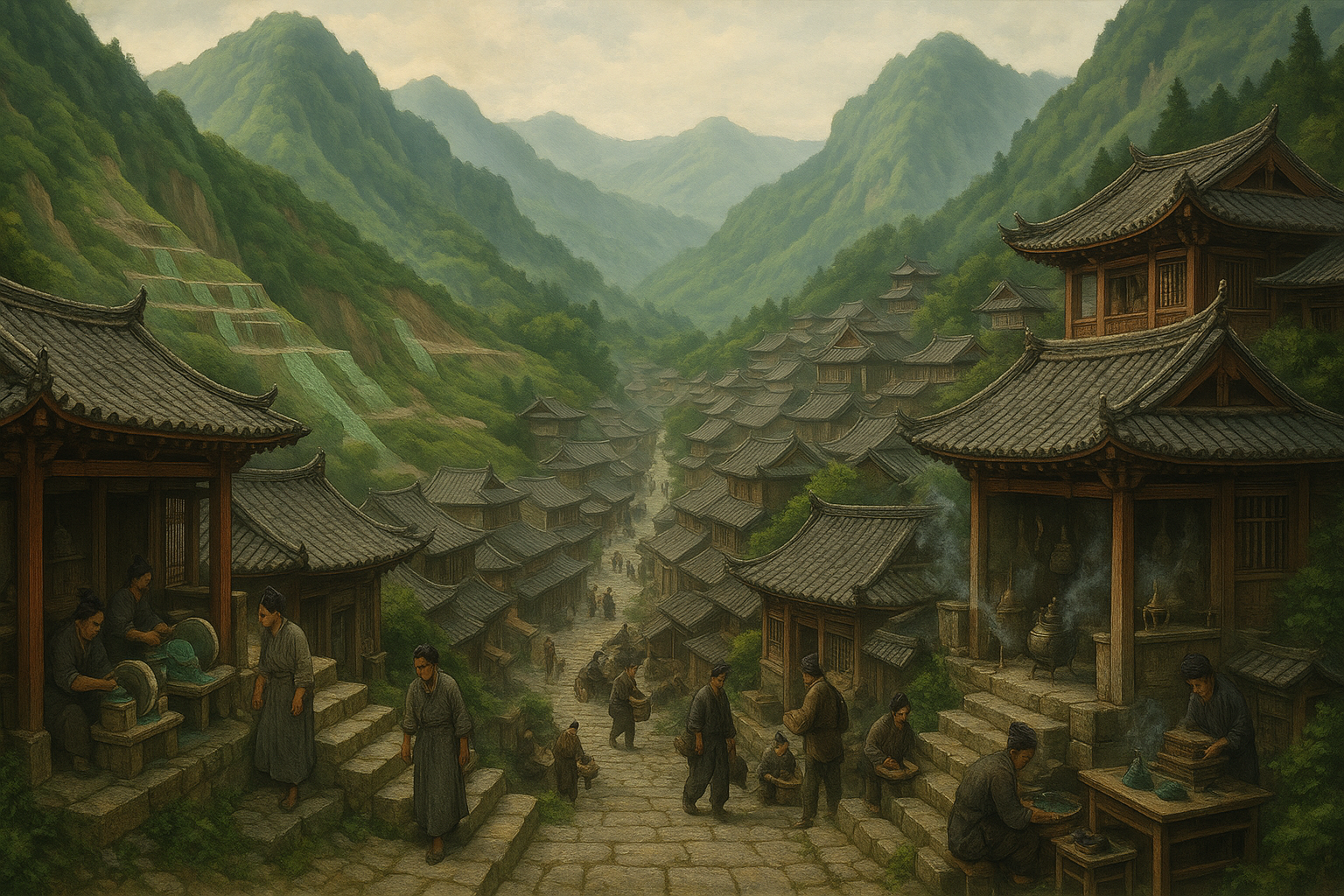
Baoshan occupies a valley between two forested hills where the underlying rock formation produces (inconsistently, by the mountain's schedule rather than any human preference) deposits of jade, certain semiprecious stones, and mineral pigments that the craftspeople of eastern Shoing have depended on for centuries. The town is built in the valley floor and on the lower slopes, with the mining operations visible above the treeline in the form of cleared cuts and the tailings that mark extraction points.
Architecture is eastern Shoing standard: timber-framed buildings with stone bases, the older structures showing generations of maintenance rather than replacement. The Ishida compound sits at the valley's upper end, where the hill elevation gives it sight lines over both the mining slopes and the road to Higatomo. This positioning is practical; the Baron's family has been managing the flow of materials down that road for eleven generations, and the sight lines matter.
Craftspeople work near the lower market; the finishers who turn raw jade and stone into trade-ready form operate in a specific district that has accumulated the infrastructure and expertise over generations. Raw extraction workers live higher on the slope, nearer the operations. That division is practical and has become cultural: the finishers consider themselves urban, the miners consider the finishers softer than they appear to be, and both are correct in ways neither fully acknowledges.
Geography & Setting
Baoshan sits in a northeast Shoing interior hill valley, approximately forty miles inland from the Koko Nor coast and southeast of Higatomo. Hills are forested on their lower and middle slopes, a cool-climate conifer forest that has been managed for selective timber removal for generations without being exhausted. Upper slopes are the jade country: the geological formation that produces the deposits is exposed above the forest line, and the extraction operations work the face.
The road to Higatomo is the town's commercial lifeline; the majority of Baoshan's exports travel this route. A secondary road connects south to the broader eastern Shoing interior. Geography makes Baoshan firmly in the Higatomo sphere of influence rather than oriented toward the more distant Gwajin Realm, which purchases Baoshan materials but through Higatomo intermediaries.
The valley has two seasonal streams that provide water supply and, in their lower course, power for the stone-working mills. Forest provides timber for the mining operations' supports and bracing, managed carefully to avoid depleting the supply.
The People
Demographics
Baoshan is predominantly human with a substantial dwarf minority concentrated in the mining operations. The dwarves arrived in the town's early period; their geological knowledge and mining technique were incorporated into the extraction practice, and their descendants have maintained that role for generations. The relationship between the human surface-operations and the dwarf underground-extraction community is functionally integrated and socially distinct: they work together, they celebrate some festivals together, and they maintain separate cultural practices that neither side has pressure to merge.
Economy
Jade is the primary product. Shoing jade, specifically the variety produced from the northeast hill formation, has a distinctive color range: pale greens and greys with occasional deep emerald concentrations. The aesthetic preference for this material in eastern Shoing's court tradition is long-established, and the Ishida family has benefited from being the primary source for eleven generations. The jade is extracted in raw blocks and finished to various degrees by the town's craftspeople before export.
The mineral pigments, specific ochres and earth colors produced as extraction byproducts, are exported primarily to Higatomo, where the ink-makers use them as supplementary colorants for specific ink grades. This relationship predates the current Ishida-Murano formal arrangement and forms one of its practical foundations.
Timber is a third line: the managed forest produces selectively harvested timber that the coast settlements need and cannot locally source.
Primary Exports
- Baoshan jade: The primary product; raw blocks and finished pieces; exported to noble houses and court buyers across eastern Shoing
- Mineral pigments: Ochres and earth colors extracted with the jade; primary buyer is Higatomo's ink trade; secondary buyers are lacquerwork craftspeople
- Semiprecious stones: Secondary extraction products; consistent volume but lower individual value than jade
- Managed timber: Forest products for the coast settlements; consistent demand
Primary Imports
- Food staples: The valley farms produce supplementally but not sufficiently; grain from the agricultural interior is the primary food import
- Trade goods from Higatomo: Lacquerwork, finished ink, court-quality goods that Baoshan's merchants purchase for resale
- Metal goods and tools: Mining equipment, finished ironwork; the town has a modest smithing operation but imports most specialized tooling
Key Industries
- The Jade Extraction Operations: Multiple claim-holding families work the mountain face under a licensing system administered by the Baron; the Ishida family holds one of the largest claims directly
- The Finishing District: The craftspeople who take raw jade and stone to finished trade-ready form; organized into three family workshops and several independent practitioners
- The Pigment Processing Works: Managed by a single family, the Nakata, who hold the formula and processing arrangement with the Higatomo ink trade
- The Timber Cooperative: Managed harvest of the valley forest; provides employment for approximately a quarter of the non-mining population
Food & Drink
Baoshan eats in the eastern Shoing tradition. The valley farms produce root vegetables and some grain; the forest provides mushroom varieties specific to the cool conifer environment that appear in the cooking in dried form year-round. Meat comes from hunting (the forest supports deer and smaller game) and from the modest livestock kept in the valley floor farms. The cold stream fish are taken in season and preserved.
The signature food item that other eastern Shoing settlements associate with Baoshan is a mushroom preparation (slow-cooked with the specific forest fungi and the herb varieties that grow at the forest's edge) that the town's cooking tradition has refined over generations. Visitors who know to request it consider it exceptional.
Culture & Social Life
Baoshan's culture reflects the extractive relationship with the mountain: the sense that value is in the stone, that the stone gives on its own schedule, and that patience and technique are the only appropriate responses to this fact. The eastern Shoing honor culture is present in its full form. The specific expression in Baoshan emphasizes the honor of craft: the finishers who take raw jade and produce finished pieces of lasting value understand their work as honorable in itself, not merely as commerce.
The dwarf community's relationship with the human population is the town's most interesting social dynamic. After generations of integrated work in the extraction operations, the two communities share specific aspects of professional culture (the mining protocols, the geological vocabulary, the specific risk-management practices in the extraction zones) while maintaining distinct social traditions outside of work. Marriages across the community line are rare but not unknown and are treated with the social complexity they represent.
The Ishida-Murano relationship is a structural fact of the town's political position: Baoshan is in Higatomo's sphere and the Ishida family's authority derives in part from the Murano Barons' recognition. Its current Baron maintains this relationship through regular correspondence with Higatomo and a small annual tribute that formalized the arrangement two generations ago.
Festivals & Traditions
The Jade Opening
At the beginning of the extraction season (spring, when the mountain face is accessible again after the worst of winter), the Baron formally opens the mining operations with a ceremony at the primary extraction point. The first stone of the new season is presented to the Baron, assessed, and returned to the extraction crew with a formal statement of the season's intentions. The ceremony has been performed without interruption for eleven generations.
The Caminus Market
Once each year, timed to the midpoint of the extraction season when the year's jade production can be assessed, Baoshan holds an open market that draws buyers from across eastern Shoing. The Caminus Market is the primary direct-sale event for jade and semiprecious stone, supplemented by goods from the crafts district and general market trade. It is the town's most significant external-facing event.
Music & Arts
The jade-finishing craft is the art. The Baoshan tradition for worked jade, specific cutting and polishing techniques developed over generations, produces pieces recognized by collectors as distinct from other Shoing jade work. The dwarf community's contribution to this tradition is significant: their lapidary methods, integrated into the finishing practice over centuries, are now understood as Baoshan style rather than as imported technique.
The calligraphic tradition is secondary but present; the connection to Higatomo's ink trade means Baoshan has access to court-standard materials and has produced several notable calligraphers over the generations.
Religion
Primary Faith
Caminus rules the finishing district: craft as devotion, mastery as morality. Talbar is the other pillar, because valuation is everything in a jade economy and a dishonest scale is sacrilege.
Secondary / Minority Faiths
Zopha is honored by pigment processors and scribes who treat technique as knowledge worth guarding. Household ancestor shrines are widespread, and Shen-Li is explicitly invoked in the Ishida compound's genealogical records and the miners' memorial ledgers. Shinigami is present through funerary orders that oversee mine deaths and enforce timely rites.
Secret or Forbidden Worship
Rare and individual: a few carvers claim the mountain speaks through dreams and will not name the spirit publicly.
History
Founding
The Baoshan jade deposits have been known and worked for as long as the northeast hill region has been inhabited. The current town's formal establishment (its governance structure, its Higatomo relationship, and the House Ishida foundation) is approximately three hundred years old. Before that, extraction was less organized and the output less reliable. The Ishida ancestor who formalized the governance also formalized the relationship with the Murano family of Higatomo, establishing the political framework that remains today.
Key Events
The Ishida-Murano Compact (approx. 250 years ago)
The formal establishment of Baoshan as a Higatomo Northern Provinces subject settlement, with the Ishida family holding the Baronship under Murano recognition. The compact included specific provisions about pigment supply to Higatomo's ink trade that have never required renegotiation because both sides have found them commercially sound.
The Deep Strike (approx. 80 years ago)
The dwarf extraction team working the primary jade claim discovered a secondary deposit significantly deeper than any previous find, and of a jade quality that was, in the assessment of the Baron at the time, better than anything the surface operations had produced. The extraction required new technique and significant investment. The resulting output, which reached the Gwajin court's buyers within five years, established Baoshan's reputation for the highest-quality northeast jade and substantially increased the town's commercial position.
The Claim Dispute (approx. 30 years ago)
A boundary dispute between two extraction claim-holding families produced the most significant legal proceeding in the town's recent history. The Baron's resolution, which drew on eastern Shoing noble precedent in ways that required significant scholarship, satisfied neither party completely but prevented the dispute from escalating. The resolution documentation is now referenced in extraction claim disputes across the Higatomo Northern Provinces.
Current State
Baoshan is commercially productive and politically stable. The extraction operations have been consistent for a decade. The Caminus Market's buyer relationships are strong. Baron Kenji is a competent administrator with a specific interest in the geological side of the extraction operation that gives him more direct knowledge of the mountain than his predecessors typically maintained. The current concern, discussed only within the Ishida household, is that the primary jade claim's deepest accessible seam appears to be thinning.
Leadership & Governance
House Ishida: Overview
The Ishida family holds the Baronship through Murano recognition and hereditary claim in the eastern Shoing minor noble tradition. Their authority is primarily administrative and commercial: the extraction licensing system, the trade relationships, and the Higatomo compact are all within the Baron's formal purview. The governance is oriented toward maintaining the extraction operations' productivity and the town's trade position.
Baron Kenji Ishida
Human, Male; fifties
Kenji has been Baron for eighteen years and has spent significant personal time in the extraction operations, more than any previous Baron in living memory. He understands the geology of the jade formation at a level that is unusual for a noble, which has made him a more effective licensing administrator and a more credible negotiator with the dwarf extraction teams. He is also the person who first recognized that the primary claim's deepest seam is thinning, and he is deciding what to do with that information.
His daughter Riko manages the market district's commercial relationships and has built the Caminus Market's buyer network to its current scale. She is expected to succeed him and is prepared for it.
Riko Ishida: Market Director
Human, Female; late twenties
Riko has developed the Caminus Market's commercial infrastructure and manages the ongoing buyer relationships that make it function. Her network extends to three major eastern Shoing cities and has recently added contact with a Gwajin court buyer directly, circumventing the Higatomo intermediary on one significant transaction, which the Murano family noticed and has not yet commented on.
Notable Figures
Master Dol Stonefist: Dwarf Extraction Lead
Dwarf, Male; forties; the extraction operations
Dol leads the dwarf extraction team in the primary claim and is the person whose geological assessment the Baron trusts most. He also knows about the thinning seam; he found it first and told the Baron. He has an idea about where the formation continues that he has not shared, because confirming it would require extending the extraction operation in a direction that would take the work beyond the current claim boundary.
Craftmistress Hana Mori: Jade Finishing
Human, Female; fifties; the finishing district
Hana leads the most prestigious of the finishing workshops and is the person whose quality assessment the court buyers treat as authoritative. Her workshop produces the pieces that appear in noble collections across eastern Shoing. She trained under the previous generation's master and has been training the next for fifteen years.
Factor Yuki Nakata: Pigment Processing
Human, Female; thirties; the Nakata works
Yuki manages the pigment processing operation and the Higatomo supply relationship. She is third generation in the role and has recently begun exploring markets for the pigments outside the Higatomo arrangement, specifically the lacquerwork craftspeople in other eastern Shoing towns who have the same need for the mineral pigments but currently source from Higatomo's secondary distribution.
Key Locations
Seat of Power
- The Ishida Compound: At the valley's upper end, with sight lines over both the mining slopes and the Higatomo road; the family's residence and the licensing administration office are in the same building
Houses of Worship
- The Caminus Shrine: In the market district; associated with the finishing craftspeople; the entrance gate bears a hammered mark worked directly into its metal fittings
- Talbar's Witness Alcove: A small, formal niche used to witness major sales, settle valuation disputes, and record agreements between buyers and workshops
- The Dwarf Shrine: In the dwarf residential section; not accessible to the general public; the human community's respect is expressed as non-interference
Inns & Taverns
- The Jade Road Inn: The principal inn; positioned at the market district's edge; the interior decoration includes examples of Baoshan jade finishing work that serve as advertisement for the town's craft
- The Deep Strike: Named for the historical find; a tavern in the upper town near the extraction operations; frequented by miners and extraction workers; the dwarf community drinks here alongside the human workers without the social separation that characterizes other contexts
Shops & Services
- The Finishing District: The three family workshops and independent practitioners; buyers arrange viewings through the Caminus Market structure or through the craftspeople directly
- The Nakata Pigment Works: Not retail; trade buyers through established relationships only
- The Extraction License Office: At the Ishida Compound; where claim licensing is administered and recorded
The Market
- The Caminus Market: Annual event; the town's primary external commercial occasion; for the three days of the market, Baoshan's population increases by approximately a third as buyers and visitors arrive
- The Daily Market: The valley floor's standard market; local goods, food, general commerce
Other Points of Interest
- The Primary Extraction Face: The main jade claim's working surface above the forest line; accessible by a maintained path; the scale of the operation is impressive from the overlook below the working face
- The Stone-Working Mills: On the lower stream course; water-powered; where the raw extracted material is cut for the finishing district's work
Secrets, Rumors & Hooks
- The primary jade claim's deepest accessible seam is thinning. Baron Kenji and Master Dol both know this. Dol has a theory about where the formation continues: beyond the current claim boundary, which would require renegotiating the licensing structure and potentially opening a dispute with the adjacent claim-holder, who is a Higatomo-connected family with standing in the Murano court.
- Riko Ishida's direct sale to the Gwajin court buyer, circumventing the Higatomo intermediary, was not a mistake or an oversight. It was deliberate. She is building a direct Gwajin relationship because she believes the Higatomo dependency is a strategic vulnerability for the town's long-term commercial position. She has not told her father, who would see it as an honor breach of the Murano compact.
- The dwarf community's deep-extraction records go back further than anyone in the human community knows. Their geological notes on the formation include observations from the initial settlement period that predate the Ishida family's arrival in the valley. Those notes describe a deeper layer of the formation that has never been accessed and whose jade, by their assessment, would be of a quality that the surface deposits cannot match.
- The fox population in the valley forest has increased significantly in the past two years. Local superstition treats this as auspicious. Master Dol's dwarf tradition treats it as a specific warning about geological instability in the formation above. He has not mentioned this interpretation to the Baron because he is not certain how it would be received.