Belon
Belon: The Town on the Salt Flats
"The Rhodian does not offer shelter here. We have learned to not require it."
Prefect-Warden Sona Drell, on the town's architectural philosophy
At a Glance
| Continent | Shoing |
| Region / Province | East-northeast Shoing, Gwajin Realm: Rhodian Ocean coast, dry coastal plain |
| Settlement Type | Town |
| Population | ~4,500 |
| Dominant Races | Human (majority) |
| Ruler / Leader | Prefect-Warden Sona Drell |
| Ruling Body | House Drell, hereditary prefecture under Gwajin Realm authority |
| Primary Deity | Solis (sun deity, clarity, the honest light that reveals what the sea conceals) |
| Economy | Salt production, open-water fishing (Rhodian Ocean), dried fish trade, coastal surveillance services |
| Known For | The most productive salt works in eastern Shoing; the specific white salt that the Gwajin court kitchen specifies; the exposed coastline that produces excellent sailors because the Rhodian does not permit poor ones |
First Impressions
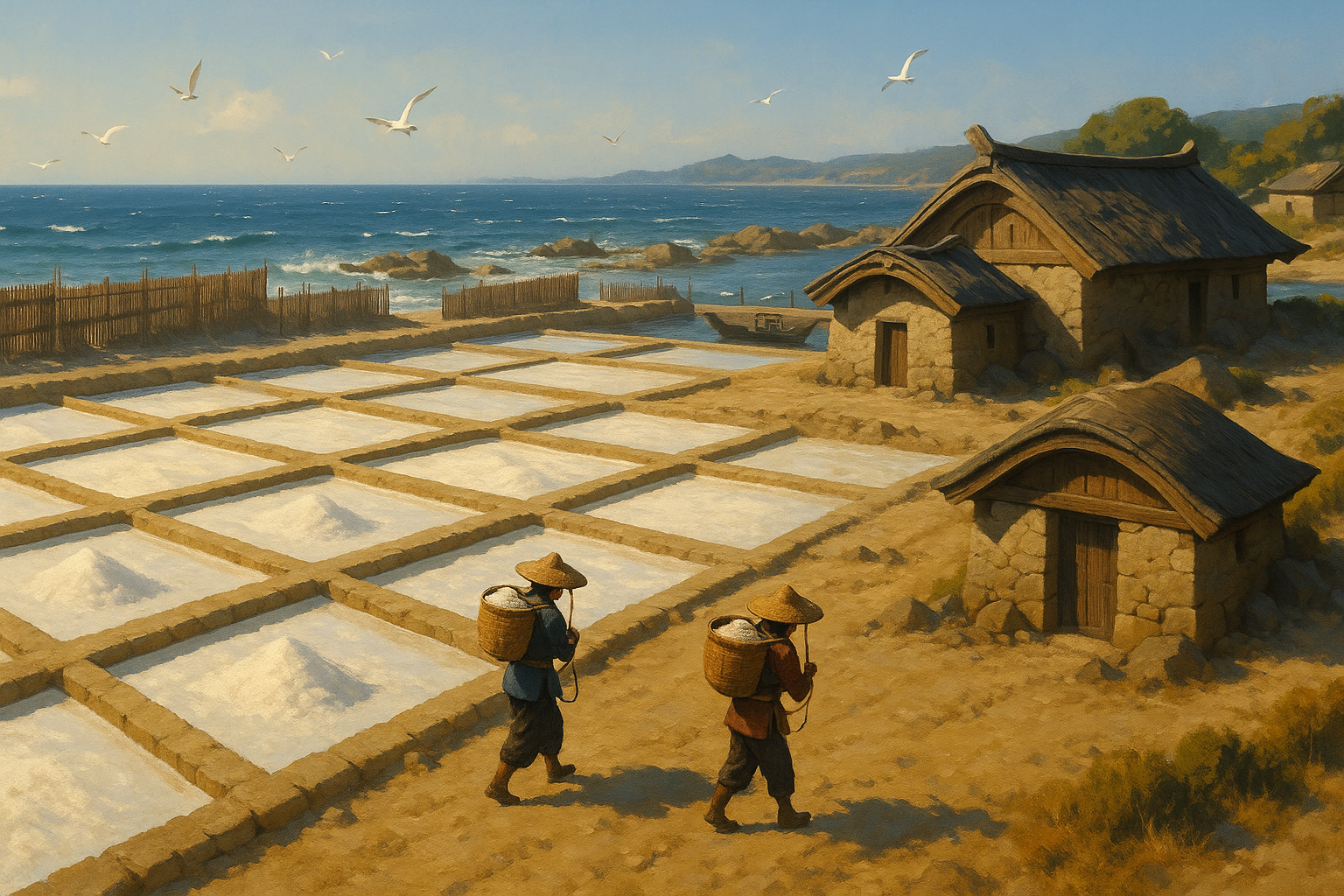
Belon's coastline is exposed. The dry coastal plain runs to the Rhodian Ocean without the forest cover or delta protection that other eastern Shoing coastal settlements have, and the Rhodian here is the full open ocean, not a gulf or bay, with the weather that implies. Belon is built with this exposure as the design constraint: low, stone throughout, the buildings oriented to minimize wind-face while maintaining the sight lines to the ocean that the fishing and salt operations require.
East of the town are the salt flats, broad white expanses between the town and the ocean where the shallow coastal pools evaporate in the dry coastal wind. From the approach road, the salt crystallization pattern is visible, and in the full-production season, the white coverage extends for significant distance. The smell is salt, which in Belon means it is so omnipresent that residents have forgotten it and visitors notice nothing else for the first day.
Belon's fishing harbor is the most sheltered location on this exposed stretch of coast, which means it is sheltered behind a natural rock formation rather than in a natural bay. Fishing boats are built to handle open-water conditions because this harbor, on a significant weather day, is not actually sheltered.
Geography & Setting
Belon sits on a dry coastal plain where the sparse vegetation and high evaporation rate combine with the coastal seawater intrusion into shallow depressions to produce the salt crystallization conditions that make the town commercially viable. That plain extends inland for several miles before transitioning to the eastern Shoing's more typical terrain. There are no significant rivers and no forests within practical distance.
The Rhodian Ocean here is the full open-water eastern ocean. Fishing grounds are productive precisely because the open-ocean conditions support fish populations that the sheltered bay waters do not. Sailors who fish these grounds are among the most technically capable in eastern Shoing because the conditions demand it.
The People
Demographics
Belon is almost entirely human; the exposed conditions and the specific industries have not attracted significant non-human communities. The population is multigenerational and deeply local in orientation: the knowledge required to work the salt flats effectively, to fish the Rhodian's open-water grounds, and to navigate the harbor approach in the weather conditions that define this coast is largely tacit and learned from the generation before.
Economy
Salt is the economic foundation. The Belon salt works produce the specific white sea-salt that the Gwajin court kitchen specifies; the dry coastal plain's evaporation rate and the specific mineral composition of the coastal seawater in this location produce a crystal size and flavor profile that the court buyer has verified cannot be replicated from other eastern Shoing salt production. The premium market for this specification has financed the town's relative prosperity for two generations.
Open-water fishing is the second pillar. The Rhodian's eastern fishing grounds are accessed by the Belon fleet (smaller boats capable of handling open-water conditions), and the catch is preserved through the drying methods that the coastal wind and sun facilitate.
Primary Exports
- Belon white salt: Court-specification grade; exported to Gwajin and the eastern Shoing luxury market; the most commercially valuable product per unit weight in the town's production
- Salt (general grade): Larger volume; standard food preservation trade; consistent demand
- Dried open-water fish: Rhodian Ocean species not available from the sheltered bay fishing grounds; commercial and luxury markets
Key Industries
- The Salt Works Cooperative: The managed evaporation and crystallization operations; the entire coastal plain east of the town; administered by the Prefect-Warden's office
- The Fishing Fleet: Organized collectively; the open-water boats are the town's most technically significant equipment investment
- The Salt Packing and Export Operations: The final processing and commercial staging of the salt for export; the point where the quality separation between court-grade and general-grade production occurs
Food & Drink
Belon eats preserved food better than any other eastern Shoing settlement, because access to unlimited high-quality salt transforms the preservation options. The fish, dried and salt-preserved in combinations that the town's culinary tradition has been developing for generations, is the dietary foundation. The court-specification salt is used in the household cooking without ceremony, which visitors from elsewhere find impressive.
Belon's drink is a specific mineral-water preparation; the coastal plain has springs with a specific mineral content that the salt production process has revealed, and the spring water prepared with the mineral additions that the salt residue provides is the town's specific beverage tradition.
Culture & Social Life
Belon's culture is built around the exposure. The Rhodian's conditions (wind, open water, the specific demands of salt flat work in sun and wind) produce a community that values physical capability and straightforwardness in a way that the more ceremonial eastern Shoing towns find somewhat blunt. The honor tradition is present; the specific expression is about reliability under conditions that don't permit pretension.
Open-water fleet operations are the most socially significant activity; the crews that fish the Rhodian are the town's most respected members, and the specific skill set required produces a community culture around maritime competence that is the town's strongest social value.
Festivals & Traditions
The Salt Crystal
At the peak of the production season, when the evaporation conditions produce the highest crystallization yield, the Salt Works Cooperative formally assesses the season's court-grade production. The Prefect-Warden presides over the assessment and formally confirms the year's export allocation. The evening following the confirmation is the town's principal annual celebration.
The Open-Water Festival
Before the fishing fleet's annual extended Rhodian voyage, the three-week deep-ocean expedition that yields the most commercially significant catch of the year, the town gathers at the harbor for the fleet's departure. The Solis temple's priest performs a clarity acknowledgment. The fleet leaves at dawn.
Religion
Primary Faith
Solis - sun deity, clarity, the honest light - is the primary focus. In Belon, sun determines salt, weather determines survival, and clarity is treated as civic virtue.
Secondary / Minority Faiths
Amaterasu is honored alongside Solis as the life-giving aspect of light, especially by families who frame dawn observance as protection for the fleet. Ryujin is respected by open-water sailors who treat the Rhodian as conscious and dangerous. Talbar appears in export allocation contracts, and Martus is invoked in the fleet's risky voyages. Household ancestor altars are universal, and Shen-Li is named in the annual remembrance list read after the Open-Water Festival. Shinigami's rites govern burial timing and the handling of bodies recovered from the sea.
Secret or Forbidden Worship
Belon is blunt and public; its faith is mostly out in the sun.
History
Founding
Belon's salt flat operations predate the Drell family's prefecture by approximately one hundred years. The salt was worked informally before the current organized production. The Drell family was appointed by the Gwajin Realm approximately one hundred fifty years ago when the Realm recognized the salt production's commercial potential and sought to formalize its administration.
Key Events
The Court Salt Specification (approx. 80 years ago)
The Gwajin court kitchen's formal designation of Belon white salt as its specification product. The designation required the Drell family's sustained lobbying and a multi-year quality demonstration. It is the town's most significant commercial achievement.
Current State
Belon is stable and productive. Prefect-Warden Sona is in her early fifties, experienced, and currently managing one specific concern: a new salt production operation being established approximately sixty miles up the coast, backed by Gwajin commercial interests, that may eventually produce a court-grade competitive product. The competition is not yet real (the new operation's water chemistry has not yet been verified), but Sona is treating it as a serious long-term threat.
Leadership & Governance
Prefect-Warden Sona Drell
Human, Female; early fifties
Sona has been Prefect-Warden for eighteen years and has managed the court specification through two buyer reviews and one attempt by a Gwajin commercial interest to have the specification amended to include a broader supply base. She is effective, commercially focused, and specifically alert to the new coastal operation's potential.
Notable Figures
Salt-Master Reko Vane: Works Cooperative Lead
Human, Male; sixties; the salt flats
Reko manages the salt works cooperative and is the person whose quality assessment determines the court-grade separation. His family has worked the flats for four generations and his specific knowledge of the evaporation patterns, the crystallization timing, and the mineral variation across the flat's different sections is the practical foundation of the court specification's consistency.
Fleet-Captain Yara Sorn: Fishing Fleet
Human, Female; forties; the harbor
Yara commands the fishing fleet's extended Rhodian voyages and is the most experienced open-water sailor in Belon. Her navigation of the open-ocean grounds, which requires reading weather patterns that no chart or written record fully captures, is the fleet's commercial foundation. She has opinions about the new coastal salt operation that are more geographically specific than Sona's: Yara's fishing routes have taken her past the new operation's location, and the water chemistry there, in her assessment, will not produce court-grade salt.
Key Locations
Seat of Power
- The Drell Prefecture House: Stone, low, oriented away from the prevailing wind; the administrative and residential center; the salt flat is visible from the eastern windows
Houses of Worship
- The Solis Open Temple: A stone circle rather than a building; open to the sky; the sun-exposure is the practice rather than the setting
Inns & Taverns
- The Flat House: The town's primary inn; practical, not comfortable by court standards, preferred by the fishing community
- The Salt & Sun: A tavern; the court-specification salt appears in the food here, which visitors who know about it find significant
The Market
- The Salt Works Market: Open twice weekly; primarily the salt production output and the dried fish; the specialty food market of eastern Shoing
Secrets, Rumors & Hooks
- The new coastal salt operation is backed by a commercial interest that Sona has not fully identified. Her investigation has traced the investment through three holding arrangements to a trading house in Gwajin, but the trading house's beneficial ownership is not documented in the public commercial records. Fleet-Captain Yara's opinion that the competing location won't produce court-grade salt may be correct as a natural assessment but wrong as a practical prediction: the backing interest may have access to a process modification that compensates for the water chemistry difference.
- Salt-Master Reko's four-generation flat knowledge includes an observation his great-grandmother recorded about a specific section of the eastern flat that produces salt with unusual crystallization properties once every several years. The mechanism is not explained in her notes. The specific section's output, when it occurs, is the highest-quality salt Belon produces, not by a small margin. Reko has been setting aside the output from this section in separate storage for twelve years, waiting to understand what it is before deciding what to do with it.
- The Solis Open Temple's stone circle is older than the town. The positioning of the stones tracks a solar alignment that the Drell family's historical records note but have never investigated. The alignment's specific target date is not the solstice or the equinox. It is a date that does not correspond to any festival or astronomical event in the current Shoing religious calendar.