Cam Pha
Cam Pha: The Pearl of the Cracked Sea Shore
"You arrive by ship thinking you're stopping at a fishing port. Then the spice smoke hits you on the dock, and you realize you're going to be here longer than you planned."
A traveling merchant, entry in a trade log found in Gwajin
At a Glance
| Continent | Shoing |
| Region / Province | Southwest Shoing, Cracked Sea coast |
| Settlement Type | Town |
| Population | ~3,200 |
| Dominant Races | Human (majority), Felair, Half-Elf |
| Ruler / Leader | Thakur Arjun Devara |
| Ruling Body | House Devara, hereditary stewards of the southwest coast |
| Primary Deity | Ryujin, Talbar |
| Economy | Pearl trade, spice cultivation, coastal fishing |
| Known For | Cracked Sea pearls of unusual color, spiced fish preparations found nowhere else in Shoing, and a market that runs at all hours |
First Impressions
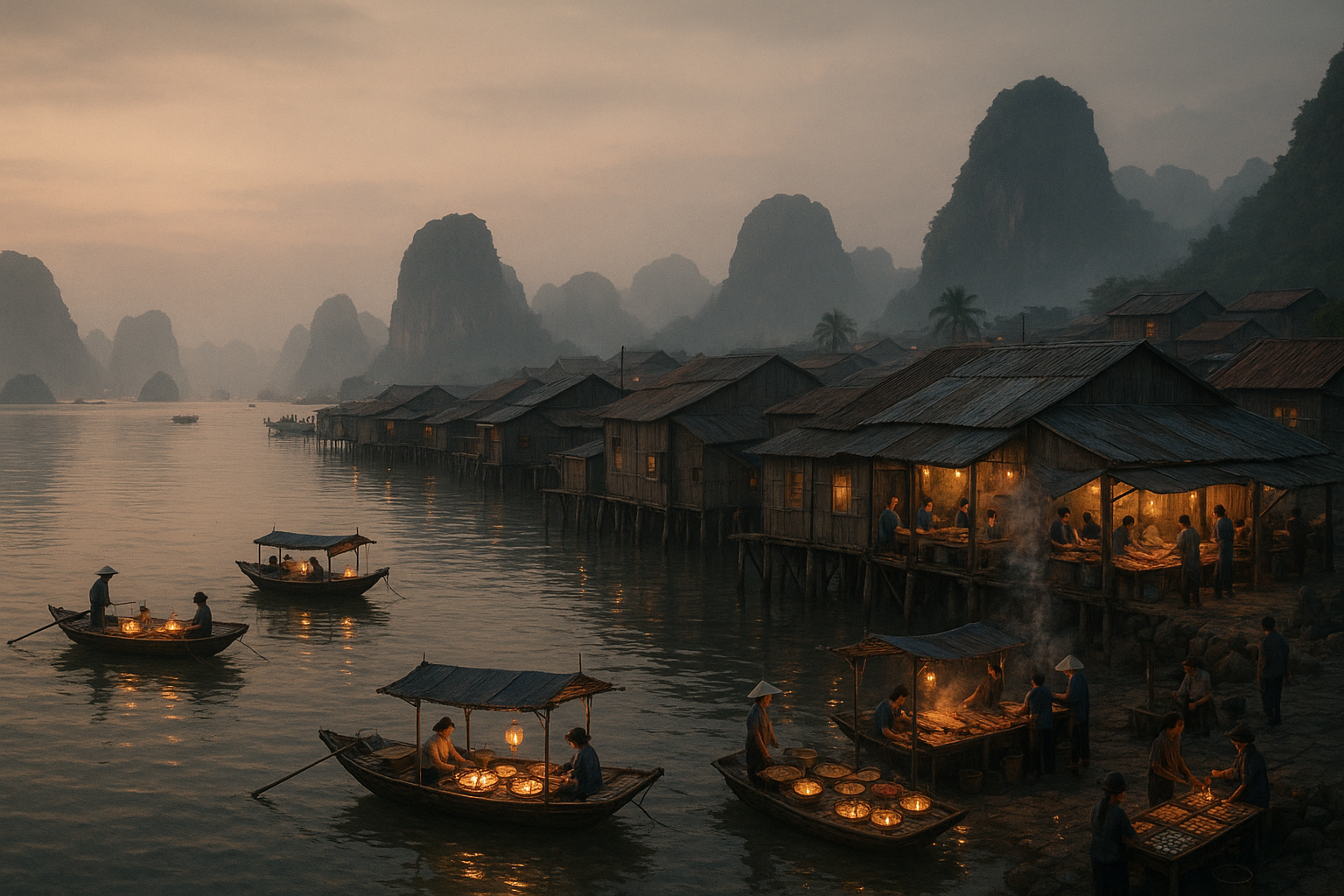
Cam Pha announces itself before it comes into view. From the water, on the right wind, the smell reaches you: cardamom, smoke, fish, and something floral that you'll eventually identify as the jasmine garlands sold at the dock shrine to Ryujin. The harbor is shallow and protected, a natural crescent that the town has built around over generations. Buildings along the waterfront are close together and tall: three and four stories of whitewashed stone with carved wooden balconies painted in deep reds and golds, laundry and spice bundles hanging from the upper floors, the whole face of it reflected imperfectly in the harbor water.
Away from the docks, the streets are narrow and deliberate, designed more for foot traffic and cart animals than for anything larger. The market occupies the central quarter of the town and operates continuously; it does not have hours. What is available shifts with the tide and the season, but something is always being sold and someone is always there to sell it.
The Cracked Sea itself is visible from most of the town's upper stories, not a comfortable ocean, but a dramatic one, the water fractured by outcroppings and small islands that catch the light differently at every hour. It is beautiful in the way that things are beautiful when they also require attention.
Geography & Setting
Cam Pha occupies a natural harbor on Shoing's southwest coast, where the mainland curves to meet the edge of the Cracked Sea: a stretch of coastal water that takes its name from the pattern of islands, rocky outcroppings, and submerged formations that make it largely unnavigable without a local guide. The town sits at the junction of mainland and sea access, which is why it exists and why it has persisted.
Land behind the town rises into the fertile highlands of southern Shoing: warm, wet enough for rice paddies and spice gardens, the air humid and fragrant even in the dry season. Coast itself is exposed to the southwest winds in storm season, and the town is built accordingly: thick stone on the seaward side, the harbor mouth partially shielded by a stone breakwater that the Devara family commissioned two generations ago and which has probably paid for itself several times over.
The Cracked Sea islands (dozens of them, ranging from large enough for a small settlement to too small to land on) begin less than a mile from the harbor and continue southwest in a ragged chain. Pearl beds are in the shallower water between the islands.
The People
Demographics
The population is predominantly human, reflecting southern Shoing's demographics. The Felair community is notable, several extended families who came over from the eastern parts of Shoing two generations ago and have integrated thoroughly into the fishing and pearl-diving trades. Their presence is unremarkable to the locals and occasionally startling to visitors from the continent's interior. A handful of half-elves, the product of earlier trade contact with Irna, are scattered through the merchant class.
Outsiders are common enough in a trading port that they do not attract particular attention. What Cam Pha actually cares about is whether you can be dealt with honestly and whether your coin is good. The honor culture of Shoing is present here, but in the pragmatic, mercantile form it takes in port towns rather than the elaborate formal version maintained inland.
Economy
Cam Pha runs on three things: what comes out of the sea, what grows in the hills, and what passes through on its way somewhere else.
The pearl trade is the town's oldest and most prestigious industry. Cracked Sea pearls are distinctive; the mineral composition of the water produces pearls in a range of colors from the standard cream-white through grey, lavender, and, rarely, a deep green that commands significant prices in Gwajin and beyond. Diving families, human and Felair, who work the beds are the town's traditional aristocracy, and their social standing has not diminished as the merchant class has grown.
Spice cultivation in the highlands behind the town feeds both local consumption and export. Cam Pha's spice merchants have established relationships with buyers across Shoing and maintain seasonal contact with traders who come from further afield. Cam Pha's fish preparations, elaborate spiced cures and preserves that reflect southern Shoing's culinary tradition, have also developed into an export commodity.
The port function means that Cam Pha sees cargo from the Cracked Sea islands and the open ocean routes to the south. A significant portion of the town's income is transit trade.
Primary Exports
- Cracked Sea pearls: The colored pearls especially; the green variety is internationally sought after
- Spiced preserved fish: Cam Pha-style preparations with distinctive spice profiles
- Cultivated spices: Cardamom, pepper, and several varieties found primarily in this coastal region
Primary Imports
- Grain and textiles: The highlands provide spices but not staple food in sufficient quantity
- Metal goods: The town has no significant smithing capacity
- Luxury goods: For the merchant and ruling class; Gwajin-made goods flow southwest along the coast
Key Industries
- The Pearl Diving Families: Half a dozen major family operations and several smaller ones; a loose guild called the Shell Compact regulates prices and diving territories
- Devara Spice Holdings: The ruling house's commercial enterprise, managing the highland spice gardens and their export
- The Salt Houses: Several establishments that produce the spiced fish preparations; two families dominate, one human and one Felair
- The Harbor Brokerage: A commercial firm that handles the transit cargo and takes a percentage; run by a half-elf named Mirela Voss who came from Irna and has not left
Food & Drink
Cam Pha eats with complexity. The southern Shoing tradition of spiced cooking is present in everything: rice dishes cooked with aromatics, fish prepared in sauces built from the locally cultivated spices, vegetable preparations that use the abundant highland produce. Coconut milk appears in more dishes than a northern visitor would expect. The flatbreads of southern Shoing are made fresh at small street operations throughout the market quarter at most hours.
The town has a specific reputation for its fish curry: a preparation that uses Cracked Sea catch with a spice base that takes two days to prepare properly, sold from two establishments whose recipes are treated as family secrets and whose rivalry is entirely real. Visitors are expected to try both and form an opinion.
Local drink runs to a rice spirit distilled in the hills above town that is consumed warm, and a cardamom tea that accompanies most meals and all business negotiations.
Culture & Social Life
Cam Pha is southern Shoing's honor culture applied to commerce. A merchant's word here is genuinely binding; a broken agreement has consequences that go beyond the financial, touching family reputation in ways that persist. Negotiations are conducted with patience and ceremony; rushing a deal is considered both rude and suspicious. The result is that business is slow and reliable, which tends to suit the pearl trade's long-cycle nature.
The diving families maintain a social precedence that is respected even by wealthier merchants, because the pearl beds are old and their knowledge of them is older. This has created a town where money and status are related but not identical, which produces some interesting social dynamics.
The Felair community is integrated but distinct; they maintain their own social customs within the broader framework, and their position in the diving trades gives them standing that insulates them from the occasional discomfort other parts of Shoing express toward animalistic races. Here they are simply part of how things work.
Festivals & Traditions
The First Dive
At the start of the pearl-diving season, the Shell Compact's senior diver, currently a Felair woman named Priya Suresh, performs a ritual opening dive at the primary pearl bed before any commercial diving begins. She brings up one pearl, which is offered at the Ryujin shrine. The quality of this pearl is read as an omen for the season. A flawed pearl means a difficult season; a colored pearl means unusual opportunity; a perfect white pearl means a steady, reliable year. The reading is taken seriously even by people who do not particularly believe in omens.
Lantern Night
On the winter solstice, when the pearl-diving season is closed and the storm season at its peak, the town lights paper lanterns and releases them from the harbor. The stated purpose is to honor those lost at sea in the year past. The actual character of the evening is more complex; it is also the night when old debts are acknowledged, estrangements are sometimes mended, and a great deal of cardamom spirit is consumed. It is the most emotionally alive night in Cam Pha's calendar.
Music & Arts
Southern Shoing's musical tradition is present in full force here: elaborate vocal performances, the sitar and tabla common to the region, street musicians who are genuinely skilled rather than performing for charity. The market quarter hosts informal performances throughout the day. The town has a small covered performance space near the central market where the better performers appear in the evenings.
The visual arts run to textile work; the elaborate silk embroidery of the ruling family's ceremonial dress is produced by two ateliers in town and represents a significant secondary industry. Less formally, the carved wooden balconies and painted shutters of the waterfront buildings have produced a distinct Cam Pha aesthetic that is recognizable from a distance.
Religion
Primary Faith
Ryujin and Talbar share civic prominence: the sea provides, the market measures, and both are treated as holy realities.
Secondary / Minority Faiths
Shen-Li is prevalent in household ancestor halls and in pearl-family lineage books that are treated as sacred objects. Caminus is honored by jewelers and bead-workers who finish pearls and set them into trade goods. Martus thrives in the all-hours market's wagers, risk-taking, and speculative buying. Gormandus appears in the night food culture - abundance and indulgence as celebration after hard work.
Secret or Forbidden Worship
Shinigami's grave-monks operate quietly but constantly: drownings, diving accidents, and delayed funerals are treated as spiritual emergencies.
History
Founding
Cam Pha was established as a fishing shelter: a natural harbor that boats used seasonally, which gradually became inhabited year-round by the families who fished its waters and eventually by the traders who followed them. The Devara family arrived as merchants from the southern highland interior approximately three hundred years ago, proved their commercial worth, and over two generations accumulated enough influence to assume the Thakur title. The pearl diving families predate them by at least a century and consider this history significant.
Key Events
Discovery of the Colored Pearls
The particular combination of minerals in the Cracked Sea produces pearl coloration not found in other beds. The first recorded green pearl was brought up by a Felair diver and sold to a Gwajin merchant for a price that caused a brief regional scandal. Within two generations, Cam Pha pearls, especially the colored varieties, had established a distinct market identity. This is the event that transformed the town from a regional fishing port to a trading destination of wider note.
The Devara Breakwater (approx. 70 years ago)
Thakur Priya Devara, the current Thakur's grandmother, invested the family's accumulated commercial wealth in the stone breakwater that now protects the harbor. The construction took four years and required the cooperation of the pearl diving families, who negotiated a favorable trade arrangement with House Devara in exchange. The breakwater opened the harbor to larger vessels during storm season and materially changed the town's transit trade capacity.
The Mirela Voss Affair (approx. 15 years ago)
When the half-elf merchant Mirela Voss arrived from Irna and established the Harbor Brokerage, she initially faced significant resistance, both as an outsider and as someone who was inserting a fee-taking intermediary into transactions that had previously been direct. The Devara family initially tried to restrict her operation. She spent three years being so relentlessly useful (connecting Cam Pha's pearl merchants with buyers in Antaea and beyond) that the opposition dissolved. Her business is now integral to the transit trade and she has dinner with Thakur Arjun quarterly.
Current State
Cam Pha is prosperous and its major tensions are commercial rather than political. The Shell Compact has been negotiating with House Devara over pearl export pricing for two years without resolution. Mirela Voss is quietly building relationships with buyers in Antaea, which could significantly expand the town's trade profile but would also shift the balance of power toward her brokerage. The harbor is at capacity during peak season and a second harbor expansion has been discussed for a decade without action.
Leadership & Governance
House Devara: Overview
The Devara family holds the Thakur title and exercises governance through a combination of hereditary authority and commercial relationship. They own significant portions of the highland spice operations and collect port fees. They are not a military house and maintain no significant armed force of their own; law enforcement is handled by a town watch funded through the port fees. Their authority is generally accepted because they are competent administrators and because the alternative (the pearl diving families, who have their own competing claims to influence) is not something anyone has managed to organize.
Thakur Arjun Devara
Human, Male; early forties
Arjun Devara is a compact, well-dressed man who has the manner of someone who grew up being taken seriously and has not abused the advantage. He knows the spice trade deeply (he spent three years working his family's highland operations before assuming the title) and has more genuine knowledge of the town's economy than any pure administrator would. This makes him difficult to mislead about commercial matters, which he is aware of and uses.
He is not particularly interested in the formal aspects of governance. He runs Cam Pha much as he would run a commercial enterprise: efficiently, with clear goals, tolerant of disagreement and intolerant of inefficiency. His relationship with the pearl diving families is the defining political tension of his administration: he respects their historical standing, wants their cooperation, and finds their pricing negotiations exhausting.
Thakurani Nalini Devara
Human, Female; late thirties
Nalini manages the highland spice operations and is, in the commercial sense, the more active of the two. She spends half her time at the highland farms and half in town, and is more likely to be found at the Salt Houses or the Harbor Brokerage than at the family residence. Her relationship with Mirela Voss is genuinely collegial (they think about trade in compatible ways), which is occasionally a political complication when her husband is in conflict with the Brokerage over fees.
The Town Watch
Cam Pha's watch numbers eighteen, commanded by a human man named Warden Dass, a former Shell Compact diver who transitioned to security work after a diving injury. The watch handles market disputes, drunken sailors, the occasional cargo theft, and the complex jurisdictional questions that arise when a fight involves three different ships' crews and the harbor facilities. Dass is pragmatic about law; he enforces what needs enforcing and leaves alone what the town needs to leave alone.
Law & Order
Cam Pha follows Shoing law. Notable local customary law: the Shell Compact's territorial agreements over the pearl beds have a quasi-legal status that the town watch enforces without any formal mechanism for doing so; it is simply understood that the diving families' arrangements are real. This occasionally produces jurisdictional friction with the Shoing imperial law that technically governs water rights.
Notable Figures
Priya Suresh: Head of the Shell Compact, Senior Diver
Felair, Female; fifties; the Shell Compact's offices on the harbor road
Priya is the most influential non-noble person in Cam Pha. She is lean, grey-furred, missing the tip of her left ear from a diving accident forty years ago that she describes in minimizing terms. She runs the Shell Compact with a combination of tradition and commercial calculation, and her pricing negotiations with Thakur Arjun have been running longer than most of the participants are comfortable with. She is not being difficult for the sake of it; she has a specific number in mind, and she is waiting for House Devara to reach it.
Mirela Voss: Harbor Brokerage
Half-Elf, Female; sixties; the Brokerage offices at the harbor entrance
Mirela has the accent of Irna and the instincts of someone who has spent forty years making herself indispensable in places where she had no natural advantage. She is tall, grey-haired, and dressed better than anyone else in a working port has a reason to be. She knows the buying networks of three continents and which specific merchants on each continent will pay premium prices for which specific goods. She is the most useful person in Cam Pha to know if you are selling something.
Father Selvam: Chief Priest of Ryujin
Human, Male; eighties; the harbor shrine and the small residence behind it
Selvam has been the harbor priest for as long as most people can remember. He is weathered to an almost indeterminate age, moves slowly, says little, and is present at the harbor entrance every morning before dawn. He is one of the few people in Cam Pha that both House Devara and the Shell Compact defer to without negotiation. What he actually believes about Ryujin, as opposed to what he performs, is not something he discusses.
Rajan and Amara Salvi: The Rivalry
Human, Male and Female; both fifties; their competing Salt Houses on opposite sides of the market quarter
The Salvi family operates the two dominant spiced fish establishments, run by siblings who have not spoken directly to each other in fourteen years over a disagreement about their parents' estate that predates their commercial success. They are in violent culinary competition and each is excellent. The town quietly enjoys this.
Key Locations
Seat of Power
- Devara House: A three-story carved stone building at the highest point of the town, facing both the harbor and the highland road. The ground floor is open to business; the upper floors are private. The ceremonial room on the second floor has a floor-to-ceiling carved wooden screen that is the most impressive piece of craftsmanship in town.
Houses of Worship
- The Breakwater Shrine of Ryujin: On the harbor breakwater itself, carved wood that is repaired and repainted seasonally. Accessible by a narrow walkway. Not comfortable in rough weather. Always attended.
- Temple of Talbar: In the market quarter, stone-built and prosperous-looking. The interior is organized around a central weigh-scale used in ceremonial contract witnessing. The clergy charge modest fees for this service.
Inns & Taverns
- The Pearl Light Inn: The better of the town's two inns, two blocks from the harbor. Adequate rooms, excellent food, a dining room that fills with merchants most evenings. The innkeeper, a woman named Devaki, speaks four languages and will help with translation for a fee.
- The Anchor: Down by the docks, for sailors and those who prefer their lodging uncomplicated. The spiced fish is better than the establishment deserves.
Shops & Services
- The Salvi Salt Houses: Rajan's is on the west side of the market, Amara's on the east. Both sell prepared spiced fish, both serve meals, both will tell you the other's product is inferior. Both are correct about the other's inferior product.
- Shell Compact Sales House: Where pearl purchases of any significance are transacted. Not open to walk-in browsing; appointments are required and the Compact takes this seriously.
- Devara Spice Shop: The retail face of the family's highland operation. Well-stocked, competitively priced, and staffed by people who know the products.
The Market
- The Cam Pha Night Market: The central market runs continuously, but its night configuration (lit by oil lamps and braziers, with a narrowed selection focused on prepared food, small goods, and perishables) has a distinct character from the daytime market. Visitors who arrive by evening ship find this the first and most memorable thing about Cam Pha.
Other Points of Interest
- The Cracked Sea Lookout: A platform at the town's southern edge with a view of the sea and the island chain. Used by divers for weather reading and by everyone else for the view. The best time is at dawn when the light does something unusual with the water.
Secrets, Rumors & Hooks
- The green pearls' color intensifies in certain years and not others. Priya Suresh knows the pattern; it correlates with something that happens at the primary pearl bed, in the deep water, every several years. She has not told anyone what she has seen there. It is the reason she takes the Shell Compact's ceremonies seriously and has never missed one.
- Mirela Voss has recently received an approach from a purchasing agent acting on behalf of an unnamed buyer in Antaea who wants to acquire every green pearl Cam Pha produces for the next three years, at twice the current market rate. She has not told Thakur Arjun yet. She is trying to determine whether this is a business opportunity or a problem wearing the mask of one.
- Rajan Salvi's secret ingredient in his fish preparation is something he obtains from a contact in the Cracked Sea islands, a contact he has met once and does not know by name. He receives a package every three months. The arrangement has worked for eleven years. He has recently received a package that contained something extra along with the usual ingredient: a note with one sentence that he cannot read.
- The Shell Compact's off-season ceremonies at the pearl bed involve bringing something up from the deep water and returning it before dawn. Father Selvam is present. The Compact considers this entirely normal. No one else knows.