Chengdu
Chengdu: The River-Road Town
"Everything that grows upstream arrives here before it arrives anywhere else. Everything that arrives from the coast passes through here before it goes inland. This is not an accident. This is what a river valley is for."
Lord-Merchant Aldric Voss, the town's founding principle, quoted on the Exchange Hall's entrance beam
At a Glance
| Continent | Shoing |
| Region / Province | West coast interior, Galshi Western Coast: Arven River valley |
| Settlement Type | Town |
| Population | ~5,800 |
| Dominant Races | Human (majority), Smaling (significant presence in barge and river trade) |
| Ruler / Leader | Lord-Merchant Calla Voss |
| Ruling Body | House Voss, hereditary governance in the western Shoing tradition; the "Lord-Merchant" title reflects the founding family's combined political and commercial identity |
| Primary Deity | Talbar (commerce and precision exchange); Bridhel (rivers, movement, and seasonal renewal) secondary |
| Economy | Silk production and weaving, river trade brokerage, agricultural processing, barge transport services |
| Known For | The finest silk in western Shoing; the river barge network that connects the inland mountain trade to Galshi's port; the Exchange Hall where virtually every significant western Shoing interior trade agreement is signed |
First Impressions
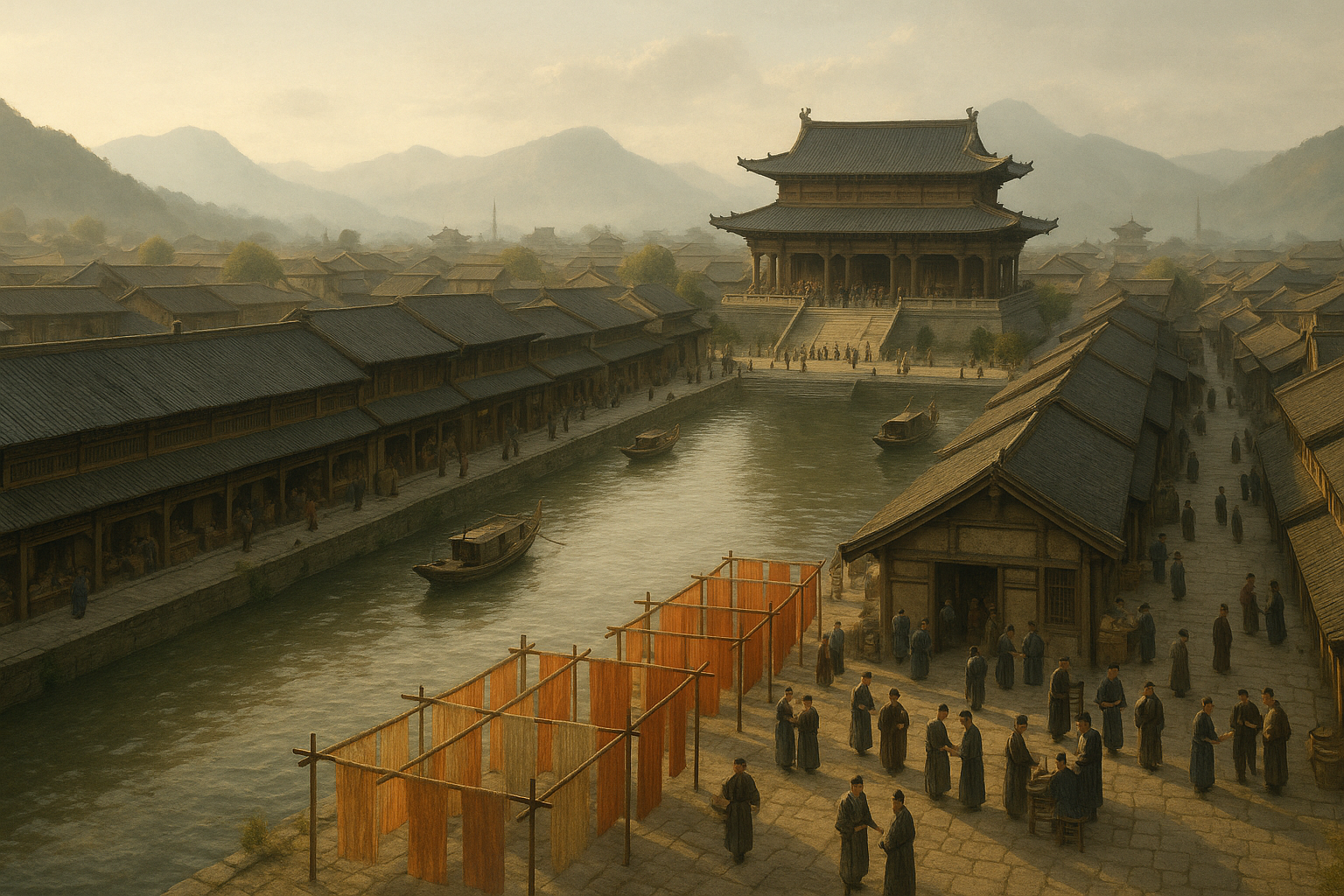
The Arven River is the first thing. It arrives in the valley as a cold fast mountain stream and widens into a navigable waterway within the town's upper boundary, and by the time it has passed through the town's dock district it is broad enough for loaded barges side by side. Chengdu has grown along the river's navigable stretch: not beside it, as most river towns are built, but on both banks, connected by three stone bridges that are among the most substantial structures in western Shoing's interior.
From the bridges, the silk quarter is visible: the mulberry orchards are on the east bank's gentler slope, the weaving workshops are in the district immediately adjacent, and the dye works are on the west bank where the river's current carries the runoff downstream. Color in the water below the dye works varies with the season's production run, which visitors find striking and residents consider a reliable indicator of which fabric orders are currently in progress.
The Exchange Hall sits at the river's central bridge approach, a large timber-framed building that is the town's most formal space and the one that most visitors end up in, since it is where the trade agreements that brought them here are concluded.
Geography & Setting
Chengdu occupies the navigable section of the Arven River, a western mountain-fed waterway that descends from the Hangyin range's western slopes and flows through this valley before continuing to the Malaea Sea coast. Chengdu's valley is forested on its upper slopes and cleared for agriculture in the river plain; the combination of river-deposited soil and the cool temperate climate that the valley's protected position maintains produces agricultural conditions that are significantly more productive than the surrounding plateau.
Connection to Galshi is the downstream river route; barges move cargo from Chengdu to Galshi's river port on a schedule that the barge cooperatives maintain. Upstream, the connection reaches toward the mountain foothills where the highland goods originate. Chengdu's position at the navigable head of the barge route makes it the natural transshipment point for everything that moves between the western interior and the coast.
Mulberry cultivation requires the valley's specific microclimate; the frost-free growing season that the valley's sheltered position extends by several weeks compared to the surrounding plateau allows the mulberry varieties that the silk operation depends on.
The People
Demographics
Chengdu is the most cosmopolitan of the western Shoing interior towns; the river trade brings a constant flow of travelers, merchants, and seasonal workers that keeps the permanent population in contact with a wider world. The Smaling presence in the barge and river trade operations is significant; the western Shoing interior Smaling community has a long tradition of river navigation that is recognized across the Galshi Western Coast sphere.
Permanent population is predominantly human, but the transient and semi-permanent merchant community includes representation from most of the western Shoing political sphere and occasional visitors from further afield.
Economy
Silk is the anchor. The Arven valley's mulberry cultivation and the Voss family's weaving operation produce western Shoing's most recognized silk, not the finest in all of Shoing (the eastern provinces have their own traditions) but the acknowledged quality standard for the western coast and a significant export to Galshi's luxury trade. The silk weaving employs a large fraction of the permanent artisan population.
River trade brokerage is the second pillar; the town takes a commission on every significant cargo that transits through its barge network, and the Exchange Hall is where the agreements that generate those commissions are signed. Voss family's brokerage operation is commercially separate from the governance function in the formal sense and practically integrated in the way that a family holding both roles inevitably produces.
Primary Exports
- Chengdu silk: The primary artisan product; woven fabric and raw thread; exported to Galshi and onward; western Shoing's quality standard for the material
- Agricultural surplus: Grain, preserved fruit, processed food products; the valley's agricultural productivity exceeds local need
- River trade brokerage commissions: Not a physical good; the commercial service that the Exchange Hall represents
Primary Imports
- Highland goods from the interior: Wool, alpine herbs, mountain minerals; arrives by upstream barge and is transshipped to Galshi
- Coastal goods from Galshi: Luxury items, imported goods from the Malaea Sea trade; arrives by downstream barge
- Raw silk materials: Supplementary silk thread and dye materials for the weaving operation beyond what the local mulberry cultivation produces
Key Industries
- The Voss Silk Operation: The mulberry cultivation and weaving complex; the family's commercial foundation; the town's largest single employer
- The Barge Cooperative: The Smaling-majority river transport operation that manages the upstream-downstream cargo flow; the most important commercial infrastructure in the town
- The Exchange Hall: The Voss family's commercial brokerage institution; where western interior trade agreements are concluded
- The Agricultural Cooperative: The valley farms' collective marketing and processing operation
Food & Drink
Chengdu eats well by western Shoing interior standards, which is a meaningful distinction. The valley's agricultural productivity means the food is varied, fresh in season, and preserved intelligently in the off-season. Rice is grown in the warmer sections of the valley flat. The cooking tradition has absorbed influences from the barge-trade community; the Smaling culinary tradition in particular has integrated into the town's food culture in ways that western Shoing visitors find familiar and eastern Shoing visitors find interesting.
Chengdu's signature beverage is a mulberry fruit wine, a byproduct of the silk operation's orchard that the town produces in good volume and exports in modest amounts. It is not the most sophisticated wine available in Shoing, but it is specific to this place and is considered representative by people who think that is a virtue.
Culture & Social Life
Chengdu's culture is commercial in the specific sense that the exchange of goods and the making of agreements have been elevated to cultural significance. The western Shoing honor framework is present; the specific expression here emphasizes the honor of a concluded deal: a trader who upholds a bad bargain stoically is respected; a trader who extracts themselves from one through clever legal argument is not.
Exchange Hall's role in this culture is significant: it is simultaneously the town's most formal commercial space and its most significant social venue. Agreements made here carry a specific weight that agreements made elsewhere do not, and the social events hosted here (the annual trade dinner, the seasonal market openings) are the occasions at which the town's commercial relationships are maintained through personal contact.
The Smaling barge community has a distinct social life centered on the river dock district. Integration with the permanent population is functional and warm in the specific ways that commercial collaboration produces; the social separation is maintained in ways that the Smaling community prefers and the human community respects.
Festivals & Traditions
The Silk Opening
When the mulberry cultivation's spring leaf production reaches sufficient volume to begin the silk thread extraction, the specific moment that the Voss family's head weaver determines each year, the town formally begins the production season. This is commercial ceremony with cultural weight: the first thread of the new season is woven into a small test piece and displayed in the Exchange Hall for the season.
The Barge Race
Once per year, at the summer's peak water level when the Arven runs at its fastest, the Smaling barge community holds a race on the navigable section through the town. This is a cooperative event (the race is more about demonstrating technique than competition in the conventional sense), but it draws the town's permanent population to the riverside and is the most visually spectacular thing that happens in Chengdu annually.
Music & Arts
The silk-weaving tradition produces cloth as art in the most direct sense. The Voss operation's highest-quality pieces, the patterned silks that sell to noble households and court buyers, are designed by specific pattern masters whose work is recognized across western Shoing. The designs are part of the Voss family's commercial signature and are protected carefully.
Smaling barge community's music tradition is the river music of the western interior: fast, rhythmic, designed for performance on moving vessels, more lively than the formal court traditions and more popular in the dock district taverns as a result.
Religion
Primary Faith
Talbar governs Chengdu's Exchange Hall culture: contracts, fair measure, and the sacredness of terms. Bridhel remains visible as the river's rhythm and the seasonal renewal that makes silk and harvest possible.
Secondary / Minority Faiths
Caminus is honored by weavers and loom-makers who treat precision as devotion. Ryujin is respected by barge captains and river pilots. Themela appears in the halls where commercial disputes become legal judgments. Household ancestor altars are universal and explicitly framed through Shen-Li in the clerk families who keep lineage and record as the same work.
Vessikar has shrines near weighhouses and market courts; honest measures are treated as civic peacekeeping. Nesara is honored at wells and river shrines, and in irrigation councils: water held in trust for everyone downstream. Caldrin is honored at gates, bridges, and caravan yards for safe passage, true directions, and upheld guest-right. Sylira keeps whisper-shrines in inns and social halls: places to trade news, manage reputation, and pretend it isn't politics. Dolen is kept by weavers and tailors, especially those who make mourning cloth and mend grief into garments.
Secret or Forbidden Worship
Shinigami is present as a quiet enforcement: when bodies vanish from the river or funerals are delayed for commerce, their monks intervene.
History
Founding
Chengdu's founding is attributed to the Voss family's ancestor, a merchant-adventurer who identified the Arven valley's barge-navigation potential and established the first formal trade operation at what is now the central bridge site. The silk operation came later, introduced by a second-generation Voss who recognized that the valley's mulberry cultivation potential was being underutilized as incidental harvesting. The Exchange Hall was built in the third generation, formalizing what had been informal brokerage from the beginning.
Key Events
The Exchange Hall Founding Compact (approx. 200 years ago)
The formalization of the Exchange Hall as a recognized neutral trade ground, a space where agreements made under its roof carry a specific legal weight recognized by the Galshi Western Coast political authority. The compact's terms established the Hall's neutrality provisions and the Voss family's administrative role.
The Great Flood Reconstruction (approx. 90 years ago)
A catastrophic Arven flood destroyed significant portions of the dock district and damaged two of the three bridges. The reconstruction, which the town managed largely without external support, resulted in the current bridge infrastructure, which is significantly more substantial than the original. The Smaling barge community's contribution to the reconstruction is credited with its speed and quality; the event is cited as the origin of the specific community relationship that characterizes Chengdu's town-barge cooperative dynamic.
The Silk Certification (approx. 40 years ago)
The Galshi Western Coast noble assembly formally recognized Chengdu silk as a certified quality standard, the first such certification in the western Shoing sphere. The certification has commercial implications (certified silk commands a price premium), and its politics were complicated (two competing silk producers in other western towns objected and were overruled). The certification is maintained through annual quality review.
Current State
Chengdu is prosperous and active. The silk production is at its highest volume in a generation. The barge trade is consistent. The Exchange Hall's seasonal activity is high. Lord-Merchant Calla has been in the role for eight years (young for the position, having taken it following her father's unexpected death) and has managed the transition effectively. The ongoing concern is competition: two highland operations have begun producing silk thread of improving quality, and if they achieve certification, Chengdu's price premium will narrow.
Leadership & Governance
House Voss: Overview
The Voss family holds the Lord-Merchant position by western Shoing noble tradition and by the Exchange Hall compact's provision. The governance combines formal administrative authority with the family's commercial operations in a way that western Shoing finds natural and that outsiders sometimes find conflicted. The family's position is maintained by commercial competence as much as by hereditary claim.
Lord-Merchant Calla Voss
Human, Female; early thirties
Calla took the Lord-Merchant position at twenty-four following her father's death from illness. She has been managing the governance and the commercial operations simultaneously, which her father handled in sequence; she does not have the option of learning one before the other. She is handling it competently and is keenly aware that "competent" is not the same as "excellent" in a role that requires both. Her specific focus has been the silk certification's competitive threat; she is developing a response that involves improving quality rather than restricting competition.
Notable Figures
Master Weaver Doros Tal: Silk Pattern Master
Human, Male; sixties; the Voss weaving operation
Doros has been the Voss operation's pattern master for thirty years and is responsible for the design tradition that distinguishes Chengdu silk from its competitors. He is the person whose approval the quality reviewers are actually deferring to when they certify a production run. He is also aware that one of the highland operations has hired his former apprentice, and that the apprentice is talented.
Harbor-Master Pip Shortwick: Smaling, Barge Cooperative Lead
Smaling, Female; forties; the dock district
Pip manages the barge cooperative's operations and is the primary liaison between the Smaling river community and the town's governance. She is effective and politically sophisticated in the specific way of someone who manages a community that everyone depends on and everyone sometimes forgets to acknowledge. She and Calla Voss have a productive working relationship that is currently being tested by a proposed toll adjustment that Calla believes is necessary and Pip believes is not.
Factor Oren Brightwater: Exchange Hall Administrator
Human, Male; fifties; the Exchange Hall
Oren manages the Exchange Hall's administrative operations: the agreement documentation, the neutrality enforcement, the seasonal event coordination. He is the institutional knowledge of how the Hall functions and is the person that visiting merchants contact when they want to understand the town's commercial norms. He has been in the role for twenty years and has accumulated knowledge about the western interior's commercial relationships that is not formally documented anywhere.
Key Locations
Seat of Power
- The Voss Compound: On the east bank, adjacent to the silk operation; the residence and governance administration are integrated with the commercial operation in the way that the Voss family's founding arrangement always intended
Houses of Worship
- The Talbar Exchange Temple: In the market district; the annual commercial audit is performed here; the Hall is more important functionally but the temple is the formal worship space
- The Bridhel River Shrine: On the west bank at the downstream bridge; maintained by the Smaling community; receives significant foot traffic from valley agricultural workers at seasonal turning points
Inns & Taverns
- The Exchange Inn: The principal accommodation for visiting merchants; positioned at the central bridge approach; the common room is the most commercially active social space in the town outside the Hall itself
- The Downstream: The Smaling dock district tavern; the barge community's social center; the music is the fastest in Chengdu and the river spirit served here is the best in the interior
Shops & Services
- The Voss Silk Showroom: Where production-run silk is available for direct purchase; by appointment for significant quantities; the pattern master's current season designs are displayed here before going to the external buyers
- The Exchange Hall: Where agreements are made; not a shop; visitors arrange access through Oren Brightwater's administrative office
The Market
- The River Market: On the east bank below the central bridge; open daily; the most active commercial space in the town's daily life; grain, produce, general goods, and lower-grade silk available directly
Other Points of Interest
- The Three Bridges: The stone crossing infrastructure that gives the town its character; the central bridge is the oldest and most architecturally significant; the downstream bridge was built first after the flood reconstruction and is the sturdiest
- The Mulberry Orchards: The east bank slope above the weaving district; the source of the silk operation's raw material; accessible and visible from the road; the spring leaf-out is the most visually striking seasonal moment in the valley
Secrets, Rumors & Hooks
- Doros Tal's former apprentice, now working for the highland competitor, has the talent to develop a distinctive style that would directly challenge Chengdu's certification position. Doros knows this. He has also been in correspondence with the apprentice since the departure (correspondence that is not known to the Voss family) and has some influence over the direction the apprentice's development is taking. He is not certain whether he is guiding the apprentice toward less competitive territory out of loyalty to the Voss family or out of affection for the apprentice.
- Factor Oren Brightwater's twenty years of Exchange Hall administration have given him comprehensive knowledge of the western interior's commercial relationships. Some of this knowledge (specifically, which trading houses have been consistently present at negotiations involving goods that shouldn't exist in the volume they're moving) suggests a systematic trade in prohibited materials that passes through the western interior without anyone formally acknowledging it.
- The proposed barge toll adjustment that Calla Voss believes is necessary is, from Pip Shortwick's analysis, not justified by the stated infrastructure needs. The numbers in Calla's proposal don't add up the way Pip has worked them. The discrepancy is not large enough to indicate fraud; it is large enough to indicate that Calla has a second purpose for the toll revenue that she has not disclosed.
- There is a chamber beneath the Exchange Hall's foundation that is not on any current building plan. It was built in the original construction, appears in the earliest Voss family records as "the secured vault," and is not mentioned in any documentation after the second generation. The current administrative staff is unaware of it. The eldest of the Smaling barge community's elders knows it exists, because her great-grandmother helped build the original Hall.