Chon Buri
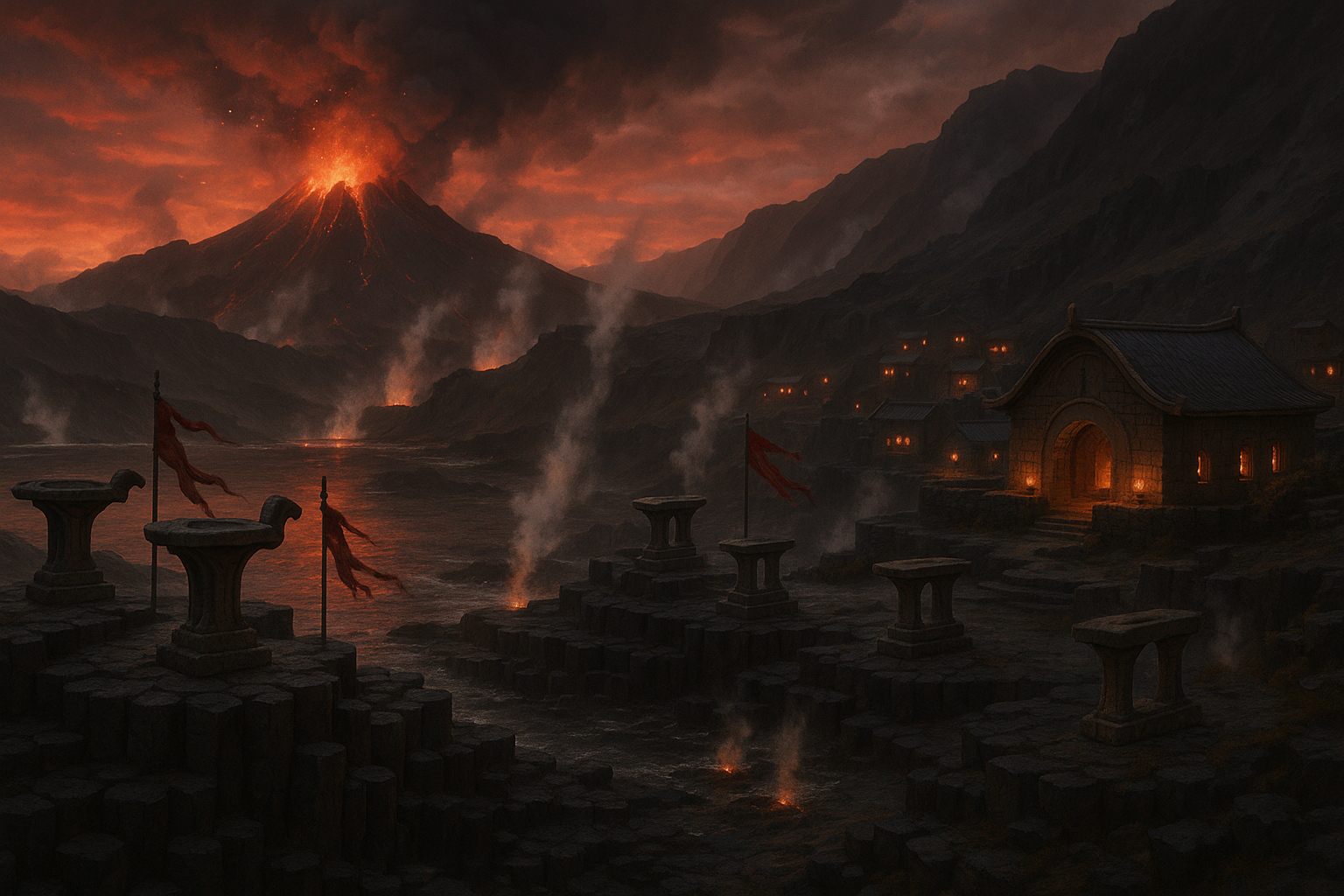
Chon Buri: The Town at the Caldera's Mouth
"You do not breed the Flame Runner. You make yourself acceptable to it, and if you are sufficiently acceptable, and if the conditions are correct, and if the dragon finds this arrangement worth its while, then, possibly, something is born. The word 'bred' is a courtesy we extend to ourselves."
Bonder-Keeper Isao Tsurugi, responding to a Gwajin academician's inquiry
At a Glance
| Continent | Shoing |
| Region / Province | Northeast Shoing, Koko Nor Ocean coast (active volcanic coastal caldera) |
| Settlement Type | Town |
| Population | ~2,800 |
| Dominant Races | Human (majority), small Drakin presence |
| Ruler / Leader | Baron Emiko Tsurugi |
| Ruling Body | House Tsurugi, hereditary governance; the Bonder-Keeper tradition has been held by the family's firstborn for eleven generations |
| Primary Deity | Erumpens (volcanoes, vent-fire, the caldera's living heat) |
| Economy | Drakine Flame Runner bonding and sale, volcanic mineral extraction, sulfur trade, specialized military contracting |
| Known For | The only place in the known world where the Drakine Flame Runner have been successfully bonded to human riders; the caldera that has burned for four hundred years without cooling; the town that exists because the dragons allow it |
Geographic Note: Chon Buri is a coastal volcanic settlement on the northeast Koko Nor Ocean shore, built against and partially within the slopes of an active volcanic caldera system. The subarctic maritime climate of the Koko Nor coast is moderated locally by the caldera's heat output, producing a microclimate that supports the Flame Runner's breeding conditions and certain agricultural varieties that do not otherwise survive at this latitude.
First Impressions
The glow is visible at sea before the town is. The caldera does not erupt in the catastrophic sense (it has not done so in recorded history), but it vents constantly, and the vent gases burn at the rim in a continuous low flame that is visible for miles over the Koko Nor at night. Sailors who do not know the coast sometimes mistake it for a distress signal. Sailors who do know the coast do not mistake it for anything except a landmark.
Chon Buri occupies the western slope below the caldera rim, built in a material that makes its origin obvious: the stone is volcanic basalt, dark grey and dense, and the buildings do not burn. They were constructed to be in this location, near these vents, in this heat, and they show it. Architecture is heavy, low-slung, with small windows and thick walls, not for defense but for heat management. Upper reaches of the town, where the slope steepens toward the rim, are the Tsurugi compound and the bonding grounds: a series of terraced stone platforms where the Flame Runners land, are tended, and (when the conditions are correct) reproduce.
Dragons themselves may be visible from the approach. The Flame Runner is not large by dragon standards; a fully grown specimen is perhaps the size of a heavy horse, not the size of a building. What makes it notable is the coloration: deep orange-red scales that appear to emit their own faint heat shimmer, and the fire output, which is significantly hotter than other fire-breathing varieties and burns with a pale blue-white core. They fly in pairs or small groups over the caldera, and when they spiral upward into the cold Koko Nor air above the vent glow, they are unmistakable.
Geography & Setting
Chon Buri sits on the western slope of the Akagane Caldera: "red metal" in the old Shoing tongue, named for the copper-orange mineral deposits that line the vent edges. The caldera is not dormant. It vents gases continuously, burns at the rim, and periodically produces minor lava flows on the eastern interior face that the townspeople track and record. Flows have never reached the town. Tsurugi records note that they have come within a quarter mile twice in four hundred years.
Volcanic soil on the western slope is extraordinarily fertile for specific crops: root vegetables that tolerate heat, a variety of herb that grows only in volcanic mineral conditions and is traded as a specialty good. Above the agricultural terraces the slope is the bonding grounds and, above that, the dragon territory proper: the caldera interior, the vent fields, and the nesting ledges on the rim's inner face where the Flame Runners make their breeding sites.
The Koko Nor Ocean is visible from the town's lower terraces. Its harbor, a small natural break in the volcanic coastal shelf, is adequate for the supply vessels that bring food staples the town cannot produce and export the sulfur and mineral goods that come from the caldera's productive side. It is not safe in heavy Koko Nor storms, and the town has learned to manage its supply timing around the seasonal storm pattern.
The People
Demographics
Chon Buri is small and does not grow much. The bonding tradition that is the town's defining activity is hereditary in specific families: the Tsurugi foremost, and four other families that have maintained bonding relationships for multiple generations. New bonds with unbonded Flame Runners are rare and require a combination of circumstance, temperament, and what the bonding tradition describes as "the dragon's recognition," which is not further explained in the tradition's recorded texts. The community that has developed around the bonding families is stable, insular, and aware that it exists because of the dragons.
A small Drakin presence in the town is of unclear origin. Drakin families have been in Chon Buri for as long as anyone records, and their relationship with the Flame Runners is different from (and in some ways more natural than) the human bonding tradition. The Tsurugi family's opinion of the Drakin community is respectful and cautious in equal measure.
Economy
The Flame Runner bond market is the primary economic driver, and it is small by volume but enormous by transaction value. A fully bonded adult Flame Runner, transferred with a rider-compatible bond to a qualified buyer, is one of the most expensive single transactions in Shoing's military economy. The Gwajin Realm, the Karubo Highlands, and several noble houses of the eastern provinces have acquired Flame Runners through Chon Buri over the past century. The transactions are rare (typically two to four per generation), and each one finances the town's operations for years.
The sulfur trade is more consistent. The caldera produces sulfur in accessible quantities, and sulfur is required for a range of applications across Shoing: alchemical, agricultural, and military. Chon Buri employs several dozen people in the sulfur extraction and processing operations, and the product ships out on every supply vessel.
The volcanic mineral exports (copper-bearing stone, specific mineral pigments derived from the vent deposits) are a smaller line but consistent and valued by craftspeople across eastern Shoing.
Primary Exports
- Bonded Drakine Flame Runner: Rarely; extraordinarily valuable; the transaction that defines the town's economic significance
- Sulfur: Consistent production; ships with every supply vessel; alchemical and agricultural demand
- Volcanic mineral pigments: Copper-orange and deep red; valued by lacquer craftspeople including those in nearby Higatomo
- Caldera herbs: Dried; volcanic-soil varieties with specific medicinal properties
Primary Imports
- Food staples: Grain, preserved fish, general provisions; the volcanic slope produces specialty items but not sufficient food volume
- Metal goods: The heat conditions make extended smithing difficult; most metalwork comes from outside
- Timber: No significant forest on the volcanic slope; all construction timber is imported
Key Industries
- The Tsurugi Bonding Grounds: The terraced facilities where Flame Runner bonding, breeding assistance, and rider-dragon relationship development occurs; not a commercial enterprise in the normal sense
- The Sulfur Works: The extraction and processing operation on the caldera's accessible vent fields; managed by the town's second family, the Oshiro
- The Mineral Cooperative: Three families managing the mineral deposit extraction and export
Food & Drink
Chon Buri eats around constraint. The volcanic slope produces root vegetables in unusual variety; the heat and mineral content of the soil generate flavors that are intense and specific. These appear in the cooking prepared in ways that offset their assertiveness: long simmering, careful spicing, combination with the dried fish that comes in from the Koko Nor coastal supply. The Erumpens tradition around fire and purification has influenced the cooking; open-flame preparation is used where possible, and the controlled heat available from vent proximity in the upper town's kitchens is considered a mark of culinary capability.
The local spirit is distilled from the volcanic-soil root crops and is significant. It is not exported. It is consumed locally with the understanding that it is not for the uninitiated.
Culture & Social Life
The culture of Chon Buri is the bond. The bonding families understand themselves as stewards of a relationship with the Flame Runners that predates the town's formal settlement; the Tsurugi oral tradition holds that the first ancestor came to the caldera because a Flame Runner led him there, and the town grew up around the resulting relationship. Whether this is accurate history or foundational myth, it functions as the community's self-understanding.
The honor culture of eastern Shoing is present but modified by the dragon context. Personal honor is still paramount, but the community adds a layer: the bond is a form of honor-obligation that supersedes personal relationships. A bonded rider's primary obligation is to the dragon, and the community understands this. A rider who abandons a bond, or who transfers a bond under circumstances the dragon has not accepted, is the most disgraced figure possible in this community's moral framework.
The Drakin families exist in a cultural position that is somewhat apart from this framework; they do not bond in the same way, and the community does not require it of them. Their presence is treated as part of the caldera's nature rather than as a community relationship to be managed.
Festivals & Traditions
The Vent Watch
Once each season, the full adult population of the town walks the caldera rim at dawn, observing the vent conditions and noting any changes. This began as a practical safety tradition and has become ceremonial without losing its practical function. The Bonder-Keeper leads the walk and formally records any observations. Changes in the vent pattern are treated as significant information requiring interpretation.
The Bond-Day Recognition
When a new bond forms between a Flame Runner and a rider (which may happen once in a decade, or not at all in a generation), the event is treated as the most significant social occasion the town holds. The new rider is presented to the town at the bonding grounds, the dragon present and visible, and the community formally acknowledges the bond. The ceremony is brief. What it represents is not.
Music & Arts
The artistic tradition of Chon Buri is modest in volume and intense in focus. The lacquerwork that Higatomo is known for has a Chon Buri variant that uses the volcanic mineral pigments, particularly the copper-orange, to produce a color not achievable elsewhere. A small workshop in the lower town produces this work, and collectors who know Higatomo's quality standard know Chon Buri's variant as its complement.
Dragon imagery in the art is omnipresent and specific: the Flame Runner, never generic dragon forms. Chon Buri knows one kind of dragon, and the art reflects that knowledge.
Religion
Primary Faith
Erumpens is the caldera made divine: living heat, catastrophe, and transformation through danger. The town exists because the volcano allows it, and worship reflects that blunt fact.
Secondary / Minority Faiths
Fujin is common among riders and soldiers who embrace chaos, wind, and battle-fury on the caldera's rim. Caminus is honored by smiths and tack-makers who must build gear that survives ash and heat. Cameth is a household faith because fire is both sacred and threat. Ancestor worship is strong in the rider lineages; Shen-Li is invoked in bonding oaths and memorial scrolls. Shinigami's grave-orders oversee funerals when the mountain takes someone quickly.
Secret or Forbidden Worship
A few cultlets treat the dragons themselves as gods; the priests call this an error and do not argue with the dragons about it.
History
Founding
The Tsurugi oral tradition places the founding four hundred years ago, when the first Tsurugi ancestor followed a Flame Runner to the caldera and established the first bond. The written records, which begin approximately three hundred years ago, confirm the family's presence and the bonding practice at that date but do not confirm the founding story. What the written records do confirm is that the Flame Runners were established at the caldera before the human settlement, and that the settlement grew up around the dragon relationship rather than the reverse.
Key Events
The First Bond Transfer (approx. 280 years ago)
The first recorded sale of a bonded Flame Runner to a buyer outside Chon Buri, a military noble from the Gwajin Realm who had traveled to the caldera specifically to negotiate a bond acquisition. The negotiation took three years. The resulting bond transfer established the framework that all subsequent transactions have followed. The Tsurugi records from this period are the most detailed in the family archive.
The Caldera Event (approx. 150 years ago)
A vent opening on the caldera's northeastern interior face produced a lava flow that came closer to the bonding grounds than any other on record. Two bonded Flame Runners directed riders to relocate the ground-level facilities in the three days before the flow reached the terraces. Whether the dragons understood what they were communicating, or whether this was a coincidence of timing, is a question that the Tsurugi family records note without resolving.
The Drakin Arrival (approx. 90 years ago)
The Drakin families arrived in Chon Buri within a decade of each other, from different directions, with different stated purposes. All of them stayed. The Tsurugi records note the arrivals without expressing surprise. The Bonder-Keeper at the time recorded only: "The caldera has drawn them. This may be the dragon's work or its own. We will observe."
Current State
Chon Buri is stable in the way that a community organized around an extraordinary natural and social phenomenon can be stable; the extraordinary thing is ongoing, and the community's role in managing it is clear. The current Baron and Bonder-Keeper is managing two pressures: an increase in external interest in Flame Runner acquisition (three separate parties from different Shoing realms have made inquiries in the past decade, and the dragons have accepted none of them), and a change in the Flame Runner breeding pattern that the Bonder-Keeper is observing without yet being able to explain.
Leadership & Governance
House Tsurugi: Overview
House Tsurugi holds the Baronship and the Bonder-Keeper role by hereditary claim. The two positions have been held by the same person in every generation; the family has never separated governance from the dragon relationship, and the community would find the separation incoherent. The Baron's authority in temporal matters is practical and uncontested. The Bonder-Keeper's authority in matters relating to the dragons is absolute by tradition and has never required enforcement.
Baron Emiko Tsurugi: Bonder-Keeper
Human, Female; late forties
Emiko has been Baron and Bonder-Keeper for sixteen years, following her father's death. She holds a bond with a Flame Runner named Kasai: an older male, the most experienced dragon on the bonding grounds, who has been her partner since she was nineteen. She is the town's most experienced rider and the person with the deepest ongoing relationship with the Flame Runner population. She is also the person who has noticed the breeding pattern change and who is deciding how to respond to it.
She does not have children. The question of succession (who will hold the Bonder-Keeper role, which requires a dragon bond that cannot be manufactured) is the question she avoids examining directly. She is aware she is avoiding it.
Keeper-Secondant Haruki Oshiro
Human, Male; late thirties
Haruki is the most senior non-Tsurugi rider, bonded to a young female Flame Runner named Hoshi. His family manages the sulfur works and has held the Keeper-Secondant role, essentially the Baron's deputy in dragon matters, for three generations. He is competent, loyal to Emiko, and quietly terrified that she will not solve the succession question before it becomes urgent.
Notable Figures
Elder Sako: Drakin Elder
Drakin, Female; sixties; the Drakin quarter
Sako is the eldest of the Drakin community and its de facto spokesperson when the community speaks at all. Her relationship with the Flame Runners is not a bond in the human sense but is clearly something; the dragons treat her differently from how they treat unbonded humans, and she appears to understand things about their behavior that even Emiko does not. She and Emiko have a working relationship built on mutual respect and a careful avoidance of certain questions.
Craftmaster Yori Nakamura: Mineral Pigment Workshop
Human, Male; fifties; the lower town workshop
Yori produces the copper-orange lacquerwork that distinguishes Chon Buri's artistic output. He trained in Higatomo and returned because the specific pigment was here and nowhere else. He has a relationship with Higatomo's Master Ren Tachibana; the two correspond, and occasionally pieces from both workshops appear in the same collections. Yori is the person in Chon Buri most connected to the outside world and has opinions about it.
Supply-Master Kira Yamamoto: Harbor Operations
Human, Female; forties; the harbor
Kira manages the supply vessel schedule, the sulfur export logistics, and the general commercial operations that keep the town provisioned. She is not a bonding family member and has no dragon relationship, which gives her a perspective on the town's situation that is less invested and occasionally more clear-eyed. She is aware of the external acquisition inquiries and has her own assessment of the political risks they represent.
Key Locations
Seat of Power
- The Tsurugi Compound: On the upper slope below the caldera rim; the bonding grounds terraces are part of the compound; the Baron's residence and the Bonder-Keeper's working space are the same building; the approach from the town is a stone stair cut into the volcanic slope
Houses of Worship
- The Erumpens Vent Temple: At the caldera rim; open stone structure; the primary worship element is the continuous vent fire, which the temple is built to frame; the most visually striking structure in the area and the one most visible from the Koko Nor
Inns & Taverns
- The Basalt House: The only inn in the town; positioned in the lower quarter near the harbor approach; visitors are uncommon and the Basalt House reflects this: adequate, not comfortable, specific about rules regarding the bonding grounds and the upper slope
- The Vent's Edge: A tavern on the middle slope; primarily local; the volcanic root spirit is available here and is the establishment's main distinction
Shops & Services
- The Mineral Workshop: Yori Nakamura's operation; where the copper-orange lacquerwork is produced and where the raw mineral pigments are processed for export; not primarily a retail space but visitors who know what they are looking for can arrange purchases
- The Sulfur Works Office: Managed by the Oshiro family; commercial transactions for sulfur export arranged here
Other Points of Interest
- The Bonding Grounds: The terraced stone platforms where the Flame Runners land and are tended; access is restricted; visible from the lower town but approached only with the Bonder-Keeper's authorization
- The Caldera Rim: The walking path that the town uses for the seasonal Vent Watch; the view from the rim into the caldera interior (and the Flame Runner nesting ledges on the inner face) is unlike anything else in eastern Shoing
- The Drakin Quarter: The cluster of buildings in the town's northeastern edge where the Drakin families live; not restricted but the community's preference for privacy is respected
Secrets, Rumors & Hooks
- The Flame Runner breeding pattern change that Baron Emiko has been observing is not a statistical anomaly or a seasonal variation. The dragons are producing more eggs than the caldera's historical record shows. Elder Sako knows why. She has not told Emiko, and Emiko has not asked directly; both of them are treating this as information that will arrive when it is ready.
- The succession question is more urgent than the town knows. Emiko has no biological heir, but this is not the primary problem. The primary problem is that Kasai, her bonded Flame Runner, is showing behavioral patterns that the Bonder-Keeper's tradition associates with the end of a bond. Not death. End. What happens to a Bonder-Keeper whose dragon terminates the bond is not clearly addressed in the tradition, because it has not happened in eleven generations of recorded history.
- One of the three external parties that have made Flame Runner acquisition inquiries in the past decade is not representing a Shoing realm. The origin of their backing, which Supply-Master Kira has partially traced through the supply-vessel shipping manifests, suggests a continental power that has no formal presence in Shoing and whose interest in Flame Runners would be militarily significant.
- The Drakin families who arrived ninety years ago left recorded origins behind deliberately. Sako knows where they came from and why. The answer connects to the Flame Runners in a way that would complicate the town's self-understanding as a community that discovered the dragon relationship through the Tsurugi ancestor's encounter.
- There is a second caldera. Smaller, inactive, in the coastal shelf approximately two miles northeast under the Koko Nor waters. The Flame Runners use it. Fishers who have been in the right position at the right time have seen them descending to the water and not coming back up for extended periods. The Bonder-Keeper's records include a single reference to "the deep place" with no further notation.