Galshi
Galshi: The Town at the Turn of the Tide
"The inlet gives and takes on its own schedule, and the people here have learned to live on that schedule rather than their own. It makes them patient. It makes them strange. It makes the cloth they produce unlike anything else."
A merchant's route journal, southern Shoing circuit
At a Glance
| Continent | Shoing |
| Region / Province | Southwestern Shoing, Gozier Inlet |
| Settlement Type | Town |
| Population | ~4,500 |
| Dominant Races | Human (majority), with a notable Felair fishing community |
| Ruler / Leader | Thakur Vijay Mehta |
| Ruling Body | House Mehta, hereditary governance under broader southern Shoing noble authority |
| Primary Deity | Multiple (Shoing animist traditions, no single dominant temple faith) |
| Economy | Embroidered silk production, tidal fishing (particularly the seasonal Silver Run), coastal trade |
| Known For | The Galshi needlework (an embroidery tradition whose patterns are specific to this inlet and not replicated elsewhere) and the Silver Run, when the inlet fills with a silver-scaled fish that exists nowhere else in Shoing |
First Impressions
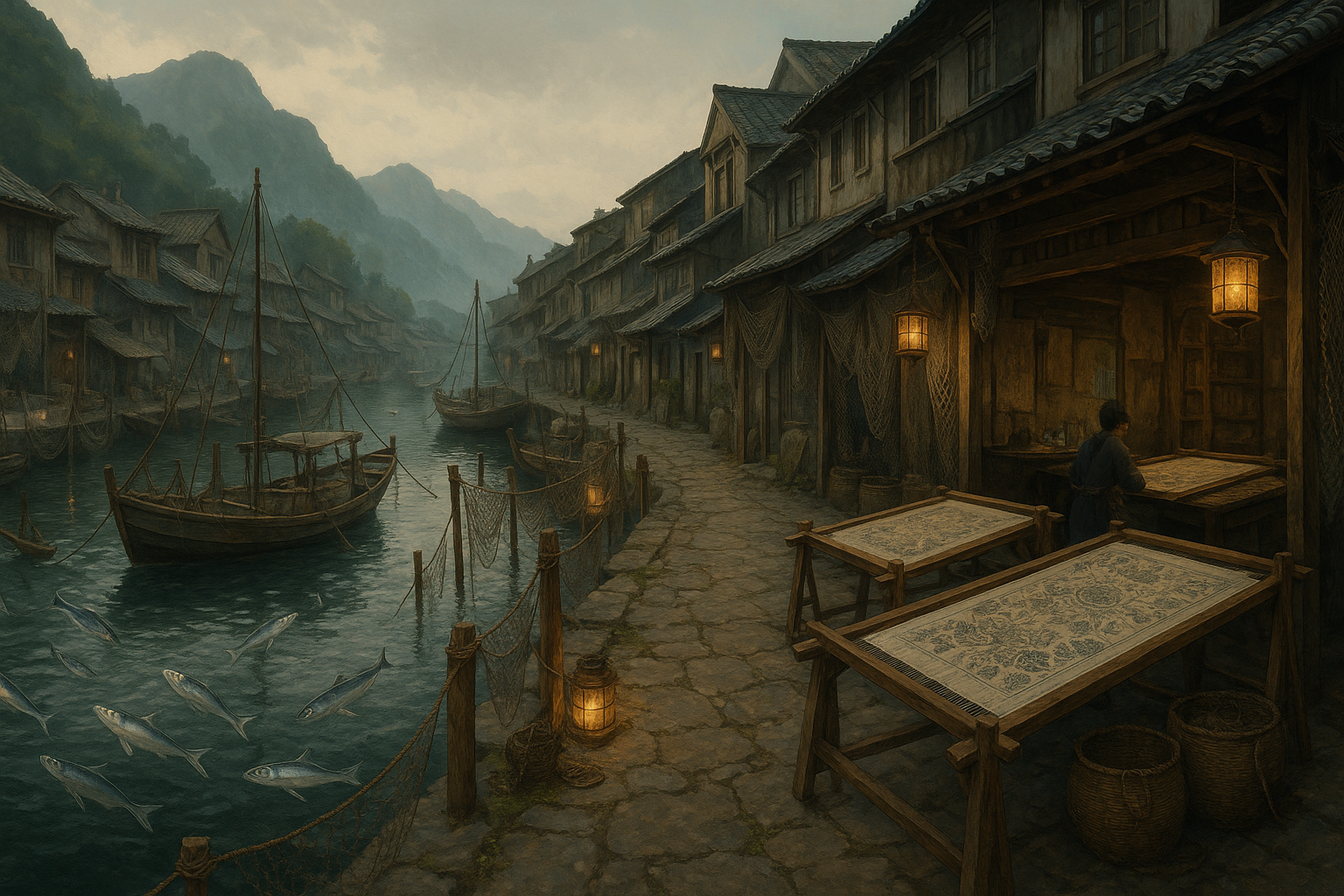
The Gozier Inlet is narrow at its mouth, wide in the middle, and flanked by tidal flats that are muddy at low water and submerged at high. Galshi sits on the inner western shore where the ground is firm enough to build on, looking across the inlet's broadest section toward the forested eastern cliff. Water here has a specific color (gray-green, not the blue of the open coast), and it moves differently from the sea: pulling when the sea is calm, surging when the tides engage.
The first thing a visitor sees from the water is the cloth. Weaving and embroidery workshops face outward to catch the light, and the finished pieces hung out for examination or display are visible from the inlet's center. Colors are specific to Galshi (indigo, ochre, crimson) applied in patterns that visitors from other textile regions recognize as technically demanding without always being able to articulate what makes them difficult.
The second thing is the boats. Galshi's fishing fleet is small by coastal standards (perhaps thirty working vessels), but they are well-maintained and designed specifically for the inlet's tidal conditions. Felair fishermen who run the most challenging tidal passages handle the smaller boats in the inlet's narrowing with a precision that land-based visitors watch from the dock in visible discomfort.
Thakur Vijay Mehta's family compound is the largest building in the town and the one that demonstrates most clearly where the money in Galshi actually comes from. The embroidery workshop in the compound's east wing employs twenty weavers whose output is sold at prices that do not correspond to the town's otherwise modest scale.
Geography & Setting
The Gozier Inlet is a tidal estuary reaching inland from the southwestern Shoing coast. It is navigable for vessels of modest draft but requires knowledge of its tidal patterns: the entry channel shifts with the seasons, the tidal flats extend unpredictably after storms, and the central deepwater channel is not always where it appears on a first reading of the water surface.
The land surrounding the inner inlet is a mix of tidal flat, damp low ground, and the firmer elevated areas where the town and its agricultural margin exist. Elevated ground to the west produces the specific mulberry variety whose leaves feed the inlet silkworms: a smaller, slower-maturing silkworm than the Shoing mainland species, whose thread is finer and whose production cycle is tied to the inlet's moisture levels. The embroidery tradition grew from the silk supply; the silk quality came from the inlet's specific ecology.
The Silver Run, the seasonal movement of a specific silver-scaled fish through the inlet in the spring months, is the most significant annual event in the fishing calendar. Fish enter from the sea, move through the inlet's full length, and exit again within approximately three weeks. During this period, the fishing community works continuously, and the preserved product of the Run sustains the town for months afterward.
The People
Demographics
Galshi is predominantly human, with a Felair community that has been present for at least three generations and is thoroughly integrated into the fishing economy. The Felair families handle the most challenging tidal navigation work and are regarded by the human majority with something that combines respect for skill and a slight unease about capabilities that are not fully understood. The integration is real but not unmarked.
Other non-human residents are few: occasional Gnomes in the dyeing trade, a single Dwarf family that has operated the town's forge for sixty years.
Economy
The silk embroidery is the high-value economy. Galshi's needlework reaches noble households across southern Shoing and into export trade, priced at levels that reflect genuine craft scarcity rather than market manipulation. The embroidery patterns are not formally codified; they are passed through the workshops by teaching and practice, which means that the ability to produce authentic Galshi work requires being in Galshi.
The Silver Run fishing is the food economy; the preserved fish sustains the community through leaner seasons and is sold in quantity to towns that don't have access to this specific catch. Year-round tidal fishing supplements this.
The coastal trade route passes Galshi without stopping in most cases, which is a perennial frustration to the town's merchant class and a subject of ongoing advocacy to Thakur Vijay.
Primary Exports
- Galshi embroidered silk: The prestige product; produced in limited quantity; sold to noble houses and wealthy merchant families across southern Shoing
- Silver Run preserved fish: Salted and smoked during the seasonal run; sold across the southwest Shoing region
- Raw silk thread: The inlet silkworm's thread; sold to textile producers who cannot achieve the same weight through other sources
Primary Imports
- Metal goods: The forge produces practical work; fine and specialized metalwork must come from outside
- Grain and provisions: The tidal geography limits local agriculture
- Dye materials: The embroidery's indigo, ochre, and crimson require import sources; the local sources produce only a portion of what the workshops need
Key Industries
- The Mehta Embroidery Workshop: House Mehta's commercial operation; the largest single producer of Galshi needlework
- The Independent Weaving Houses: Several family operations producing silk and embroidery outside the Mehta structure; smaller scale, often more experimental
- The Fishing Guild: An informal collective managing the Silver Run logistics, tidal passage scheduling, and preserved fish production
- The Silkworm Groves: Multiple small family operations maintaining mulberry stands and silkworm cultivation on the western slopes
Food & Drink
Galshi eats fish in the way that inlet towns eat what they catch, not as a preference but as a given. The Silver Run product dominates the preserved food supply. Year-round tidal catches contribute fresh fish to the daily diet. The rice grown on terraced fields above the tidal zone is the grain staple, prepared in the southern Shoing tradition with coconut milk and spices from the inland trade.
The town's most specific culinary tradition is the Silver Run feast: on the final night of the run, the fishing community eats a shared meal of the catch, prepared in a way that differs from the preserved product and that is not served at any other time of year. That recipe is specific to the Felair community's preparation and is, by informal agreement, theirs to make.
Toddy, fermented coconut sap, is the working drink. The better grades are kept for the Thakur's table and for formal hospitality; the everyday grade is freely available and variable in quality depending on who made it.
Culture & Social Life
Galshi lives by the tide's schedule in a way more direct than most coastal towns. The Silver Run determines when the fishing community works around the clock; the tidal pattern determines when the inlet's navigation is possible; the mulberry harvest determines when the silk season opens. The embroidery work, which is indoor and light-dependent rather than tide-dependent, runs in the gaps.
The honor culture of Shoing operates in Galshi at the scale of a small town, which means everyone is aware of every obligation, debt, and slight, and the social consequences of failures of conduct are immediate and communal. Thakur Vijay manages this with more attention to precedent than to personal preference, which is the pragmatic approach for a noble in a community this size.
The Felair community's integration is managed through a specific honor accommodation: the Mehta family formally recognized their contribution to the Silver Run and to the inlet navigation at a public ceremony three generations ago, and this recognition has been renewed by each subsequent Thakur. That ceremony is brief and is not particularly celebrated, but its absence would be felt.
Festivals & Traditions
The Silver Run Opening
On the first night of the Silver Run's arrival, the town halts other work. The fishing community enters the inlet in formation (the Felair pilots in the lead boats, the human crews following), and the first catch is brought back and divided according to a formula that has not changed in living memory. The Thakur receives the first fish of each size category. The rest is community property for that first night.
The Thread Ceremony
When the silkworm cocoons are ready for processing, the silk families bring the first thread of the season to the Thakur's compound and the thread is formally named. This is not a practical ceremony (it takes less than twenty minutes), but it establishes the year's silk as Galshi silk, and the thread naming is referenced in the sales documentation for export. It is, in commercial terms, a provenance ceremony.
Music & Arts
The embroidery is the art. Galshi's needlework is not decorative supplement to a textile tradition; it is the tradition. The patterns hold specific meaning in southern Shoing heraldic and narrative conventions, and the weavers who execute them are not simply skilled with a needle; they know what they are making and what it means.
Music is communal and tied to work. The Silver Run has its own repertoire of working songs, call-and-response forms that coordinate the fishing crews. The Felair community maintains their own musical tradition that has influenced the human community to a degree that neither group discusses with particular awareness.
Religion
Primary Faith
Galshi remains animist at the root: inlet spirits, seasonal fish runs, and the household dead treated as present participants in community life.
Secondary / Minority Faiths
Where the animist practice is formalized, it is explicitly under Shen-Li: shrines, lineage records, and the keeping of names are civic infrastructure. Ryujin is honored by fishers and ship captains. Talbar anchors the port's contracts and fleet provisioning. Caminus is strong among needleworkers and shipwrights. Bridhel is present in performance culture and the movement of water and people.
Secret or Forbidden Worship
Shinigami is the real death authority when the sea returns bodies late or rumors of undeath surface in the harbor slums.
History
Founding
Galshi grew from a fishing camp at the inlet's best tidal anchorage. The silk tradition was a later development; a weaving family from inland Shoing who arrived seeking a quieter location recognized the inlet silkworm's quality and established the first mulberry grove. The two economies coexisted without formal connection for a generation before the embroidery tradition began to integrate silk with the fishing community's patience for intricate work.
Key Events
The Felair Compact (approx. 90 years ago)
The Felair fishing families arrived from further south along the coast and negotiated their settlement with the previous Thakur. The terms gave them specific rights over the inlet's primary navigation channel in exchange for piloting services during the Silver Run. The compact has held through three generations of governance and three renegotiations. The current version grants slightly more autonomy than the original.
The Honor Debt (approx. 30 years ago)
Thakur Vijay's father arranged his son's marriage to Rekha of the Sharma family, a more prestigious house than the Mehtas in the regional hierarchy. The marriage was politically useful; the implied obligations were not fully articulated. Thirty years later, those obligations are a recurring presence in the Thakur's relationship with his wife's family.
The Embroidery Recognition (approx. 15 years ago)
A pattern created by Padma Krishnan's predecessor, a specific arrangement of the traditional ochre and indigo forms, was replicated by a workshop in a larger southern Shoing city without attribution. The case went to the regional noble authority, which ruled in Galshi's favor and established the thread naming ceremony as formal provenance documentation. The ruling is still cited in textile trade disputes across the region.
Current State
Galshi is stable and quietly aware of its own value. The embroidery trade sustains the town at a level that its population size would not suggest, and the Silver Run's reliability means the food situation is secure. The principal tension is the Sharma family's ongoing expectations from the Mehta-Sharma marriage connection, expectations that Thakur Vijay cannot entirely refuse and cannot entirely satisfy.
Leadership & Governance
House Mehta: Overview
The Mehtas have governed Galshi for four generations through a combination of commercial dominance and the traditional minor noble structure of southern Shoing. The Thakur sets water access rules, adjudicates disputes under Shoing's honor code, manages relations with the regional Raja, and runs the family embroidery operation as a commercial enterprise. These roles are entangled and treated as a single thing.
Thakur Vijay Mehta
Human, Male; fifties
Vijay is a careful man who has spent three decades navigating the specific difficulty of governing a small town where everyone knows everyone's business and where the honor obligations are correspondingly personal. He is not brilliant but he is thorough, and his decisions (once made, which takes longer than some people prefer) tend to hold. His primary external problem is the Sharma family's expectations. His primary internal problem is that he has no son and his daughter Ananya is the one with his instincts, and the question of how to position her for succession in a culture that has expectations about this is one he is actively working.
Thakurani Rekha Mehta
Human, Female; fifties
Rekha came from a more prominent family and has not forgotten it, but she has also genuinely made Galshi her home, which puts her in the uncomfortable position of representing both sides of the Sharma-Mehta relationship. She manages the household, the weaving workshop's social side (the commercial side is the Thakur's formally), and the diplomatic interactions with her family with a competence that masks how much effort it requires. Her relationship with her husband is functional and occasionally genuinely warm; her relationship with her family is complicated.
Notable Figures
Padma Krishnan: Master Embroiderer
Human, Female; seventies; the Krishnan family workshop
Padma has been producing Galshi embroidery for fifty years and has trained more working weavers than anyone else in the town's history. She is the person whose opinion on whether a piece of embroidery is genuinely Galshi or merely good carries institutional weight. She has declined to be formally employed by the Mehta workshop on three occasions, on the grounds that independence protects the standard from being commercially expedient.
Rajan: Felair Lead Pilot
Felair, Male; age uncertain, appears middle-aged; the fishing dock
Rajan has been piloting vessels through the Gozier Inlet's primary channel for twenty years and knows the tidal patterns with the specificity of someone who has watched them fail in every possible way. He is not the official leader of the Felair community (they don't organize that way), but he is the person the Thakur deals with on community matters because he is available and because he speaks Shoing's common trade tongue without the accent that the older generation maintains.
Ananya Mehta: Thakur's Daughter
Human, Female; twenties; the Mehta compound
Ananya has her father's patience and her mother's awareness of the family's social position, and she is sharper than either of them in several respects that they are aware of. She manages the Mehta workshop's export documentation and has quietly established relationships with buyers in three cities that the previous export agent had not maintained. The Thakur has told her nothing formally about succession; he has been quietly arranging things for two years.
Dhruv the Blind: Tide Reader
Human, Male; seventies; the dock
Dhruv lost his sight thirty years ago and developed compensatory perceptions of the inlet's tidal patterns that are, by the community's consensus, more reliable than any other method available. He doesn't explain his methods and doesn't need to; when Dhruv says the Run is coming in three days, the community prepares. When he says the channel has shifted, the pilots change their approach. His legitimacy is empirical.
Key Locations
Seat of Power
- The Mehta Compound: The Thakur's residence, administrative center, and the primary embroidery workshop; the largest structure in the town, built in successive additions over four generations; the workshop wing faces east for morning light
Houses of Worship
- The Inlet Offering Site: Not a building; a specific rock formation at the water's edge where tide-turn offerings are left; the oldest continuously used location in the town
- The Caminus Shrine: Maintained in the weaving quarter; practical in intent
Inns & Taverns
- The Run House: The principal inn; positioned near the dock for obvious reasons during the Silver Run; run by a family that has been feeding fishing crews for two generations
- The Western Slope Inn: Smaller, quieter, used by the embroidery trade's buyers when they visit; has a private consultation room that Ananya Mehta uses for export meetings
Shops & Services
- The Krishnan Workshop: Padma Krishnan's independent operation; viewing by appointment; the standard for authentic Galshi embroidery
- The Mehta Workshop: Larger output, slightly lower prestige; the Thakur's commercial operation
- The Forge: The Dwarf family's operation; practical metalwork, adequate to the town's needs
The Market
- The Inlet Market: Open on the days between tidal work; divided between fish products (dominant), silk and textile goods, and the agricultural produce from the western slopes. Expands significantly during the Silver Run weeks when buyers from outside town arrive.
Other Points of Interest
- The Tidal Flats at Low Water: The inlet's flats at low tide expose a landscape that is, depending on one's tolerance for mud and strange smell, either remarkable or unappealing; the flat species include mollusks and crabs specific to the inlet that the Felair community harvests
- The Mulberry Groves: The western slopes above the town; the silkworm cultivation is visible in the appropriate season; the trees are maintained with care that reflects their economic importance
Secrets, Rumors & Hooks
- Dhruv the Blind's tide-reading ability is not purely perceptual adaptation. He encountered something in the inlet the night he lost his sight (something he has never described), and the knowledge that allows him to read the water is connected to that encounter in ways he has not disclosed to anyone. He is not certain whether whatever he encountered is still present.
- Ananya Mehta's export relationships include one buyer who is acquiring Galshi embroidery in quantities that exceed any decorative use; the patterns being purchased are specifically the older heraldic forms. Ananya has not asked why. She has started wondering.
- The Sharma family's expectations from the Mehta-Sharma marriage include a specific obligation that Rekha's brother made clear five years ago and that Vijay cannot fulfill without significant political cost: providing navigation information about the Gozier Inlet to a regional military authority for purposes that are not explained. Vijay has been delaying. The deadline, which was informal, is becoming less informal.
- A Felair child found something in the tidal flats three months ago and brought it to Rajan. Rajan identified it as older than the inlet's human settlement history and brought it to Dhruv. Dhruv recognized it, became very quiet, and asked Rajan to put it back exactly where it was found. Rajan did. Neither has mentioned this to anyone outside the community.