Gwajin
Gwajin: The City That Shoing Built
"Gwajin is not eastern Shoing. Gwajin is Shoing. The distinction matters."
Grand Duke Haruo Tessawa, to a foreign ambassador who had asked about the realm's provincial structure
At a Glance
| Continent | Shoing |
| Region / Province | Central-eastern Shoing, Gwajin Realm: Gulf of Siem coast, Altai-Tienshaw foothill valley |
| Settlement Type | City (capital) |
| Population | ~1,000,000 |
| Dominant Races | Human (dominant majority), Elf, Dwarf, Half-Elf, Smaling, most other races represented |
| Ruler / Leader | Grand Duke Haruo Tessawa |
| Ruling Body | House Tessawa, hereditary Grand Duchy; the Gwajin Realm's full administrative apparatus (ministries, courts, military commands, colonial administrations) operates from the city |
| Primary Deity | Ryujin (patron of the sea, rivers, and rulership by divine right) |
| Economy | Imperial trade and taxation, maritime commerce, silk and ceramic manufacturing, court arts and crafts, military production |
| Known For | The largest city in Shoing; the seat of the Gwajin Realm's political and commercial power; the court whose aesthetic standards define what "refined" means across eastern Shoing; the navy that controls the Gulf of Siem and the Banda Bay approach |
First Impressions
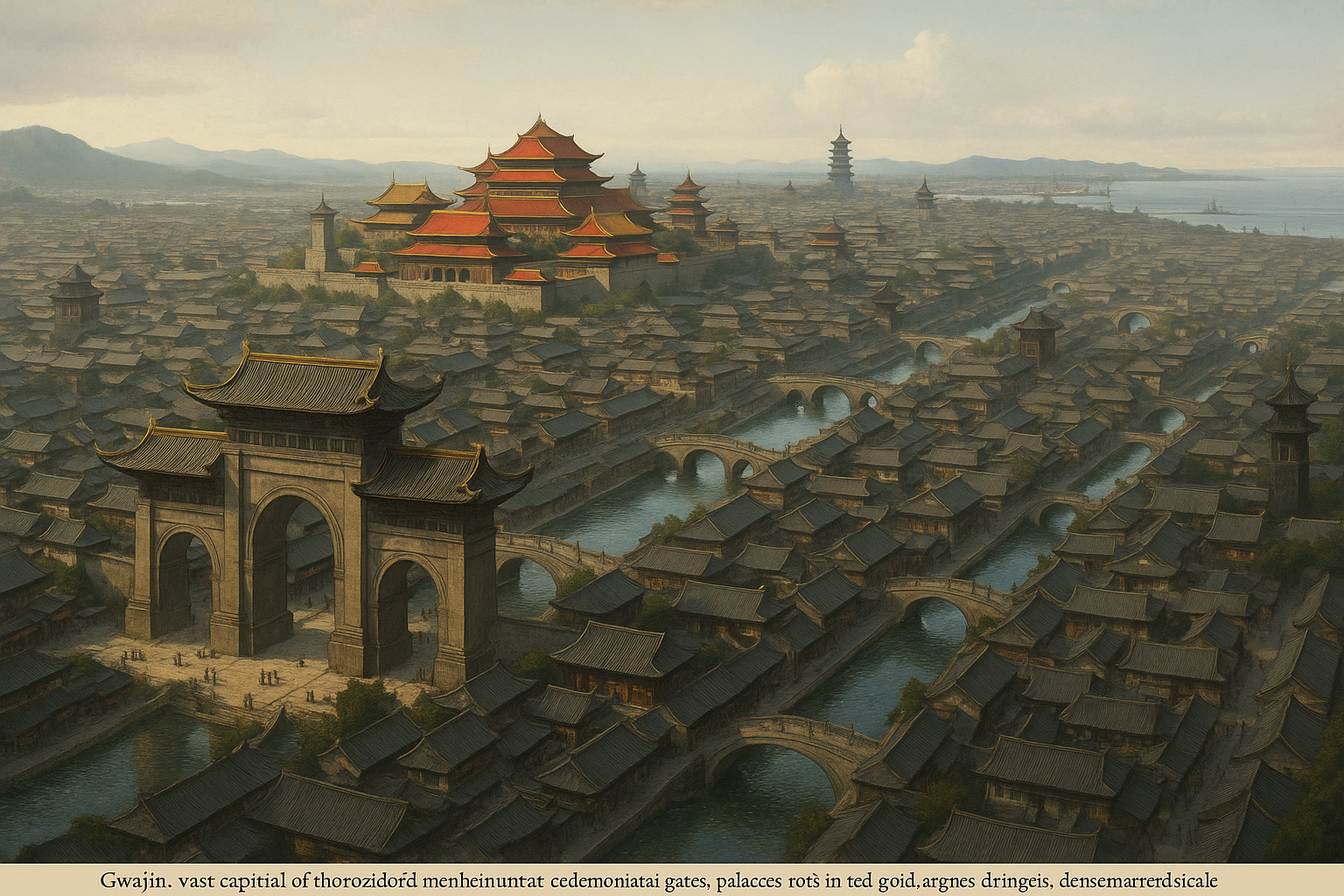
Gwajin arrives before it is reached. The ships in the harbor are visible twenty miles offshore; the Grand Fleet's mooring is the largest anchorage in Shoing, and the merchant vessels that crowd the outer roads add to the silhouette. Closer in, the city resolves from an abstraction of towers and walls into something more specific: a tiered settlement built up the foothills between two mountain spurs, with the harbor district at the base and the Tessawa Palace at the summit, and between them a density of streets, districts, and populations that no other Shoing settlement approaches.
The harbor district is commerce incarnate: the largest covered market in Shoing, the most significant customs house in the eastern sphere, the warehousing that handles the Banda Bay trade. The middle city is manufacturing and residential, organized into recognized districts by trade and by origin population. The upper city is administrative and cultural: the ministries, the court institutions, the academies, and the Palace.
The smell of the harbor is fish, salt, lacquer, and smoke from the ceramic kilns. The sound is permanent, comprehensive, and not reducible to a single source. Residents navigate by district-sound as much as by visual landmark: the harbor bells, the silk district looms, the metalwork guild hammers, and the ceramic district's kiln-management activity each have specific acoustic signatures that people who live here parse without thinking.
Geography & Setting
Gwajin occupies a coastal position at the Gulf of Siem's inner shore, where a natural harbor is formed by two promontories of the Altai-Tienshaw foothill system that descend to the water. The harbor is the most significant natural port on the Gulf: deep enough for the largest vessels, sheltered from the prevalent storms by the promontory configuration, and connected to the river system that runs from the highland interior.
Gwajin has grown into the foothill terrain in all available directions. The flat harbor area was the original settlement; the terraced middle city and the upper administrative districts are centuries of expansion into the slope. Two mountain spurs frame the harbor and mark the city's geographic boundaries: the eastern spur holds the Grand Fleet's naval installation and its defensive fortifications; the western spur holds the trade authority's inspection facilities and the outer market complex.
The Gulf of Siem's connection to the Banda Bay gives Gwajin maritime access to the southern coast and the Cracked Sea routes. This geographic position, controlling the approach to both major southern bodies of water, is the physical foundation of the Gwajin Realm's political dominance.
The People
Demographics
Gwajin is the most demographically diverse settlement in Shoing by virtue of its size and position. Human majority is dominant, but the city's role as the realm's commercial and political capital means that every significant non-human community has a presence: Elven merchant families who have been in the city for centuries, Dwarf craft communities in the metalwork and construction districts, Smaling river-trade communities in the harbor district, Half-Elves throughout the court and administrative sectors. The diversity is managed through district organization rather than through integrated neighborhoods; each major community has its recognized district, with the commercial and administrative spaces serving as the integrated zones.
Population of approximately one million is a pre-census estimate based on tax roll and housing survey data. The Grand Duke's administrative census office places the number between 950,000 and 1,100,000 depending on whether the outer districts' seasonal populations are included. Gwajin itself does not have a firm boundary; it grades into satellite settlements on its landward sides that are administratively part of the Gwajin Realm but not technically within the city proper.
Economy
The Gwajin Realm's taxation of its subject settlements is the largest single revenue stream, which flows into the city's administrative apparatus and funds everything the state does. The city itself generates substantial commercial income through the harbor dues, the market tolls, the customs charges on Gulf of Siem trade, and the manufacturing sector's output.
Silk production is the largest manufacturing industry; Gwajin silk is the court standard against which all other Shoing silk is measured, and the manufacturing district's output reaches every significant market in the sphere. Ceramic production is the second largest; court-grade Gwajin ceramics are the luxury good that noble households across Shoing specify. The lacquerwork industry, benefiting from access to the best materials from the eastern sphere including Higatomo's production, produces court-level pieces that the Tessawa household commissions and that foreign buyers actively seek.
Primary Exports
- Silk (court grade): The acknowledged quality standard; exported throughout Shoing and to external trade partners
- Gwajin ceramics: Court-grade porcelain and glazed ware; the luxury good of eastern Shoing
- Realm authority documents: Trade licenses, navigation permits, title certifications; administrative products that generate revenue
- Military production: Weapons, armor, naval equipment; produced at scale for the Realm's forces and sold to subject settlements
Key Industries
- The Harbor Authority: The customs and trade regulation apparatus; funds a significant portion of the city's administrative budget
- The Silk Manufacturing District: Multiple guild organizations managing the city's silk production from raw thread to finished fabric
- The Ceramic District: The kiln operations producing court-grade ceramics; concentrated in the middle city's eastern section
- The Grand Fleet Yards: The naval construction and maintenance facility; the largest shipbuilding operation in eastern Shoing
- The Administrative Ministries: The governmental apparatus that manages the Realm's subject settlements, military forces, and external relationships
Food & Drink
Gwajin eats everything, because everything comes through the harbor. The city's food culture is eastern Shoing's most developed: the court cuisine that the Tessawa household maintains has set the standard for Shoing gastronomy for three generations, and the interpretation of that standard has filtered through the city's population in the way that court influence propagates. The result is a city where ordinary street food is more sophisticated than the formal dining in most other Shoing settlements.
The harbor district's food culture is distinct (the practical, portable preparations that the dock workers and sailors require) and is where the foreign influences are most visible: cooking traditions from the sea trade partners appear in the harbor district's food stalls in forms that the middle city's population occasionally visits for novelty.
Gwajin's tea tradition is the eastern Shoing standard at its most developed. Court tea ceremony protocol has produced a city-wide culture of careful tea preparation that is the most visible daily cultural marker distinguishing Gwajin from western Shoing cities.
Culture & Social Life
Gwajin's culture is eastern Shoing's honor tradition at scale and in its most formalized expression. The Tessawa court's aesthetic and social standards propagate downward through the city's population: the way things look, the way ceremonies are conducted, the way agreements are made are all calibrated against what the court considers correct. This produces a city where social signaling is elaborate, where position is constantly being communicated through the precision of presentation, and where departures from the standard carry specific social weight.
Gwajin's size also produces a complexity that the eastern Shoing honor tradition's simpler formulations cannot fully contain. Harbor district populations are not fully subject to the court's standards; the foreign merchant communities are subject to different norms by negotiated arrangement; the manufacturing districts have their own honor cultures built around craft standards rather than social rank. Gwajin is, in this sense, several cultures operating in proximate zones rather than one unified culture.
Festivals & Traditions
The Ryujin Sea Ceremony
Conducted at the harbor on the annual date commemorating the Tessawa family's founding legend (a sea-deity appearance that granted the ancestor the right to rule the Gulf approaches), the Ryujin Sea Ceremony is the city's most significant public event. The Grand Duke leads the procession to the harbor's ceremonial pier, a formal offering is made to the sea, and the Grand Fleet performs a formation display. The ceremony is attended by the full court, the ministry leadership, the subject settlement ambassadors, and the general public.
The Court Examination
Twice yearly, the Gwajin Realm's civil examination system produces its results. The examination, open to any subject of the Realm who can demonstrate literacy and reach Gwajin, selects candidates for the administrative ministry positions. The results announcement is a significant public event, and the top performers' names are posted publicly for a month.
Music & Arts
Gwajin's arts tradition is eastern Shoing's most developed. The court's patronage of music, visual arts, calligraphy, poetry, and theatrical forms has produced specialist communities in each discipline that set the standard for the sphere. The court calligraphers specify Higatomo ink by name; this is the relationship that made Higatomo's ink the acknowledged standard. The court lacquerwork collection is the most significant in Shoing. The court music tradition has produced the formal composition style that other eastern Shoing cities perform in imitation.
The city's popular arts (the street theater, the harbor-district music, the commercial visual arts) are separately developed and more varied and sometimes more interesting than the court tradition.
Religion
Primary Faith
Ryujin remains the Realm's legitimacy: sea, rivers, and rulership by divine right. The Grand Temple is both theology and statecraft.
Secondary / Minority Faiths
Gwajin's scale sustains everything. Talbar is the harbor's second religion - contracts, tariffs, and the sacredness of exchange. Vessikar is honored in the customs weighhouses and the Grand Harbor Market where honest measures are the difference between order and riot. Themela is embedded in the courts and ministry archives. Zopha thrives in scholarship, examination preparation, and the libraries that make administration possible. Caminus is honored by guilds, shipyards, and court crafts. Shen-Li is ubiquitous in household ancestor halls and in the court's genealogical bureaucracy. Sylira is effectively unavoidable in a city of ministries, districts, and court factions; reputation and rumor move faster than official proclamations. Hista has fashionable shrines in bathhouses and silk-district salons where beauty is political. Tixa is beloved by street theater troupes and quietly by satirists who like to remind the powerful that refinement is also performance. Shinigami is the primary death authority in Shoing and maintains multiple grave-houses and consecration orders. Salvius and Morbina both have strong medical presence: healers for cure, scholars for understanding, especially after outbreaks.
Secret or Forbidden Worship
Gormandus is never truly secret in a capital; he is merely private - feasting cults in noble dining rooms. Mamaxa exists in discreet circles where power and shame are traded.
History
Founding
Gwajin's founding is dated to the Tessawa family's assumption of governance approximately four hundred years ago, though the settlement predates this by a significant period. The harbor was in use before the Tessawa ancestor established control, and the city that existed then was already a significant trade hub. The Tessawa transformation was political (the consolidation of the Gulf of Siem approaches under single authority) rather than demographic.
Key Events
The Gulf Consolidation (approx. 380 years ago)
The series of political and military actions by which the Tessawa family established control over the Gulf of Siem's navigation and the Banda Bay approaches. The consolidation required approximately twenty years and produced the political framework (the Gwajin Realm) that has governed eastern and central Shoing since.
The Court Examination System (approx. 200 years ago)
The establishment of the civil examination as the primary mechanism for administrative ministry staffing. The examination replaced the previous patronage system and significantly improved the administrative quality of the Realm's governance. It also produced a new social category (the examination-qualified administrator) that has been one of the most powerful forces for social mobility in eastern Shoing since.
The Banda Bay Treaty (approx. 100 years ago)
The formalization of the Gwajin Realm's authority over Banda Bay navigation, concluded with the southern coastal settlements that were operating in the Bay's approaches. The treaty established the navigation fee structure and the Realm's responsibility for piracy suppression that has defined the Bay's commercial conditions since.
The Grand Fleet Expansion (approx. 40 years ago)
The doubling of the Grand Fleet's capital vessel count under the current Duke's father. The expansion was justified by increasing piracy in the Cracked Sea approaches and completed over twelve years. It significantly increased the Realm's naval projection capability and has implications for the political balance with the Zazua Cracked Sea League that neither party has yet formally addressed.
Current State
Gwajin is at the peak of the Gwajin Realm's power and in the early stages of the administrative challenges that peak power produces. The realm is prosperous, the fleet is strong, and the examination system produces good administrators. The current tensions are: the Karubo Highlands trade negotiation (which the Duke has sent a senior diplomat to manage and which is proving more resistant than expected); the Cracked Sea League's political position (which the fleet expansion complicates); and within the city, a succession debate about the interpretation of the examination system's scope that has been simmering in the ministry for a decade.
Leadership & Governance
House Tessawa: Overview
The Tessawa family holds the Grand Duchy by hereditary claim and by the Ryujin theological framework that sanctifies their rulership. The governance apparatus is the most complex in Shoing: five ministries, a military command structure, provincial governors for each subject settlement sphere, a naval command, and the court administration that manages the family's own affairs. The Grand Duke governs through this apparatus rather than directly, which means that the quality of the apparatus (and the quality of the relationships between its components) significantly determines the quality of the governance.
Grand Duke Haruo Tessawa
Human, Male; sixties
Haruo has been Grand Duke for thirty years and has governed effectively enough that the Realm's power has increased substantially during his tenure. He is a skilled political operator in the specific sense of managing large organizational systems and the personal relationships within them. He is less effective at strategic vision: the Grand Fleet expansion, which was his father's project, has created political dynamics that Haruo has not fully addressed, and the Cracked Sea League situation has been managed reactively rather than proactively.
He has two daughters; the elder, Sora, is the expected successor and manages the Ministry of Commerce as her preparation. The younger, Miko, is the court's most respected calligrapher and has been systematically excluded from the succession preparation by her own choice, a decision that the court finds both admirable and slightly implausible.
Minister-General Oto Daimaru: First Ministry
Human, Male; fifties; the Ministry of Governance
Oto manages the Realm's administrative apparatus: the provincial governors, the examination system's administration, and the internal coordination between the ministries. He is the most powerful non-family figure in the Gwajin Realm's administrative structure and has held the position for fifteen years. He is also the figure at the center of the ministry debate about examination scope, specifically about whether examination-qualified administrators should have authority over military appointments, which the military command regards as an existential challenge.
Notable Figures
Commander-Admiral Yena Sato: Grand Fleet Command
Human, Female; fifties; the Naval Installation
Yena commands the Grand Fleet and is the person responsible for the naval expression of the Realm's authority over the Gulf of Siem and Banda Bay. She is effective at the naval military function and politically aware enough to have formed her own assessment of the Cracked Sea League situation, which differs from the Grand Duke's assessment in ways she has not yet expressed formally.
Sora Tessawa: Ministry of Commerce Director
Human, Female; thirties; Ministry of Commerce
Sora manages the Realm's commercial policy and the harbor authority's governance. She is preparing for the succession by demonstrating administrative competence, which she has in abundance, and by building the personal relationships with the ministry heads and the provincial governors that she will need when she takes the Grand Duchy. She is also the figure who commissioned the analysis of the Zazua Third Finger channel situation; the Realm's intelligence about Zazua's harbor future is more current than the Zazua administration knows.
High Priest Rei Makino: Ryujin Grand Temple
Human, Male; seventies; the Grand Temple
Rei has administered the Ryujin Grand Temple for thirty years and has managed the theological-political relationship with the Tessawa household through three leadership transitions. He is the most politically experienced religious figure in Shoing and the person whose interpretation of the Ryujin divine mandate for Tessawa rulership is the theological foundation of the Realm's legitimacy. He and Haruo have a working relationship built on mutual understanding of what each requires from the other and sustained by a carefully maintained ambiguity about which of them holds the higher authority.
Master Examiner Hana Orita: Civil Examination System
Human, Female; forties; the Ministry of Governance
Hana administers the biannual civil examination and is the person whose assessment of candidates' results is authoritative. She is the practical center of the examination system that the ministry debate is nominally about; in practice, she has been operating the examination with a scope interpretation that supports Oto Daimaru's position, and she is aware that this alignment has political implications she has not been fully transparent about.
Key Locations
Seat of Power
- The Tessawa Palace: At the summit of the upper city; the Grand Duke's residence, the court's formal spaces, the central administrative offices, and the Ryujin household shrine; visible from throughout the city and from the harbor approaches
Houses of Worship
- The Ryujin Grand Temple: In the upper city below the Palace; the most significant religious structure in eastern Shoing; the sea ceremony's destination; administered by Rei Makino's priesthood
- The Talbar Harbor Temple: In the harbor district; the most commercially significant religious institution in the city; its membership includes most of the harbor authority's major commercial participants
Inns & Taverns
- The Tessawa Welcome Houses: The court-adjacent accommodation for visiting nobles and foreign ambassadors; maintained to court standards; guests are the Grand Duke's responsibility while present
- The Harbor Quarter Inns: Multiple commercial accommodations in the harbor district; varying quality; the best are comparable to provincial noble residences; the worst are functional
Shops & Services
- The Silk District: The manufacturing and retail area where court-grade silk is produced and sold; organized by guild; direct purchase from the guild salesrooms
- The Ceramic District: Similar structure; the kiln operations and their associated salesrooms
- The Harbor Authority: Where navigation permits, customs documentation, and trade licenses are processed; the most practically necessary administrative location for any merchant operating in the Gulf
The Markets
- The Grand Harbor Market: The largest covered market in Shoing; open daily; the most significant commercial space in the eastern sphere
- The Middle City Markets: District-specific daily markets throughout the residential and manufacturing areas; each district's market reflects its population's commercial character
Other Points of Interest
- The Grand Fleet Naval Installation: On the eastern spur; the most significant military facility in Shoing; not accessible to the public; the Fleet's mooring dominates the harbor's eastern view
- The Civil Examination Hall: In the upper city administrative district; open twice yearly for examination; the queue of candidates that forms in the days before examination begins is the most distinctive visual in the city's administrative calendar
- The Foreign Ambassador District: A specific middle-city district where the ambassadors of non-Realm polities maintain their residences; managed by the Ministry of External Relations; the most politically monitored residential area in the city
Secrets, Rumors & Hooks
- The Gwajin Realm's intelligence service, which formally does not exist, has current information about the Zazua Third Finger channel situation that is more specific than what the Zazua administration knows the Realm has. Sora Tessawa commissioned this analysis eighteen months ago as part of a broader assessment of the Cracked Sea League's long-term political viability. The conclusion of the analysis (that Zazua's harbor will become unusable within fifteen years and the League will fracture) has produced a strategic planning document that Sora is using to position the Realm to fill the resulting political vacuum. The document is in Sora's personal office, not in the ministry records.
- Commander-Admiral Yena Sato's assessment of the Cracked Sea League situation, which she has shared with her senior staff but not with the Grand Duke, is that the League's fracture following the Zazua harbor situation will not produce a power vacuum that the Realm can fill cleanly. It will produce a piracy surge, a refugee movement, and a political competition between the Realm and at least two other powers that are watching the same situation. She believes the Realm needs to engage with the League proactively rather than waiting for the fracture. She is trying to determine how to present this to Haruo without triggering the defensive response that his current strategic framing produces.
- High Priest Rei Makino has a successor problem. His two senior clergy are both capable administrators and both have fundamental theological disagreements with each other about the interpretation of the Ryujin divine mandate for Tessawa rulership. One interpretation would significantly expand the priesthood's independent authority; the other would consolidate the theological function more firmly within the Tessawa household's control. Rei has been preventing the disagreement from becoming public for seven years. He is seventy and not certain he can prevent it for much longer.
- Miko Tessawa (the younger daughter, the calligrapher) is not as excluded from the succession question as the court believes. She has been systematically building relationships with the examination-qualified administrative class for four years, and the examination-scope debate that is nominally between Oto Daimaru and the military command is, at a deeper level, a proxy contest between two different visions of what kind of authority the next Grand Duke should exercise. Miko's vision is the one that expands examination scope. She is not the next Grand Duke, but she may be the power that determines what the next Grand Duke can do.