Hechi
Hechi: The Town in the Green Dark
"The Luxiang is not a forest you clear. It is a forest you learn. The merchants from Gwajin who arrive expecting to buy timber and leave disappointed are learning this. The ones who arrive asking what the forest has to offer and are willing to wait for the answer are the ones we do business with."
Forestward Emi Nakao, at the annual Gwajin trade commission
At a Glance
| Continent | Shoing |
| Region / Province | Southeast Shoing, Gwajin Realm: interior Luxiang Forest |
| Settlement Type | Town |
| Population | ~3,800 |
| Dominant Races | Human (majority), Wood Elf (significant minority) |
| Ruler / Leader | Forestward Emi Nakao |
| Ruling Body | House Nakao, hereditary Forestwardship under Gwajin Realm authority; the Forestward title reflects the specific function (administration of the Luxiang Forest territory) rather than a standard noble designation |
| Primary Deity | Gramil (ancient trees, old-growth stewardship) |
| Economy | Medicinal herb and compound production, managed forest materials trade, forest-knowledge services, specialist hunting |
| Known For | The most comprehensive medicinal preparation knowledge in Shoing; the Luxiang Forest's specific botanical resources that do not exist outside its canopy; the Wood Elf community that has been in the forest since before the human settlement and whose cooperation determines what the Nakao family can actually do |
First Impressions
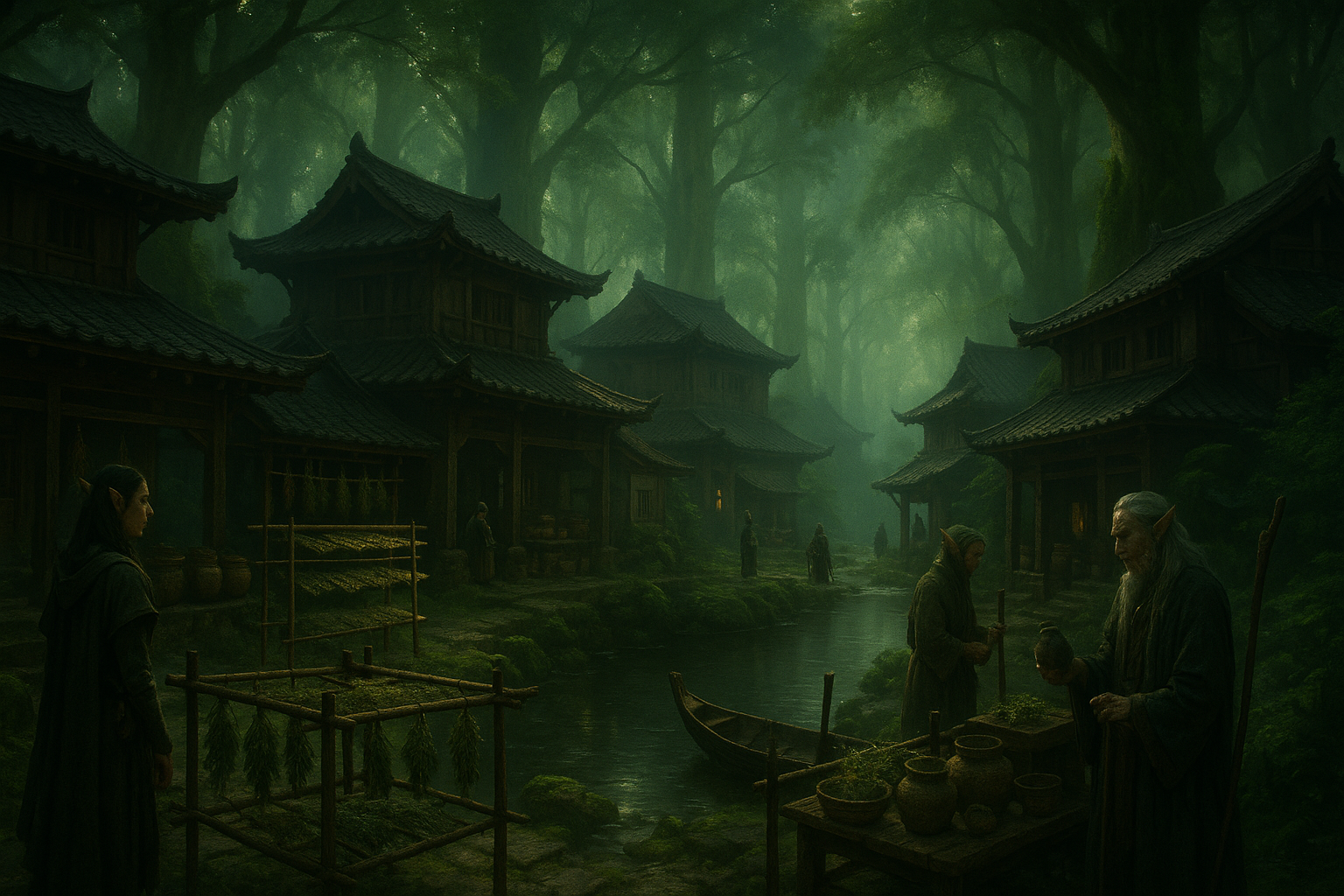
Forest closes over the approach road approximately two miles before the town. This is not unusual for forest settlements, but the Luxiang does it in a specific way. The canopy is dense enough, and old enough, and the understory complex enough, that the transition from the open terrain outside the forest boundary to the interior is dramatic. The light changes. The sound changes. The temperature drops in summer and moderates in winter, because the canopy creates its own microclimate.
Hechi arrives without announcement; there is no clearing large enough to see the settlement from a distance. The first indicator is the smell: the processing operations for the medicinal compounds produce a complex, layered herbal scent that is the most information-rich smell in Shoing, according to people who have thought carefully about this question. Then the sound of the water-mills comes through, the grinding operations that process the dried herbs into compound powders. Then the town itself, built in and around the large-diameter old-growth trees that the settlement has never cleared.
Architecture here is adapted to the canopy. Buildings are built to the canopy height rather than above it; no structure rises higher than the surrounding old-growth trees, by a tradition the Nakao family codified as law two hundred years ago. That result is a town that is effectively invisible from above and from outside the forest and profoundly visible from within it, because the building materials (dark-toned wood, green-glazed ceramic, copper fixtures that have aged to match the forest light) are chosen to be appropriate to the specific environment rather than visible from a distance.
Geography & Setting
Hechi occupies a section of the Luxiang Forest's interior where several small streams converge into a navigable tributary of the broader river system. Those streams power the water-mills that the medicinal processing operations require. Forest floor here is drier than the surrounding lowland Luxiang sections (the stream drainage keeps the soil at a moisture level that the specific botanical resources prefer), and this microecological distinction is why the settlement is here rather than in the wetter sections of the forest.
Forest extends for several days' travel in all directions. Hechi is interior (not a forest-edge settlement but a deep-interior one), and this isolation is both the source of its botanical resources and the defining characteristic of its social situation. The Wood Elf community that has occupied the deeper forest sections for longer than anyone records does not share all of its forest territory with the human settlement, and the Nakao family's administration is partly a function of managing the boundary between human activity and Wood Elf territory.
The People
Demographics
Hechi is predominantly human with a significant Wood Elf minority that exists in a specific relationship with the town: the Wood Elves who are present in the town are the community's designated liaisons rather than integrated residents. The broader Wood Elf population occupies the deeper forest sections and interacts with the human settlement primarily through these liaisons, through the cooperative botanical harvesting arrangements, and through occasional direct contact with the Nakao family.
Human population includes a concentration of practitioners (herbalists, compound-makers, forest guides, and specialists in specific botanical identifications) at a level that other Shoing settlements of comparable size do not approach. This is a community organized around specific knowledge.
Economy
Medicinal preparations are the foundation. The Luxiang Forest's specific botanical resources, plant species that grow only under the Luxiang's canopy conditions and that have the properties the Shoing medical tradition relies on for specific treatments, are the basis of the town's commercial identity. The Nakao family controls the harvesting rights under the Gwajin Realm's administrative framework, and the Wood Elf community's cooperative agreement governs the access to the deeper forest's botanical resources.
Preparations are not raw herbs; the town's processing tradition converts the forest botanicals into compound preparations, tinctures, and dried powders that the Gwajin medical practitioners, the eastern Shoing court physicians, and the broader trade market specify by name. Knowledge required for this processing is the town's most valuable asset.
Primary Exports
- Luxiang medicinal compounds: The core product; compound preparations produced from forest botanicals; specified by Gwajin court physicians and broadly traded
- Dried botanical materials: Raw herb and plant materials for practitioners who prefer to compound their own preparations
- Forest-knowledge services: Guides, botanical identification, ecological consulting; a service trade that the outside world's foresters and herbalists purchase
- Specialty forest materials: Specific resins, barks, and structural materials that the Luxiang produces and that do not appear in other Shoing forests
Key Industries
- The Compound Processing Cooperative: The organized production of medicinal preparations; multiple family operations with shared quality standards administered by the Forestward's office
- The Botanical Survey: The ongoing inventory and monitoring of the forest's resource population; managed by the Wood Elf liaison community jointly with the Nakao family
- The Guide Cooperative: The professional forest navigation service; the Luxiang's interior is navigable safely only with practitioners who know it
Food & Drink
Hechi eats from the forest in ways that are more sophisticated than "foraging" implies. The Luxiang's interior produces specific mushroom varieties, forest fruits, roots, and small game that the town's cooking tradition has been developing preparations for across generations. The results are food that forest-food detractors find too specific and forest-food practitioners find remarkable. The Wood Elf community's cooking influence, present through the liaison relationships, has contributed specific preparation techniques that the human cooking tradition has absorbed and adapted.
Hechi's tea is the most complex in Shoing: the combination of Luxiang botanical varieties available for tea production, and the generations of preparation knowledge, produces blends that the Gwajin court physician community considers medically significant in addition to gastronomically distinguished.
Culture & Social Life
Hechi's culture is the forest. The Nakao family's two-hundred-year tradition of building to the canopy height is the most visible expression of a culture that understands itself as existing within the forest rather than imposed upon it. The practical cooperation with the Wood Elf community has shaped this self-understanding; the human population has learned, over generations, that the forest's ecological complexity requires attention and deference that extraction-focused communities do not give.
Eastern Shoing's honor culture is present but modified by the forest context. Honor here is expressed in part through ecological stewardship: a practitioner who over-harvests a botanical population, or who guides clients to sensitive areas without proper authorization, is disgraced in terms that the general eastern Shoing tradition would recognize as parallel to a military dishonor.
Festivals & Traditions
The Canopy Acknowledgment
Once per year, at the summer solstice when the canopy is at maximum density, the Wood Elf liaison community and the Nakao family jointly conduct a forest acknowledgment ceremony at the oldest tree in the settlement area. The ceremony's specific content is not shared with the broader human population; the Nakao family participates and does not describe it in detail to outsiders.
The Processing Opening
At the beginning of the annual compound processing season, the autumn period when the primary botanical harvest is complete and the processing begins, the Compound Processing Cooperative formally opens the production cycle. Quality standards are reviewed, the year's harvest is assessed, and the production allocation is determined.
Music & Arts
The Wood Elf liaison community's artistic tradition (specifically their musical practice, which involves instruments built from Luxiang wood varieties) has influenced the human community's musical culture in ways that are visible and not easily categorized as either tradition. The result is a local musical form that visitors from outside the forest find distinctive and that the two communities have developed as their most significant shared cultural expression.
Visual arts run to botanical illustration, the documentation of the Luxiang's plant species in forms that the medical tradition uses as reference materials. Work by the best practitioners is art as well as reference document, and the Gwajin medical academy's collection includes several Hechi botanical illustrations displayed as both.
Religion
Primary Faith
Gramil governs Hechi's relationship with the Luxiang Forest: stewardship, patience, and the sacred authority of old growth.
Secondary / Minority Faiths
Salvius is strong among herbalists and compound-makers who treat healing as obligation. Morbina is also present - not as surrender, but as the study of disease and balance in a place that understands poison and cure are neighbors. Household ancestor shrines are maintained with exceptional care, and Shen-Li is invoked in the Wood Elf records that treat history as living presence. Shinigami is present in the forest's death rites, particularly when predators or accidents produce bodies that must be properly ended.
Secret or Forbidden Worship
Some hunters keep private edge-rituals for courage; the forest elders tolerate them until they become cruelty.
History
Founding
The Wood Elf community's presence in the Luxiang Forest predates the human settlement by an unknown period; the elves describe it as continuous with the forest itself, which the human scholars interpret as indicating several thousand years. The human settlement arrived approximately two hundred and fifty years ago as a Gwajin Realm administrative initiative to develop the forest's botanical resources. The initial relationship between the settlers and the Wood Elves was difficult; the formalization of the Nakao family's Forestward role, including the ecological stewardship obligations, was the negotiated resolution that made the settlement viable.
Key Events
The Canopy Law (approx. 200 years ago)
The Nakao family's codification of the building height restriction and the ecological stewardship obligations. The Law's adoption was the formal conclusion of the period of difficulty in the Wood Elf relationship; the elves accepted the human settlement as permanent once the Law was in place.
The Medical Academy Recognition (approx. 80 years ago)
The Gwajin medical academy's formal recognition of Hechi compound preparations as the quality standard for specific categories of treatment. The recognition generated the demand structure that made the town's economy viable and established the Gwajin court physician community's ongoing relationship with the town's practitioners.
The Deep Survey (approx. 20 years ago)
The Wood Elf liaison community's first formal joint survey with the Nakao family of the Luxiang's botanical resource population. The survey produced the comprehensive inventory that the Botanical Survey operation now maintains. It also identified three botanical populations in the deep forest that had not previously been documented in the human medical tradition and whose properties are still being assessed.
Current State
Hechi is stable and productive. The compound preparations are consistently high quality. The Wood Elf relationship is functional. Forestward Emi is in her forties and has managed the liaison relationship effectively for twelve years. The active tension is a Gwajin administrative proposal to expand the harvesting rights into the deep forest sections currently under Wood Elf territorial control, a proposal that Emi believes would end the cooperative relationship and that she has been working to prevent without making her opposition official, because official opposition to a Gwajin Realm administrative proposal requires a more difficult political position than she currently has.
Leadership & Governance
House Nakao: Overview
The Nakao family holds the Forestwardship under Gwajin appointment. The governance is ecological management and commercial facilitation: the harvesting rights, the Wood Elf relationship, the compound quality standards, and the forest navigation authority are all within the Forestward's domain. The administration is less hierarchical than the standard eastern Shoing noble tradition; the nature of the function requires consultation and relationship management rather than directive authority.
Forestward Emi Nakao
Human, Female; mid-forties
Emi has been Forestward for twelve years and has spent them maintaining the Wood Elf relationship that is the practical foundation of everything the town does. She is a skilled botanical practitioner herself (trained in the compound preparation tradition before taking the administrative role), and this technical knowledge gives her credibility with both the human practitioners and the Wood Elf liaisons that a purely administrative background would not. She is managing the harvesting expansion proposal with the specific political skill of someone who understands that losing the Wood Elf relationship would end the town's economic viability and that the Gwajin administrative apparatus does not fully understand this.
Elder Liaison Sera: Wood Elf Community
Wood Elf, Female; appears late twenties, actual age unknown; the forest boundary
Sera is the Wood Elf community's senior liaison to the human settlement, the designated contact for all formal interaction between the communities. She has held this role for approximately thirty years (her community's time sense and the human record-keeping system do not align precisely). Her relationship with Emi Nakao is functional and genuine, which is the most that the inter-community relationship has ever achieved. She is aware of the Gwajin harvesting expansion proposal through sources she has not disclosed, and she is waiting to see how Emi handles it before deciding how the Wood Elf community will respond.
Notable Figures
Master Compounder Hiro Kita: Compound Production Lead
Human, Male; fifties; the processing cooperative
Hiro leads the compound processing cooperative and is the person whose quality assessment the Gwajin medical academy defers to. He trained under the previous generation's master and has been training the next. His specific knowledge of the preparation techniques for the three newly documented botanical species from the Deep Survey is not yet systematized; he is still in the assessment phase.
Forest Guide Sai Wend: Guide Cooperative Lead
Human, Male; thirties; the forest
Sai leads the guide cooperative and manages the forest navigation service for outside visitors. He is the most practically forest-knowledgeable human in the settlement: his routes, which he navigates without conscious thought, would take an outsider weeks to learn. He is also the person who has had the most sustained contact with the deep forest sections that the harvesting expansion would affect and has the clearest view of what that expansion would actually involve.
Key Locations
Seat of Power
- The Nakao Forestward House: Built around a living tree of significant size; the administrative offices and the family's residence are arranged around the tree's base; the Canopy Law is literally present in the building's construction
Houses of Worship
- Gramil's Grove: The oldest section of the settlement area's original canopy; not a building; the two communities' separate practices occur here at different times
Inns & Taverns
- The Understory Inn: The settlement's principal accommodation; built to canopy height like everything else; the tea service is what visitors remember
- The Root: A tavern; the name refers to the Luxiang root spirit that is a local specialty; more common-room than formal establishment
Shops & Services
- The Compound Cooperative Salesroom: Where the medicinal preparations are available; visitors by appointment; quality certification documentation provided with each purchase
- The Guide Cooperative Office: Where forest navigation services are contracted; mandatory for outside visitors going beyond the settlement's immediate perimeter
The Market
- The Forest Market: Held twice monthly; local goods, dried botanicals, forest food products; the Wood Elf liaison community sometimes participates with materials from the deep forest areas
Secrets, Rumors & Hooks
- The three botanical species documented in the Deep Survey and currently being assessed by Hiro Kita include one whose compound properties, if his preliminary assessment is correct, would have significant military applications. He has not reported this to Emi or to the Gwajin medical academy because he is not certain of the assessment and because he understands what happens when a forest resource acquires military interest.
- The Gwajin harvesting expansion proposal was not generated internally. It originated with a specific commercial interest in Gwajin (a medical compound trading house that has been losing market position to Hechi's directly supplied preparation network) and was introduced into the administrative process through a Ministry official who receives a consulting retainer from the trading house. Emi suspects this but has not confirmed the specific official.
- Elder Liaison Sera's awareness of the harvesting expansion proposal through "undisclosed sources" is more specific than her careful phrasing implies. The Wood Elf community has had observers in Gwajin (not spies in the conventional sense; simply community members who live in the human city) for longer than the human settlement in Hechi has existed. The information network is one reason the Wood Elf community's position in the Luxiang has remained stable across significant political changes in the surrounding human territory.
- There is a section of the Luxiang Forest that neither the Wood Elf community nor the human settlement accesses. It is not subject to the territorial boundary that the Canopy Law codifies; it predates the Law. Sera's community refers to it with a term that translates approximately as "the older place." Sai Wend, in seventeen years of forest guide work, has approached its boundary three times and turned back each time without being able to explain exactly why.