Higatomo
Higatomo: The Town Below the Sleeping Mountain
"The dragon has not spoken in forty years. We continue to observe the protocols. Honor does not require that the obligation be reciprocated, only that it be kept."
Baron Takeshi Murano, response to a visiting scholar's question
At a Glance
| Continent | Shoing |
| Region / Province | Eastern Shoing, mountain foothills |
| Settlement Type | Town |
| Population | ~7,300 |
| Dominant Races | Human (majority) |
| Ruler / Leader | Baron Takeshi Murano |
| Ruling Body | House Murano, hereditary governance in the minor noble tradition of eastern Shoing |
| Primary Deity | Multiple (animist traditions tied to the mountain; formal Shoing temple practices secondary) |
| Economy | Lacquerwork, ink and pigment production, mountain herb cultivation, limited mountain-access trade |
| Known For | The finest lacquerwork in eastern Shoing, the ink that Shoing's calligraphers consider the standard, and the dragon Sorath, who sleeps (or something) in the mountain above the town and has not been heard from in forty years |
First Impressions
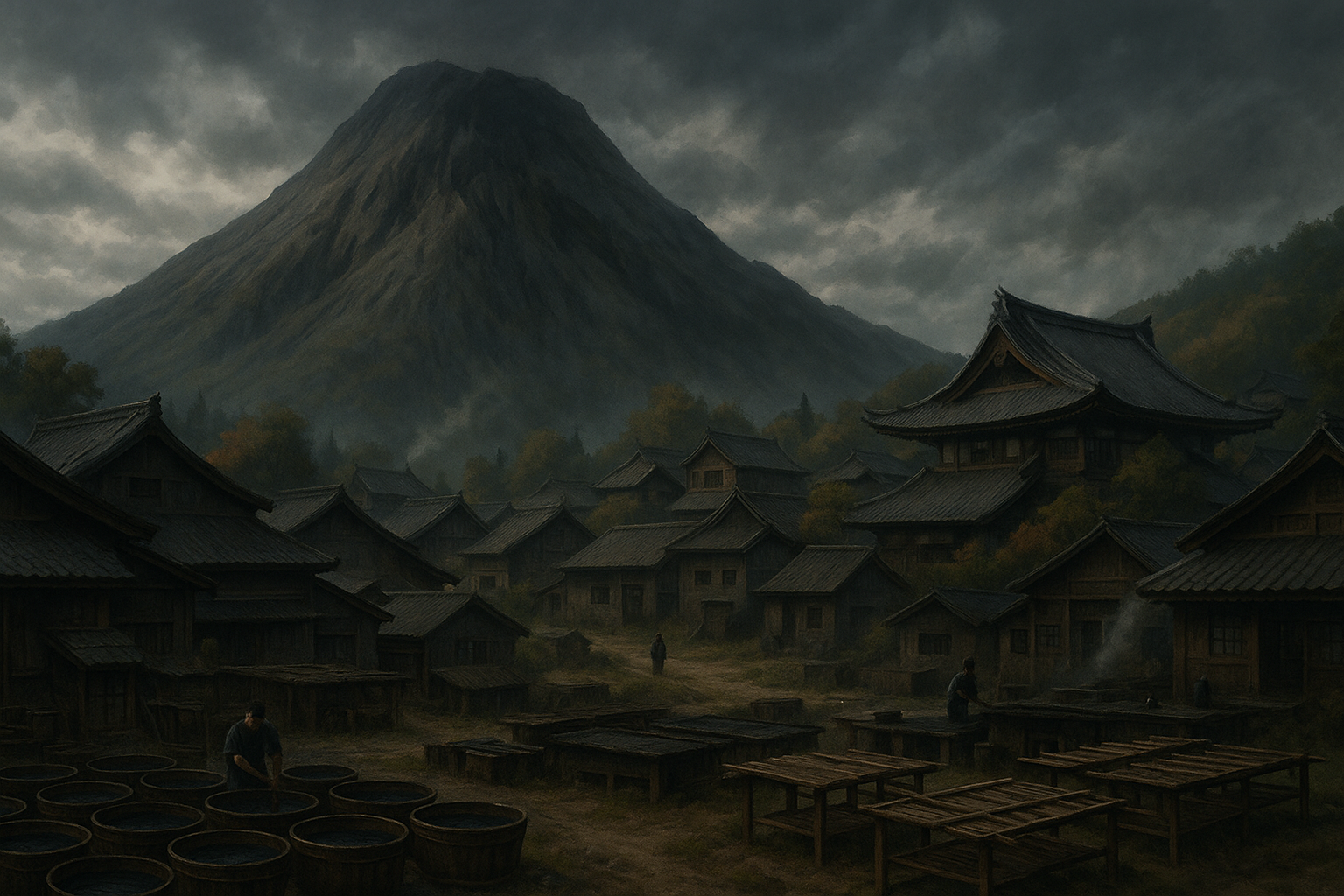
The mountain is visible from everywhere in Higatomo. It is not an active volcano in the current period, but its form, a cone that narrows to a specific point above the treeline, has the geometry of something that was once active and could be again. Higatomo sits on the mountain's lower slopes where the gradient is manageable and the soil, enriched by ancient volcanic minerals, produces the specific lacquer tree and herb varieties that make Higatomo's products what they are.
Architecture reflects a town that has spent centuries considering permanence. Buildings are stone-based with carved timber superstructures, built to endure rather than to impress. Lacquerwork that is the town's commercial signature appears as architectural decoration in the older buildings; the carved wooden elements of the gate district are finished in Higatomo black lacquer and have been for two hundred years. They show no deterioration.
At the center of the town, facing the mountain, is the Murano compound's outer wall. That wall is higher than defensive necessity requires. Its gate opens toward the mountain directly, which the town's feng shui tradition holds as either significant respect or significant risk, depending on the generation and the current state of the dragon's silence.
The mountain itself has a specific smell on certain wind directions: sulfur, faintly, and something else that the residents call the mountain-smell and do not further describe.
Geography & Setting
Higatomo occupies a terraced position on the mountain's western lower slopes, where the gradient produces a stepped topography that the town has built into rather than against. Lacquer tree groves are on the steeper sections above the residential areas; the herb cultivation is on the broader lower terraces. Higatomo's water comes from mountain springs that are cold, very clean, and specific in their mineral content, relevant to the ink production, which requires particular water chemistry.
The forest above the lacquer grove zone is the mountain's own: not managed, not harvested, treated as the dragon's territory regardless of whether the dragon is currently demonstrating territorial behavior. This has been the policy since the Murano family's first ancestor negotiated with Sorath, and it has not changed despite the silence.
The eastern Shoing geography beyond the mountain is broader plateau country with other towns and the connections to the regional noble structure above the Baron's level. Higatomo is not isolated, but it is aware of its distinctiveness.
The People
Demographics
Higatomo is predominantly human, with a smaller proportion of non-human residents than most eastern Shoing towns of comparable size. This is in part a function of the mountain: the sense that living below the mountain requires a specific relationship with it that is built through generations, which makes the community somewhat resistant to rapid demographic change. The handful of Elven and Dwarf families present have been there long enough to be considered local.
Population is technically stable but has a quiet emigration pattern: the young people who leave Higatomo tend to not come back, and the town's population has been declining very slowly for three generations. Its Baron is aware of this and has not found a satisfactory response.
Economy
Lacquerwork is the foundation. The specific lacquer tree variety found on the mountain slopes produces a resin with properties (finish depth, hardness, resistance to heat) that the mainland Shoing varieties do not fully replicate. The workshops of Higatomo have been perfecting the application techniques for this resin for centuries, and the result is a product recognized across eastern Shoing as the standard against which other lacquerwork is measured.
Ink production is the secondary industry, using a combination of the mountain's mineral spring water and specific plant materials from the herb cultivation areas. The ink's color, a blue-black that does not fade even in sunlight, is the characteristic that distinguishes it. Shoing's court calligraphers specify Higatomo ink, which is the most effective endorsement the product could have.
Primary Exports
- Higatomo lacquerwork: Decorative and functional objects; recognized quality standard across eastern Shoing; sold to noble households and commercial buyers
- Higatomo ink: The blue-black that court calligraphers prefer; exported to the major cities
- Mountain herbs: Dried and processed; both medicinal and culinary markets
Primary Imports
- Metal goods: No significant smithing tradition
- Grain and food staples: The mountain terraces produce specialty products but not sufficient food volume
- Trade goods from the plateau: General commercial goods unavailable from local production
Key Industries
- The Murano Lacquer Workshops: The family's direct commercial operation; sets the standard; employs the master craftspeople
- The Independent Lacquer Houses: Several family operations that work with the Murano standard but are not owned by the Murano family
- The Ink Guild: A collective of producers who maintain the formula and water-source access jointly; four families
- The Herb Cooperative: Manages the mountain herb cultivation areas
Food & Drink
Higatomo eats in the eastern Shoing tradition: rice, noodles, mountain vegetables prepared with careful spicing, river fish from the cold streams above the town that are cleaner than anything available at lower elevations. The mountain herb cultivation produces flavors that appear in the cooking and are specific to this altitude. The preserved forms (dried, fermented, pickled) are used with the care that concentrated flavor requires.
Tea is made from the mountain spring water, which produces a specific extraction quality. This is a known fact among tea specialists across eastern Shoing and is a minor but consistent point of local pride.
The ritual meal served at the base of the mountain on the anniversary of Sorath's first silence is simple by deliberate choice, the same dishes that the Murano ancestor ate during the original negotiations with the dragon. Whether this is ceremony or superstition is a distinction that the current Baron has decided not to pursue.
Culture & Social Life
Higatomo's culture is the product of the mountain and the dragon: not in a constant, overwhelming sense, but as a persistent presence that has shaped the community's relationship with patience, obligation, and what it means to maintain a commitment that the other party is not currently confirming. The honor culture of Shoing is present in its full form here, but the specific emphasis is on obligations that persist without reassurance.
The lacquerwork tradition carries cultural weight beyond its commercial value. Patience required by the craft (multiple application layers, long drying periods, the exacting preparation) is understood by the community as a form of discipline analogous to the mountain relationship. This is not an analogy that the craftspeople themselves necessarily articulate. It is simply the air.
Festivals & Traditions
The Mountain Offering
Each year, on the anniversary of the date when Sorath last communicated with the Murano family, an offering is prepared and carried to the established point below the forest line where the dragon's territory begins. The offering is left. Whether anything receives it is not publicly discussed. The ceremony has been performed continuously for forty years without visible effect and will continue.
The Lacquer Opening
When the lacquer season begins, the specific month when the resin harvest is at optimal quality, the workshops formally open their production cycle. The first resin of the season is brought to the Murano compound for the family's quality assessment. This is commercial (the family maintains the standard) and ceremonial (the tradition predates the current commercial structure). The opening has not been delayed in two hundred years.
Music & Arts
The lacquerwork is the art. Higatomo produces functional objects (trays, boxes, furniture elements), but the best work in the town is art in the full sense: pieces that are acquired by collectors, displayed in courts, and described in scholarly literature. The Murano workshops produce pieces annually that are auctioned to the highest bidder from among the noble houses of eastern Shoing.
Calligraphic tradition is strong; ink production and calligraphic practice are related disciplines, and Higatomo has a concentration of skilled calligraphers that exceeds what its population size would suggest. Mountain subjects appear consistently in both the lacquerwork and the calligraphic compositions.
Religion
Primary Faith
Higatomo's public religion is mountain-animist: the sleeping mountain treated as a presence with will, and the town's craft tradition framed as service to that presence.
Secondary / Minority Faiths
Caminus is honored by lacquerworkers and ink-makers who treat mastery as devotion. Zopha is strong among calligraphers and scholars. Household ancestor halls are everywhere, and Shen-Li is explicitly invoked in the genealogies and workshop lineages that Higatomo guards fiercely. Fujin appears in the storm rites performed when the mountain winds become violent. Shinigami oversees funerary practice and the consecration of graves.
Vessikar has shrines near weighhouses and market courts; honest measures are treated as civic peacekeeping. Sylira keeps whisper-shrines in inns and social halls: places to trade news, manage reputation, and pretend it isn't politics. Hista gathers devotees in bathhouses and beauty salons where appearance is treated as power (and envy is treated as prayer). Caldrin is honored at gates, bridges, and caravan yards for safe passage, true directions, and upheld guest-right.
Secret or Forbidden Worship
Rumors cluster around the dragon's silence; some keep private vigil cults that name no god at all.
History
Founding
The settlement predates the Murano governance by an unknown period. The mountain's volcanic soil had been farmed in some form long before anyone began recording it. The lacquer tree groves are old enough that their origin is not attributed to cultivation; they are treated as the mountain's provision.
The dragon Sorath was known to the settlement before the Murano family arrived. Murano's first ancestor found a community that had a functional relationship with the dragon (periodic tribute, specific restrictions on mountain access, occasional direct communication) and formalized it.
Key Events
The Murano Compact with Sorath (approx. 300 years ago)
The founding Baron negotiated the current framework for the town's relationship with the dragon: tribute schedule, territory boundaries, communication protocols. The compact has been renewed by each subsequent Baron. The renewal has, by tradition, required confirmation from Sorath: a signal, a communication, some form of acknowledgment. For the previous seven renewals, this confirmation came. For the current generation, it has not.
The Development of the Ink Formula (approx. 150 years ago)
The specific combination of mineral water source and plant material that produces the Higatomo blue-black was systematized in a document that the Ink Guild maintains as its foundational text. Before this, the quality was inconsistent. After it, it has been reliably replicated and the court calligraphers' endorsement followed within a generation.
The Dragon's Silence (40 years ago)
Sorath communicated with the Murano family at irregular intervals (requests, observations, an occasional directive) for the entirety of the compact's history. Forty years ago, the communications stopped. No explanation was given. The tribute continued. The territory restrictions were maintained. Nothing else changed, from the town's end. From the mountain's end, forty years of silence.
Current State
Higatomo is materially stable and culturally unsettled. The lacquerwork and ink industries are sound. The population decline is slow but real. The dragon's silence is the defining fact of the current generation's experience of the town, not because it has caused any specific harm but because it has not been resolved and the Murano family does not have a protocol for an obligation without a recipient.
Leadership & Governance
House Murano: Overview
The Murano family holds the Baronship by hereditary claim within the eastern Shoing minor noble structure. Their authority is practical and commercial: the lacquer workshops, the spring access for ink production, and the compact with Sorath's territory are all within the family's formal administrative domain. The governance is oriented toward maintaining the standards that make the town's products valuable and the relationships that make the mountain situation manageable.
Baron Takeshi Murano
Human, Male; sixties
Takeshi has been Baron for twenty-five years and has spent twenty-five years in possession of a problem he cannot solve. The dragon compact's renewal protocol requires confirmation that has not come. The honor code requires maintaining the obligations regardless. The town requires a sense of security that the silence undercuts without eliminating. He has managed all three simultaneously through a discipline that has made him appear, to casual observation, merely composed.
He has no son. His daughter Yuki has his clarity of thought and a pragmatism about the dragon situation that he finds either reassuring or alarming depending on his mood. She has proposed sending a delegation above the forest line to confirm that Sorath is still present. He has not said yes. He has not said no.
Yuki Murano
Human, Female; late twenties
Yuki manages the lacquer workshop's commercial operations and a portion of the Baronship's administrative functions. She is her father's practical representative in commercial contexts and has built relationships with buyers in three major eastern Shoing cities that improve the family's trade position. Her interest in the dragon situation is methodical rather than spiritual; she wants to know what is actually there, as a factual question, before deciding what to do about it.
Notable Figures
Elder Hana Kojima: Mountain Interpreter
Human, Female; seventies; her family home, mountain edge
Hana is the current Kojima family mountain interpreter, the role that has been her family's for at least eight generations. Her assessments of the mountain's signals are specific and cautious. She has told the Baron that the sulfur smell patterns have been changing for three years and that the change is not consistent with typical geological variation. She has not told him what she thinks the change is consistent with.
Master Ren Tachibana: Head Lacquer Craftsperson
Human, Male; fifties; the Murano Workshops
Ren has been the head craftsperson in the Murano workshops for fifteen years and is the most technically skilled person working in lacquer in Higatomo. He does not own the workshop and has not sought to; the Murano structure suits him. He trains the apprentices, maintains the formula records, and produces the auction-quality pieces that establish the workshop's reputation annually.
Instructor Sayo Watanabe: Calligraphic Tradition
Human, Female; forties; the calligraphy school
Sayo runs the school that trains Higatomo's calligraphers and the practitioners who will carry the ink-and-calligraphic tradition to the eastern Shoing capital and the court. She has strong opinions about the relationship between the ink quality and the calligraphic practice, opinions she expresses directly when asked and sometimes when not.
Key Locations
Seat of Power
- The Murano Compound: The family's residence and administrative center; the gate faces the mountain; the outer wall is higher than necessary; the inner garden is maintained to a standard that reflects the family's understanding of what the town sees when it looks at their home
Houses of Worship
- The Mountain Offering Point: Below the forest line, at the boundary of the designated territory; where the annual tribute is left; not a building; the surrounding area is maintained clear
Inns & Taverns
- The Lacquer Gate Inn: The principal inn for visitors; positioned at the entrance to the artisan quarter; the interior woodwork is finished in the town's product and functions as an advertisement
- The Spring House: A smaller establishment in the market district; the water served is from the mineral springs and is the tea service that the town is known for among visitors who know what to ask for
Shops & Services
- The Murano Lacquer Workshops: Not retail in the direct sense; buyers arrange viewings and orders through the Baron's commercial office
- The Independent Lacquer Houses: The family operations adjacent to the Murano district; more accessible for direct purchase than the Murano workshop
- The Ink Guild Collective: Where the ink is distributed; not glamorous; the product speaks for itself
- The Calligraphy School: Sayo Watanabe's institution; not a shop; but the school supplies and practice materials are available to the public
The Market
- The Terrace Market: Open on specific days, aligned with the seasonal production schedule; heavy on processed mountain herbs, lacquered goods in the lower price ranges, and the food products of the terrace farms. The ink is not sold retail at the market; the Ink Guild sells only to verified trade buyers.
Other Points of Interest
- The Mountain Forest Line: The visible boundary of the restricted zone; accessible on foot from the town's upper residential area; the contrast between the managed lower terraces and the unmanaged forest above it is stark
- The Spring Source: The mineral spring that supplies the ink water; accessible to the public for personal use; a modest structure covers the primary source
Secrets, Rumors & Hooks
- Yuki Murano's proposed delegation above the forest line has more support than the Baron knows. Three of the town's senior guild members have privately told her they would authorize it if he continues to decline. Yuki has not told her father this. She is not certain she is comfortable with what she is building.
- Elder Hana Kojima has not told the Baron the full content of her assessment. The sulfur smell pattern change she mentioned is the smaller part of what she has observed. The larger part involves something she heard from the mountain three months ago: not the dragon, she believes, but something that moved through the restricted zone. She has been trying to identify what it was before raising it with anyone.
- The compact document held by the Murano family includes a provision that has never required implementation: if Sorath dies, the compact specifies what happens to the territory. The provision was clearly important to Sorath when the compact was negotiated. The Murano family has never known why.
- Master Ren Tachibana, while cataloguing old workshop records last year, found a lacquered piece in storage that does not match any of the workshop's known production records. It is from the correct period (the finish identifies it as genuinely old), but the design is unlike anything in the Higatomo tradition. The design depicts the mountain, but not as it currently appears.