Karubo
Karubo: The City of Passes
"Every pass in the Hangyin range can be taken or held. The question is always cost. We keep an accurate accounting of what each one costs. That accuracy is the foundation of the Highlands' power and the Realm's patience with us."
Duke Reva Thornwald, the Karubo Highlands' political philosophy in a sentence
At a Glance
| Continent | Shoing |
| Region / Province | Central-north Shoing, Karubo Highlands: mountain valley south of the Hangyin range |
| Settlement Type | City |
| Population | ~18,000 |
| Dominant Races | Human (majority), Dwarf (significant), Gnome (present) |
| Ruler / Leader | Duke Reva Thornwald |
| Ruling Body | House Thornwald, hereditary Duchy; the Karubo Highlands assembly meets here seasonally; the Duke's authority extends over the full Karubo Highlands political sphere |
| Primary Deity | Ryujin (rivers and mountain passes, interpreted here as the deity of movement through difficult terrain) |
| Economy | Pass-toll administration, highland wool trade, river valley agriculture, mountain metalworking, pilgrimage services |
| Known For | Capital of the pass-control kingdom that governs the Hangyin range crossings; the mountain metalwork that Gwajin's court buys; the wool market that sets the price for the entire highland region |
First Impressions
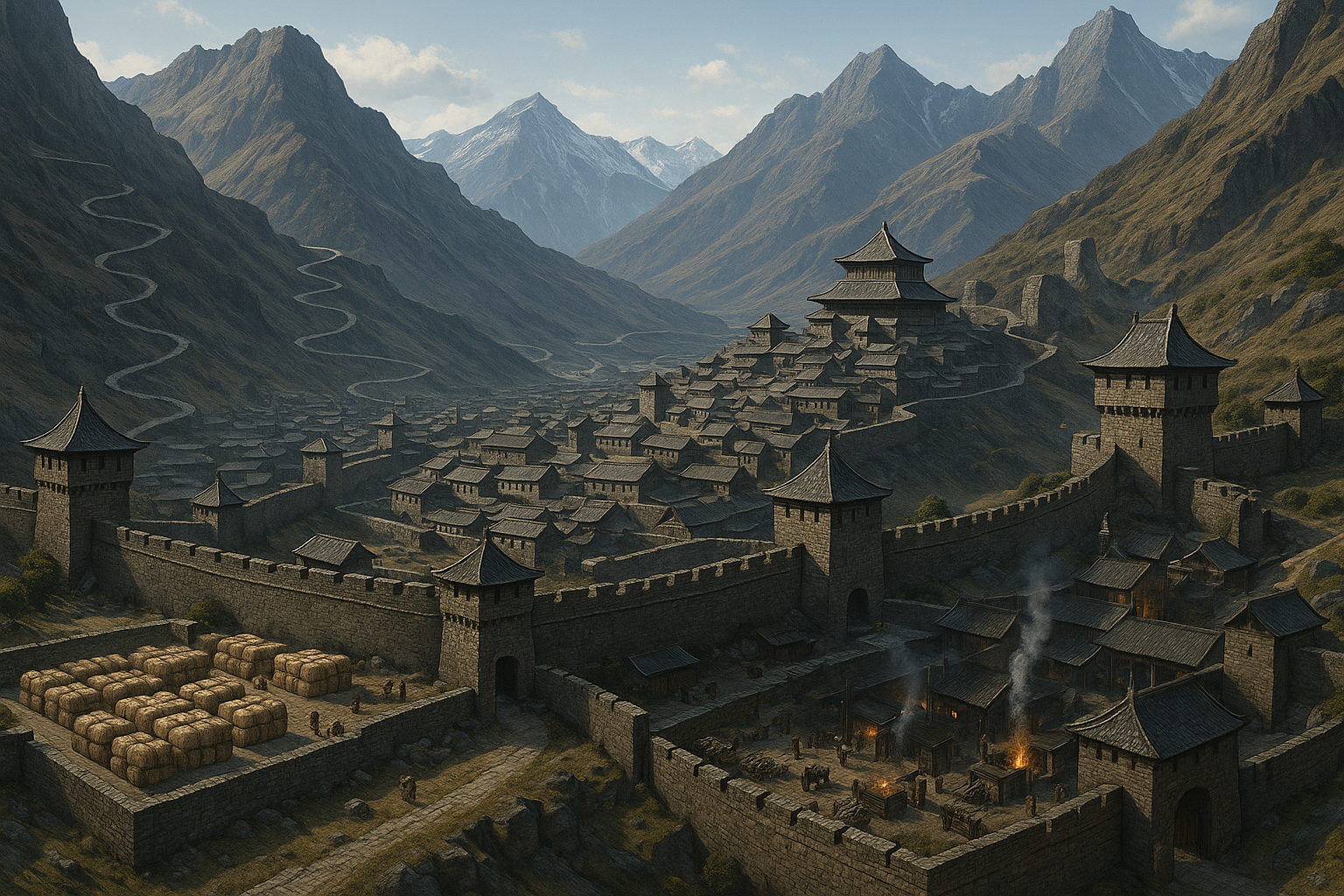
Karubo sits in a mountain valley where two highland rivers converge before joining the broader central basin system. Karubo occupies both banks of the lower confluence and extends up the valley sides on graduated terraces that give the upper residential districts an elevated view over the city below and the mountain range above. The Hangyin peaks are visible from nearly everywhere: close enough to be specific rather than generic, distant enough to frame the valley rather than confine it.
Construction is mountain-practical: stone foundations and lower courses, timber upper structures in the older districts, and in the newer sections a hybrid technique that the dwarf craftspeople introduced two generations ago that has become the regional standard. Because a significant portion of it is built into the valley sides, the city is larger than first impressions suggest; the dwarf community's contributions include underground storage, underground workshops, and in two cases underground residential districts that connect to the surface buildings through staircase systems cut into the rock.
The wool market is on the valley floor near the river confluence, a large covered structure that is the most commercially active space in the city for much of the year. The Duke's compound is on the eastern valley side at mid-elevation, with sight lines over the market and the road that approaches from the northern pass directions. That road placement is intentional: the family that controls the passes keeps its administrative center where it can observe traffic.
Geography & Setting
Karubo occupies the convergence of the Hangyin and Koru rivers: both mountain-fed, both contributing to the central basin's waterway system that eventually connects to the Gulf of Siem and the Rhodian Ocean. The valley is sheltered by the surrounding ridgelines in ways that produce a microclimate notably warmer than the northern pass settlements: the growing season here is long enough for grain, stone fruit, and the highland herbs that the surrounding altitude produces.
Karubo's geographic position is its political position: it is the natural administrative center for anyone controlling the Hangyin range crossings. The Fenling Pass to the north (where Minxain sits) is the most-used northern crossing; there are four other significant passes that the Karubo Highlands administers. The road network that connects all of them converges, eventually, on Karubo. This fact has shaped the city's layout, its economy, and its politics for as long as the Thornwald family has governed it.
The People
Demographics
Karubo is the most demographically varied settlement in the Karubo Highlands sphere. The city's position as the commercial and administrative hub draws merchants, craftspeople, and workers from across the highland region and from the broader Shoing sphere. The dwarf community is the most substantial non-human presence (concentrated in the mining, metalworking, and construction trades) and is deeply integrated into the city's craft tradition. Gnomes appear in the administrative and commercial sectors.
Economy
Pass toll administration provides the political foundation. The Karubo Highlands' control of the Hangyin range crossings is the political fact on which the Duke's authority rests, and the toll revenue is the administrative mechanism. The Thornwald family administers the toll allocation (to infrastructure, to the garrison forces that maintain pass security, and to the ducal household), and the annual audit of this allocation is a political event of significant consequence.
The wool market is the commercial foundation. Karubo serves as the price-setting market for the entire highland wool region; the buyers who come here establish the trade season's benchmarks, and the smaller highland producers (including the Minxain Wool Cooperative) sell through Karubo intermediaries rather than directly to the distant buyers. Market volume is the largest single commercial event in the north-central Shoing sphere.
Mountain metalwork is the craft industry. The dwarf tradition of highland metal processing (working with the specific ores from the Hangyin range, using the river power for the forge operations, and applying techniques that the human craftspeople have adopted and adapted) produces iron and bronze work that the Gwajin court buys and the eastern Shoing military forces equip with.
Primary Exports
- Pass-toll revenue (administrative rather than exported)
- Mountain metalwork: Iron tools, bronze fittings, specialty military equipment; exported to Gwajin Realm and eastern Shoing markets
- Processed highland wool: The market aggregates regional production; the highest-grade processing happens in Karubo's finishing workshops
- River-valley agricultural surplus: Grain, stone fruit, dried herbs
Primary Imports
- Eastern Shoing luxury goods: The city's commercial position attracts imported goods from the Gwajin sphere
- Western Shoing forest products: Timber, resin; what the mountain valley doesn't produce
- Coastal fish and marine products: The river connection eventually reaches the sea but not efficiently for food purposes; preserved coastal fish comes by trade
Key Industries
- The Pass Administration Office: The Thornwald family's toll management operation; the political core of the city's function
- The Highland Wool Market: The covered exchange facility; price-setting function for the region
- The Metalwork Guilds: Multiple craft organizations covering different metal trades; the dwarf-majority guilds and the human-majority guilds work in adjacent but distinct traditions
- The River Transport Cooperative: The barge operation that connects Karubo to the central basin's waterway network downstream
Food & Drink
Karubo eats significantly better than the pass settlements, because the valley's agricultural capacity and the river transport's import access mean the city has variety. The highland traditions (dense, caloric, herb-forward) are the foundation, but the city's commercial position has introduced preparation styles from across the Shoing sphere. The morning markets by the river sell the valley's stone fruit in season with an intensity that the city's residents consider the best argument for the highland climate.
The city's specific beverage is a highland ale brewed with the mountain herbs, not exported in quantity because the brewing tradition is not systematized in the way of the wine or spirit trades, but available throughout the city and considered by visitors who have tried it to be significantly better than its distribution would suggest.
Culture & Social Life
Karubo's culture combines the highland mountain character (direct, endurance-focused, skeptical of lowland pretension) with the administrative-commercial complexity of a regional capital. The Karubo Highlands honor tradition is present; the specific expression here emphasizes the honor of governance: a Duke who does not maintain the passes, administer the tolls accurately, or keep the peace in the valleys has dishonored both the family and the function.
The highland assembly, the seasonal meeting of the Warden-Barons and significant landholders from across the Karubo sphere, makes Karubo's political culture genuinely deliberative in ways that the more hierarchical eastern Shoing tradition sometimes finds surprising. Thornwald Dukes have governed by assembly consensus for several generations, and the tradition is stable enough to have become the regional expectation.
The dwarf community's integration into the city's commercial and craft life is extensive enough that the community does not operate as a separate social sphere; dwarves and humans participate in the same market, the same guild structures, and the same political assembly (senior dwarf craft-masters hold assembly seats). Social separation that characterizes other Shoing settlements' dwarf communities is less marked here.
Festivals & Traditions
The Wool Season Opening
The opening of the wool market's trading season, typically in late spring when the highland shearing is complete, is Karubo's most significant annual commercial event. The Duke formally opens the market, the first price-setting transactions are completed under the assembled buyers' observation, and the city's hospitality and entertainment industries are at full capacity for the following week.
The Pass Survey
Each autumn, before the first winter closures, the Duke's garrison conducts a formal survey of all five highland passes under Karubo administration. The results are presented to the highland assembly and are the basis for the following year's infrastructure allocation decisions. This has been performed continuously for as long as the Thornwald family has held the Duchy.
Music & Arts
Karubo's artistic tradition is more varied than any of the smaller highland settlements; the city's size and commercial position attract practitioners from across the Shoing sphere. The mountain metalwork is the arts-adjacent craft: the finest pieces from the dwarf and human metalworking traditions are art objects as well as functional goods, and the Thornwald household's collection is the most significant in the highland sphere.
The city also has a tradition of historical oral composition: long-form narrative works that record the history of the highland passes, the significant political events, and the Thornwald family's governance record. These are performed at highland assembly gatherings and at the wool season events.
Religion
Primary Faith
Ryujin is interpreted here as the god of movement through difficult terrain: rivers, passes, and the flow of people and goods through the Hangyin.
Secondary / Minority Faiths
Talbar is strong in toll administration, merchant arbitration, and the wool market's pricing. Vessikar is honored by the weighhouse clerks and toll auditors who keep the pass economy from collapsing into extortion. Caldrin is a near-universal roadside devotion along the hostels and switchbacks: safe passage, honest directions, and upheld guest-right. Bronthe has a strong following among the Deep Mine crews and the engineers who keep the valley wall from becoming a tomb. Themela appears in the pass-law courts where evidence and precedent keep the crossing system from becoming bandit rule. Fujin is honored by guides and soldiers who live with wind and storm as constant threat. Household ancestor shrines are maintained in every hostel, and Shen-Li is invoked in pilgrim registries and lineage guest-books. Shinigami maintains grave rites for those who die in the pass.
Secret or Forbidden Worship
None stable; the passes do not tolerate long-lived secrets.
History
Founding
Karubo's position at the river confluence predates the Thornwald family's governance by a significant period. The confluence was a natural stopping point for highland travel, and a settlement existed there before it was formalized. The Thornwald family arrived approximately three hundred years ago, took governance of the settlement by a combination of military capability and negotiated compact with the existing highland communities, and formalized the pass-control structure that is now the Karubo Highlands political framework.
Key Events
The Highland Compact (approx. 280 years ago)
The formalization of the Karubo Highlands political structure: the Warden-Baron system for the pass settlements, the ducal authority over the assembly, and the toll revenue framework. The compact was the product of several years of negotiation and one small military action; the result has been stable for nearly three centuries.
The Gwajin Trade Treaty (approx. 150 years ago)
The formal establishment of the commercial relationship between the Karubo Highlands and the Gwajin Realm, specifically the terms under which highland metalwork accesses the Gwajin market and Gwajin luxury goods access the highland market. The treaty has been renegotiated twice; the core terms have not changed. The political relationship between Karubo and Gwajin is the most significant external relationship the Duchy maintains.
The Deep Mine Opening (approx. 40 years ago)
The discovery and opening of the Karubo Deep Mine, a copper and iron deposit at significant depth in the eastern valley wall that required the dwarf community's full engineering capability to develop. The mine's output has increased the metalwork industry's supply independence and significantly improved the quality of the highest-end production. It is the most significant economic event in the city's recent history.
Current State
Karubo is prosperous and politically stable, with two active tensions: the Gwajin Realm's ongoing trade negotiation (which Duke Reva is managing to protect the current treaty terms against a Gwajin faction that wants to renegotiate the metalwork import arrangements), and the highland assembly's discussion of the Karubo Highlands' relationship with the western Shoing political sphere (the Galshi Western Coast has been making approaches that some assembly members find worth pursuing and the Duke finds premature).
Leadership & Governance
House Thornwald: Overview
The Thornwald family holds the Duchy by compact and hereditary claim within the highland tradition. The governance combines the pass-administration function (which is the source of the family's political authority) with the broader ducal functions of military leadership, justice administration, and external diplomacy. The highland assembly is a genuine deliberative body, and the Duke governs with its consent rather than over its objection.
Duke Reva Thornwald
Human, Female; early fifties
Reva has been Duke for sixteen years, following her father's death in the Fenling Pass survey (an avalanche, not an assassination, though the highland assembly spent two months establishing this). She is an experienced political administrator, a capable military commander in the highland tactical tradition, and the most effective negotiator the Thornwald family has produced in three generations. She is currently managing the Gwajin trade negotiation personally, which means she is in Karubo less than she would prefer and the assembly is managing itself more than she would prefer.
Her son Deon is the Duchy's military commander: experienced, loyal, and politically capable in the specific way of someone who understands military logic and has some intuition for political logic. Reva is preparing him for the succession without making the preparation so obvious that the assembly begins making its own assessments ahead of schedule.
Deon Thornwald: Military Commander
Human, Male; late twenties
Deon commands the Karubo Highland garrison: the pass-security forces, the Karubo city guard, and the emergency forces that the highland assembly can call on. He is effective at the military function and developing at the political function. His relationship with the dwarf craft-masters on the assembly, whom he treated initially as purely technical advisors and has come to understand are political participants, is one of the developmental arc of his current period.
Notable Figures
Master-Builder Thora Deepforge: Dwarf Assembly Member
Dwarf, Female; seventies; the metalwork guilds
Thora is the senior dwarf craft-master on the highland assembly and the person whose opinion on any metalwork-related matter (including the Gwajin trade negotiation's metalwork clauses) is the most authoritative available. She has been on the assembly for thirty years and has served under three Dukes. She is not hostile to the current Duke but she has views about the Gwajin negotiation that differ from Reva's, and she has not been quiet about them.
Market-Master Orvin Cole: Wool Market Director
Human, Male; fifties; the wool market
Orvin manages the highland wool market's operations: the buyer relationships, the price-setting sessions, the quality standards, and the dispute resolution that a market of this volume requires. He is the most commercially connected person in the city and the one who most accurately knows the highland wool economy's current condition.
River-Factor Sina Wend: Transport Cooperative Lead
Human, Female; forties; the river
Sina manages the downstream barge transport that connects Karubo to the central basin's waterway network. Her operation is the commercial artery that moves the city's exports and imports, and her knowledge of the downstream river conditions and the central basin's commercial patterns makes her one of the most practically informed figures in the city.
Key Locations
Seat of Power
- The Thornwald Ducal Compound: On the eastern valley side at mid-elevation; the assembly hall is part of the compound; the residential and administrative functions are separated within the compound's multiple buildings
Houses of Worship
- The Ryujin Confluence Temple: At the river convergence; the city's most significant religious structure; the highland assembly's opening ceremony is performed here
- The Dwarf Earth Shrine: In the underground district adjacent to the metalwork guilds; maintained by the dwarf community; accessible to the public but not promoted
Inns & Taverns
- The Pass Gate Inn: The principal accommodation for commercial visitors; positioned near the market district; the common room is the most commercially active social space outside the market itself
- The Confluence: Named for the river meeting; a tavern on the valley floor near the temple; the highland ale is available here at the best quality in the city
Shops & Services
- The Highland Wool Market: The central covered exchange; open by season; the price-setting sessions are the most commercially significant events in the north-central Shoing interior
- The Metalwork Guild District: Multiple workshops in the eastern valley industrial area; finished goods available through the guild salesrooms; commission work arranged through the guild masters
The Market
- The River Market: The daily commercial market on the valley floor; general goods, food, craft products; active year-round with peak volume during the wool season and the assembly meetings
Other Points of Interest
- The Karubo Deep Mine: The eastern valley wall mine; not publicly accessible; the most significant recent industrial development in the city; produces the copper and iron supply for the metalwork operations
- The Pass Roads: The five highland pass approaches converge on Karubo; each road's arrival at the city is marked by a distance stone giving the pass name and the Thornwald family's administration designation
Secrets, Rumors & Hooks
- The Gwajin Realm's trade renegotiation proposal, which Duke Reva is in Gwajin managing, includes a provision that the Gwajin delegation has not yet formally presented but that Reva has been warned about through a private channel: a request for exclusive access to the Karubo Highlands' military pass-closure authority in exchange for a significantly improved trade package. The provision would give Gwajin the ability to request pass closures that would affect the western Shoing trade routes. Reva believes the provision is a test of whether she can be bought. She is deciding how to respond.
- Master-Builder Thora's disagreement with the Duke on the Gwajin negotiation is not simply about commercial terms. Thora has information (from the dwarf engineering network's communication with dwarf communities in the Gwajin sphere) that the Gwajin Realm has been quietly expanding its military capacity in the foothills south of the Hangyin range. The expansion is consistent with preparation for a highland campaign. She has told Deon Thornwald, not his mother, and is watching to see how he handles it.
- The Karubo Deep Mine has a section that the official development plan does not include, a natural cavity discovered during the initial drilling that connects to a broader underground system. The dwarf engineers sealed it after an initial survey. The survey notes, which Thora has read and kept, describe the cavity as containing evidence of prior habitation. Not natural formation: structures, specifically, that predate any known Shoing settlement period.
- River-Factor Sina Wend's downstream transport network extends further than the formal Karubo Highlands sphere, and the cargo manifests that the furthest downstream operators file with Sina's office include notations that do not correspond to any recognized trade good category. Sina has not investigated, because the operation is commercially productive and the operators are not otherwise concerning. She has, however, saved the manifests in a separate ledger that she keeps in her personal office rather than the cooperative's records.