Kegun
Kegun: The Bay's Second City
"Gwajin is where the Realm is governed. Kegun is where it is paid for. The distinction is not always comfortable for the governors."
Senior Count Daro Veshi, Kegun's most frequently attributed observation
At a Glance
| Continent | Shoing |
| Region / Province | Southern Shoing, Gwajin Realm: Banda Bay coast |
| Settlement Type | City |
| Population | ~85,000 |
| Dominant Races | Human (majority), Half-Elf (merchant class), Smaling (harbor operations) |
| Ruler / Leader | Senior Count Daro Veshi |
| Ruling Body | House Veshi, hereditary Senior County under Gwajin Realm authority; the Senior Count title reflects the city's status as the second-ranking subject settlement in the Realm |
| Primary Deity | Talbar (commerce and precise exchange); Ryujin secondary |
| Economy | Banda Bay maritime trade, shipbuilding (commercial vessels), warehouse and logistics services, commodity exchange |
| Known For | The second-largest city in the Gwajin Realm; the most significant commercial port on the Banda Bay; the Commodity Exchange where southern Shoing trade prices are set; the shipyards that build the commercial vessels that the Grand Fleet does not |
First Impressions
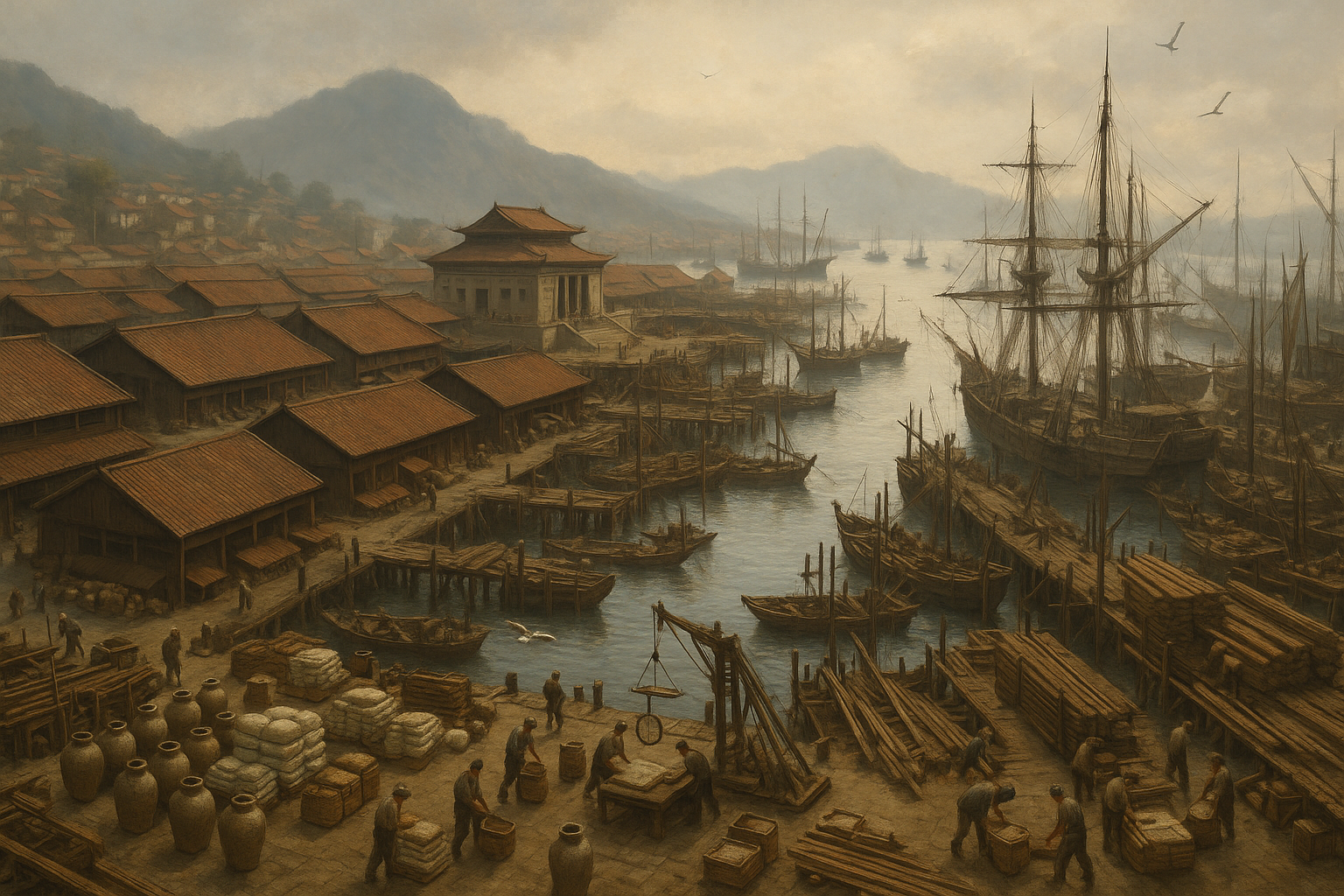
Kegun arrives at the water first. The Banda Bay here is wide and calm; the bay's geography shelters it from the open ocean weather in a way that produces reliable year-round navigation, which is the physical reason the city exists in its current form. Commercial in character, the harbor is organized around the warehouse district that lines the inner bay's eastern shore: long stone buildings, enormous by the standards of most Shoing settlements, built to hold the cargo that cycles through the bay's trade routes.
Behind the harbor district lies a commercial city's specific topology: the exchange and banking district near the harbor, the manufacturing areas further inland, the residential districts on the higher ground that gives them sight lines over the bay. At the residential district's summit, the Veshi County compound is not as elevated as the Tessawa Palace in Gwajin, but elevated enough that the bay is visible from every upper window and the harbor activity can be observed in detail.
Kegun smells of salt, rendered marine products, and the specific wood-shaving smell of the shipyards on the western harbor edge. The sound is commercial and continuous.
Geography & Setting
Kegun occupies the Banda Bay's eastern shore at the bay's most navigable inner reach. The Banda Bay connects through a channel approach to the Gulf of Siem and thus to the broader eastern Shoing maritime routes; it also opens westward to routes that eventually connect to the Perian Sea. This geographic position, accessible from both the northern and southern trade routes, is the physical foundation of Kegun's commercial dominance over the bay region.
Kegun is built on a slight coastal rise above the tidal zone, with the harbor infrastructure extending into the bay on constructed pilings and the warehouse district built on filled ground between the harbor and the original shoreline. That engineering is the product of three generations of harbor expansion and reflects the bay's changing commercial volume.
The People
Demographics
Kegun's commercial character attracts a more diverse population than most eastern Shoing cities of comparable size. The half-elf merchant community is the most significant non-human presence; the longer working lifespan is commercially valuable in a city where trade relationships are built over decades and where institutional knowledge is a competitive advantage. The Smaling harbor operations community is established and skilled. The general transient population (merchants, sailors, commercial travelers passing through) makes the city's effective daily population significantly larger than its permanent resident count.
Economy
The Banda Bay trade is the foundation. Kegun serves as the price-setting exchange for commodity goods moving through the southern Shoing trade routes (grain, preserved fish, textile materials, metal goods), and the Commodity Exchange where these prices are set is the most commercially significant institution in southern Shoing outside of Gwajin's harbor authority. The Veshi family takes administrative fees from the Exchange's operations; the Exchange's independence from the county governance is formal and is maintained carefully.
Commercial shipbuilding is the second pillar. The Gwajin Grand Fleet yards build military vessels; the Kegun yards build everything else. Commercial vessels that carry the Banda Bay trade, the fishing fleet that works the bay and the surrounding coastal waters, and the private shipping that connects the southern routes are all built here.
Primary Exports
- Commodity Exchange price-setting function (administrative rather than physical)
- Commercial vessels: The shipyard output; the most significant manufacturing product in the city
- Warehouse and logistics services: The infrastructure that makes the bay trade possible
- Bay-caught preserved fish: A consistent secondary trade good
Key Industries
- The Banda Bay Commodity Exchange: The price-setting institution; governed by a board of senior traders; operated under the County's administrative authority
- The Kegun Shipyards: The commercial vessel construction facility; multiple private yards organized under a joint quality guild
- The Warehouse District: The cargo storage infrastructure; managed by a combination of private operators and County-administered public facilities
- The Banking Houses: Kegun's financial infrastructure; several established houses that provide credit and commercial instruments for the bay trade
Food & Drink
Kegun eats the bay. The Banda Bay's fishing is productive and varied, and the city's food culture is organized around the fresh and preserved fish supply in a way that produces significant culinary development. The commercial character means that food from throughout the Gwajin Realm is available (the warehouse district's overflow economy includes food goods at prices the eastern Shoing interior cannot match), and the restaurant district near the Exchange is the most varied in southern Shoing.
Kegun's drink is the bay wine: a regional preparation that uses grape varieties brought from the western Shoing trade routes, now grown in the coastal plain south of the city, that the Gwajin court does not specifically acknowledge but that the Exchange's regular participants specifically request.
Culture & Social Life
Kegun's culture is commercial in the specific sense that the Exchange's standards propagate through the city's social life. The eastern Shoing honor tradition is present, but the specific expression here is deal-focused: a merchant's honor is expressed through commercial reliability, and a person who defaults on an Exchange agreement is socially disadvantaged in ways that parallel a military dishonor. The saying ("your word is your bond, and your bond is posted at the Exchange") is Kegun-specific.
Kegun's relationship with Gwajin is the fundamental political dynamic: the city produces a significant portion of the Realm's commercial revenue and feels this is not sufficiently acknowledged by the Gwajin administrative apparatus. For four generations, the Senior Counts Veshi have been making this argument with varying success.
Festivals & Traditions
The Exchange Opening
The annual opening of the Commodity Exchange's trading season, determined by the spring navigation calendar, is the city's most significant commercial event. The Senior Count opens the Exchange with a formal statement of the bay's trading intentions; the first significant transactions of the season are completed under the assembled traders' observation.
The Bay Regatta
Once per year, the commercial shipyards' completed vessels for the season are launched together in a formal ceremony, followed by a bay navigation display that functions as a demonstration of the yard's construction quality. The Regatta is the most publicly spectacular event in Kegun's annual calendar.
Music & Arts
The city's arts tradition is commercial rather than court-focused. The Exchange district's entertainment (the music venues, the public theaters, the commercial arts) is more varied and more focused on immediate audience engagement than the court-tradition arts. The performing arts specifically are more developed in Kegun than in any other southern Shoing city outside Gwajin, because the transient merchant population that passes through creates a demand for entertainment that the permanent population alone would not generate.
Religion
Primary Faith
Talbar is Kegun's commercial soul: the Commodity Exchange is as close to a temple as many merchants ever need.
Secondary / Minority Faiths
Ryujin is honored by shipbuilders and captains as the sea's conscious will. Vessikar holds a practical place in the weighhouses, warehouse audits, and provisioning contracts, where "fair measure" is a public safety issue. Caminus is strong in the shipyards and warehouse craft guilds. Themela is present in trade courts and shipping-dispute halls. Ancestor worship is universal and explicitly formalized under Shen-Li in merchant lineages that treat name and credit as twin inheritances. Sylira has countless small devotions in taverns, counting-houses, and back corridors of the Exchange district, where reputation and early knowledge are worth more than ornament. Tixa is popular with the Exchange district's theaters and with satirists who know how to mock power without starting a riot. Martus thrives in shipping risk, wagers, and speculative buying. Gormandus is visible in the port's feast culture.
Secret or Forbidden Worship
Shinigami's grave-monks hunt undeath and necromancy in the dock slums, where bodies sometimes vanish.
History
Founding
Kegun's position on the Banda Bay has been used for maritime commerce since before the Gwajin Realm's formation. The Veshi family's Senior County was established approximately two hundred years ago as part of the Realm's formal organization of the southern coast. The city's commercial growth over the intervening period has made it the second-largest settlement in the Realm.
Key Events
The Exchange Charter (approx. 150 years ago)
The formal establishment of the Banda Bay Commodity Exchange as an independent institution under County administrative authority. The Charter's independence provisions, specifically the rule that the County cannot set Exchange prices or alter Exchange membership without Exchange board approval, have been the source of periodic political tension with the Gwajin Ministry of Commerce and the foundation of the Exchange's commercial credibility.
The Shipyard Consolidation (approx. 80 years ago)
The organization of the Kegun private shipyards under the joint quality guild that currently administers the construction standards. The consolidation was contested at the time and produced an improved output quality that the commercial shipping market subsequently recognized.
Current State
Kegun is prosperous and politically alert. Senior Count Daro has been in the role for fifteen years and has been managing the Gwajin administrative relationship with the specific skill of someone who understands that the city's commercial importance is its primary political protection but that protection has limits. The current tension is the Gwajin Ministry's proposal to extend harbor fee authority to Kegun's operations, a proposal Daro reads as a first step toward subordinating the Commodity Exchange's independence.
Leadership & Governance
House Veshi: Overview
The Veshi family holds the Senior County under Gwajin appointment and hereditary claim. The governance combines the County's administrative functions with the commercial facilitation role that is the city's practical need. The Exchange's formal independence from the County means the Veshi family governs around rather than through the city's most commercially significant institution.
Senior Count Daro Veshi
Human, Male; late fifties
Daro has been Senior Count for fifteen years and has spent them managing the Gwajin Ministry's periodic attempts to extend administrative reach into Kegun's commercial operations. He is effective and politically sophisticated. He is also the figure who had the private channel warning about the Gwajin negotiation with Karubo; he maintains information relationships throughout the southern Shoing commercial sphere that the Gwajin Ministry is aware of and unable to fully account for.
Notable Figures
Exchange Master Reva Cole: Commodity Exchange Director
Human, Female; fifties; the Exchange
Reva administers the Exchange's operations and is the person whose reading of market conditions the southern Shoing trading community trusts. She is the most commercially knowledgeable person in the city and is specifically independent of the County governance in a way that the Exchange Charter's provisions protect. She and Daro have a functional relationship based on mutual respect and specific non-interference agreements.
Fleet-Factor Bori Wend: Shipyard Coordination
Half-Elf, Male; appears mid-forties, actual age around ninety; the shipyards
Bori coordinates the joint quality guild's oversight of the shipyard operations and is the person whose construction assessment the commercial shipping market relies on. His half-elf lifespan has given him institutional knowledge of the yards' development across four generations of human management changes.
Key Locations
Seat of Power
- The Veshi County Compound: At the residential district summit; the administrative and residential center; the bay view is considered the best in the city
Houses of Worship
Inns & Taverns
- The Exchange House Inn: The primary accommodation for visiting traders; directly adjacent to the Exchange district; the common room is the most commercially active social space in the city outside the Exchange floor
- The Bay Rest: The harbor district establishment; frequented by mariners and shipyard workers
The Market
- The Banda Bay Commodity Exchange: Not a conventional market; the formal price-setting institution; access by trading membership
- The Harbor District Market: The general commercial market; open daily; where the overflow of the bay trade appears in retail form
Secrets, Rumors & Hooks
- Senior Count Daro's private information network extends to the Zazua Cracked Sea League's internal discussions. He knows about the Third Finger channel situation, not in the specific detail that Raja Suresh and his advisors know, but enough to have been positioning Kegun's commercial infrastructure to benefit from the political realignment that will follow. He has not told Gwajin, because the information advantage is commercially significant and because he is not certain the Gwajin Ministry's response would serve Kegun's interests.
- Exchange Master Reva's market condition analysis includes an anomaly she has not made public: the southern Shoing commodity prices for a specific category of goods, metals and alchemical materials, have been showing unusual stability over the past two years. Stability at this level, in these categories, is not natural market behavior. It implies coordination among buyers, which implies either cartel behavior or a single buyer operating through multiple fronts. She does not yet know which.
- The Gwajin Ministry's harbor fee proposal is not primarily about revenue. It is about establishing the administrative precedent for the Ministry to audit Kegun's commercial operations. What the audit would reveal (not fraud, but the specific information relationships that Daro maintains and the specific commercial arrangements the Exchange has with the League ports) would be politically significant.