Kon Tum
Kon Tum: The Watching Island
"We are a transit island. Ships come through. We provision them, we record them, and they go on. The work is simple and we do it well. There is nothing complicated about Kon Tum."
Harbor-Factor Prem Chandra, to any visitor who asks about the island's commercial activities
At a Glance
| Continent | Shoing |
| Region / Province | Southern Shoing, Cracked Sea: Kon Tum island |
| Settlement Type | Town |
| Population | ~3,600 |
| Dominant Races | Human (majority), Smaling (harbor operations) |
| Ruler / Leader | Harbor-Factor Prem Chandra |
| Ruling Body | The Chandra Trading House, the island's governing commercial authority; the Chandra family holds the League port charter and the island's administrative function |
| Primary Deity | Talbar (trade, records, the official account of things) |
| Economy | Maritime provisioning, Cracked Sea transit services, inter-island cargo handling, commercial record-keeping services |
| Known For | The most efficiently run transit provisioning stop in the Cracked Sea League; the exceptional record-keeping that the Chandra house maintains for every vessel that passes through; the unobtrusive helpfulness that experienced Cracked Sea traders specifically seek out |
First Impressions
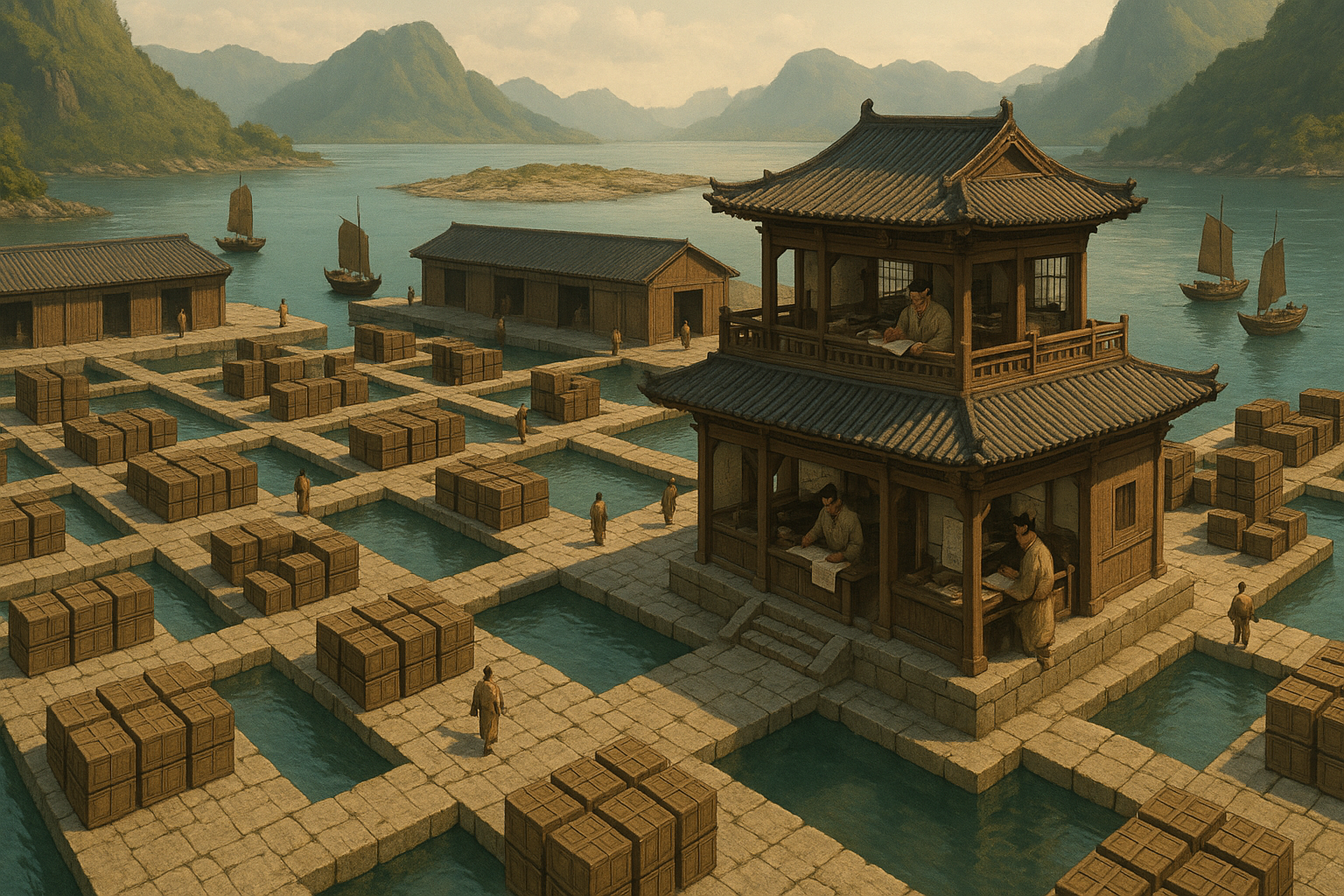
Kon Tum island presents a perfect transit stop. The harbor is sheltered, deep enough for significant vessels, and approached through a clear channel that the Chandra house's navigation buoys mark precisely. Provisioning stores are full. With a speed and accuracy that other League ports do not match, the record-keeping office handles cargo manifests, route certifications, and League documentation. Island staff are helpful, professional, and unobtrusive.
Kon Tum itself is modest and functional. Harbor facilities are the best-maintained structures. Residential areas behind the harbor district are unremarkable. There is one good inn for merchant captains and one adequate wayhouse for crews. The Talbar temple is in the commercial district, adjacent to the record-keeping office. Set back from the harbor, the Chandra house's administrative compound overlooks without being imposing.
Visiting traders who have stopped at Kon Tum more than twice describe it as the most pleasant transit stop in the Cracked Sea. Nothing is difficult. Everything is documented. You leave with a complete record of everything that happened during your stop, which is sometimes more documentation than you arrived expecting and that you learn, over time, to simply accept.
Geography & Setting
Kon Tum is a single island in the Cracked Sea's southern zone, positioned at a natural transit point on the routes that connect the Banda Bay approaches to the deeper Cracked Sea island communities and to the routes that connect northward toward the Perian Sea and eastward toward the Rhodian Ocean. Kon Tum's position is its commercial value: ships moving along any of the major Cracked Sea routes either pass through Kon Tum's natural approach zone or make a modest detour to access its provisioning and documentation services.
It is low, as the Cracked Sea islands generally are; the highest elevation is a limestone formation on the island's southern end, approximately thirty feet above sea level, where the harbor approach light is maintained. Natural depth and the absence of significant weather exposure make the harbor among the most accessible in the Cracked Sea.
The People
Demographics
The permanent population is predominantly human with a Smaling component in the harbor operations. The population is stable and has not grown significantly in the eight years since the Chandra house's current ownership assumed the island's governance. The previous population was roughly similar in composition; the transition of governance was handled smoothly enough that the community's day-to-day life was largely unaffected.
Residents are not deeply aware of the island's commercial ownership structure. They know the Chandra house governs the island, manages the harbor, and maintains the League charter. Origins of the Chandra family's commercial interests are not topics that most residents have investigated.
Economy
Maritime provisioning and documentation services are the commercial foundation. Every vessel that stops at Kon Tum is provisioned from the island's well-maintained stores (food, water, rope, sail material, general ships' supplies) and receives comprehensive documentation of the stop. The League port charter allows Kon Tum to issue official route certifications that the Cracked Sea League's navigation system recognizes.
The documentation service is the economically distinctive element. Record-keeping by the Chandra house is the most comprehensive in the League: every vessel is logged with its hull description, captain, crew count, cargo manifest, origin, and destination. Records are maintained in a system that the Chandra house describes as a service to the League's navigation safety function and that the Zazua Pilots' Cooperative has confirmed, among themselves, is more comprehensive than any navigation safety requirement would explain.
Primary Exports
- Provisioning services: Ships' stores; the most immediately economically significant service
- Route certification documentation: The League-recognized navigation documentation service
- Cargo manifest verification: A specific service that the Chandra house added approximately five years ago and that several regular traders have found valuable enough to specifically seek out
Key Industries
- The Chandra House Provisioning Operation: The stores management and commercial provisioning service
- The Documentation and Record Office: The most operationally significant facility on the island for the intelligence function that the population does not know about
- The Harbor Maintenance Authority: The buoy, channel, and facility maintenance that makes the transit stop viable
Food & Drink
Kon Tum's food is a transit-stop's food; the provisions that the island sells to passing ships are available to the population, which means the food quality is determined by what provisioning traders want to buy. The island itself produces some fish and some garden vegetables. The general food culture is practical and unexceptional.
Its specific food item is a fermented fish sauce that the Smaling harbor community has been producing for several generations and that experienced Cracked Sea traders know to acquire at Kon Tum because it does not appear in reliable form elsewhere in the island chain.
Culture & Social Life
Kon Tum's culture is transit culture; the population is accustomed to visitors and has developed the specific orientation of a community that serves travelers without being particularly interested in them. The interactions are professional and courteous. The hospitality is adequate. The local community's social life is oriented inward, toward the permanent population's relationships and traditions, which the transit function passes through without engaging with.
Chandra house governance is commercially effective and socially unobtrusive. Chandra does not hold significant public festivals or maintain a prominent social presence. The harbor function is the governance.
Honor culture here is the standard commercial tradition: deal integrity, documentation accuracy, the keeping of one's stated commercial position. These norms are genuine and practiced at the community level. They are also, at the ownership level, applied selectively in ways the community does not know about.
Festivals & Traditions
The Charter Anniversary
Once per year, on the date of the Cracked Sea League's original issuance of the Kon Tum port charter, the harbor is formally acknowledged. The Harbor-Factor reads the charter's key provisions publicly. The Talbar temple performs a brief acknowledgment. The harbor continues operating throughout because transit stops do not take days off.
Music & Arts
The Smaling harbor community maintains the inter-island music tradition of the Cracked Sea. The wider community's artistic tradition is minimal; the transit focus has not produced the conditions for significant artistic development.
Religion
Primary Faith
Talbar governs Kon Tum's identity: records, provisioning contracts, and the official account of things as sacred truth.
Secondary / Minority Faiths
Ryujin is honored by sailors crossing the Cracked Sea. Shen-Li is prevalent in ship registries and household ancestor tables kept for crews that live half their lives away. Martus is invoked in the risk of passage and the gamble of weather windows. Cameth appears in hospitality halls where shelter is treated as obligation.
Secret or Forbidden Worship
Shinigami appears when funerals are delayed by transit schedules; their clergy do not negotiate with commerce.
History
Founding
Kon Tum has been an inhabited island and a Cracked Sea transit point for longer than the League's formal existence. The Charter was issued by the League when the transit function was formally recognized and brought within the League's administrative structure. The Chandra house's current governance tenure began approximately eight years ago when the previous governing family, the Serano house, encountered commercial difficulties and sold the charter and the island's commercial rights to the Chandra house's representatives.
The Serano family's commercial difficulties, which occurred with a speed and specificity that the Zazua Pilots' Cooperative has noted, involved three consecutive seasons of poor commercial results and a specific legal challenge to their cargo manifest accuracy that the Chandra representatives appeared at an opportune moment to resolve.
Key Events
The Charter Transfer (approx. 8 years ago)
The transfer of the island's League port charter from the Serano house to the Chandra house. The transfer was reviewed by the Zazua League Secretariat under the post-Indrani Affair vetting protocol. The Chandra house's documentation was complete, its commercial history was verifiable for the required period, and its ownership chain traced to named individuals in the Cracked Sea island trader community. The vetting passed. The Secretariat noted at the time that the documentation was unusually well-prepared, which they attributed to the Chandra house's extensive commercial experience.
Current State
Kon Tum is commercially productive and operationally smooth. The provisioning operation is running well. The documentation service is expanding. The League relationship is maintained without friction. Harbor-Factor Prem has been in the role for eight years (the same duration as the Chandra house's governance) and manages the island's official functions with professional competence. The island's actual primary function (the documentation of dragon egg movements through the Cracked Sea shipping network, specifically the volumes, routes, origins, and destinations of the Flame Runner-related cargo that passes through the Cracked Sea on its way between the Chon Buri breeding grounds and various external buyers) is not visible in any of the official records.
Leadership & Governance
The Chandra Trading House: Overview
The Chandra house holds the League port charter and the island's commercial governance by purchase and League recognition. The official commercial history and ownership documentation traces to named individuals in the Cracked Sea island trader community. The actual beneficial interest behind the Chandra house's operations is a commercial front for a continental intelligence service whose home nation is not in Shoing. The intelligence function, monitoring dragon egg movement, has been the operation's purpose since before the Serano house's commercial difficulties began.
Harbor-Factor Prem Chandra
Human, Male; forties
Prem manages the island's official operations with professional competence. He is the public face of the Chandra house's governance and the person who conducts the League's official relationship, the provisioning clients' commercial relationship, and the Zazua Secretariat's periodic administrative contact. He is skilled at this role and has been since the Chandra house's establishment of the current governance.
Whether Prem is aware of the island's intelligence function depends on the question being asked. He is aware that the documentation service collects significantly more information than the League charter requires. He has been told this is for the commercial advantage of the house's broader trading operations. He has not investigated this explanation's accuracy.
Notable Figures
Records-Master Saya Thon: Documentation Office Lead
Human, Female; thirties; the documentation office
Saya manages the documentation office and is responsible for the record-keeping quality that makes the Chandra house's service distinctive. She is technically competent at the official function and, at a level she is not fully conscious of, at the additional analytical function that the documentation office serves. The pattern recognition that her training has developed (identifying cargo manifest anomalies, unusual routing patterns, cargo descriptions that don't match vessel types) was described to her as quality control. The patterns she flags are reviewed by a Chandra house representative who visits the island quarterly and who she understands to be the house's commercial quality director.
Provision-Master Haki Wend: Smaling, Harbor Operations
Smaling, Male; fifties; the harbor
Haki manages the harbor's practical operations: the provisioning stores, the buoy maintenance, the crew wayhouse. He has been at this job for twenty years, predating the Chandra house's governance by twelve years. He is the island's most locally-rooted individual and the community's most trusted non-Chandra figure. He is also the person who, approximately three years ago, noticed that the quarterly visitor who comes to review the documentation office's output spends considerably longer in the records room than a commercial quality review would require. He has not pursued this observation because he has not determined what to do with it.
Key Locations
Seat of Power
- The Chandra Administrative Compound: Set back from the harbor; the governance offices, the Prem Chandra family's residence, and the documentation office's secure archive are within the compound; the compound's interior is not accessible to general visitors
Houses of Worship
- The Talbar Transit Temple: In the commercial district adjacent to the documentation office; the Charter Anniversary ceremony occurs here
Inns & Taverns
- The Captain's House: The good inn, for merchant captains; the quality is noticeably higher than the island's size would suggest, which experienced traders attribute to the Chandra house's understanding that captain comfort is commercially important
- The Wayhouse: For crews; adequate and reliable
Shops & Services
- The Provisioning Office: The commercial transaction point for ships' stores; managed with the efficiency that characterizes all of the island's operations
- The Documentation Office: Where cargo manifests are processed, route certifications issued, and records maintained; the most technically significant facility on the island
The Market
- The Island Market: Open three times weekly; local goods, fish, fermented sauce, imported goods from the regular provisioning supply chain
Secrets, Rumors & Hooks
- The Kon Tum documentation office's records, if accessed by someone who knows what they are looking at, contain a comprehensive seven-year record of Flame Runner-related cargo movements through the Cracked Sea: volumes, origins (consistently Chon Buri and its secondary caldera), destinations, routing patterns, and seasonal variation. The intelligence value of this record for a party with strategic interest in Shoing's dragon population is significant. The record is maintained in a notation system that appears to be standard commercial shorthand and that is, to the initiated reader, a specific cipher.
- Provision-Master Haki's observation about the quarterly visitor is more significant than he knows. The quarterly visit's duration corresponds to the time required to extract the documentation office's compiled dragon-movement records and transmit them through a courier arrangement that the Chandra house maintains with a specific shipping line that passes through Kon Tum. The shipping line's origin, which is not documented in the Kon Tum records, is not a Shoing port.
- The Zazua Pilots' Cooperative, whose senior members have confirmed among themselves that Kon Tum is "operating under beneficial interest that is not what it appears," has one specific piece of additional information that they have not shared with anyone: one of the Cooperative's pilots, on a Third Finger approach two years ago, recognized the quarterly visitor as someone he had seen in Gwajin's foreign ambassador district. This makes the operation not simply a non-Shoing intelligence service but specifically connected to external powers that have contact points within the Gwajin diplomatic community.
- The Serano house's commercial difficulties, which created the opportunity for the Chandra house acquisition, were manufactured. The legal challenge to the Serano cargo manifest accuracy was filed by a commercial interest that, traced to its source, connects to the same commercial front network that the Chandra house's ownership documentation uses. The Serano family left the island believing they had been commercially unlucky. They were not unlucky.