Lishui
Lishui: The Town on the Still River
"The Lian Pearl is a river pearl, which means it is smaller than the sea pearl, softer in its luster, and specific to its origin in a way that cannot be replicated. The court knows this. The court pays accordingly. We have learned to be patient about the payment schedule, which is the court's prerogative."
Prefecture-Governor Ami Shen, in annual supply report to the Gwajin Ministry of Commerce
At a Glance
| Continent | Shoing |
| Region / Province | Eastern Shoing, Gwajin Realm: Lian River, river plain |
| Settlement Type | Town |
| Population | ~4,100 |
| Dominant Races | Human (majority), Half-Elf (significant in the pearl-diving trade) |
| Ruler / Leader | Prefecture-Governor Ami Shen |
| Ruling Body | House Shen, hereditary prefecture under Gwajin Realm authority |
| Primary Deity | Bridhel (rivers, movement, and the patient accumulation of beauty) |
| Economy | Freshwater pearl cultivation and diving, river fishing, scenic river trade, specialty ceramics using river-clay |
| Known For | The Lian Pearl: a freshwater pearl variety with a specific warm-rose luster found only in the Lian River's particular water chemistry; the river ceramics that use the same mineral-rich clay in their glazing; the diving tradition that is one of the most technically sophisticated non-magical craft practices in Shoing |
First Impressions
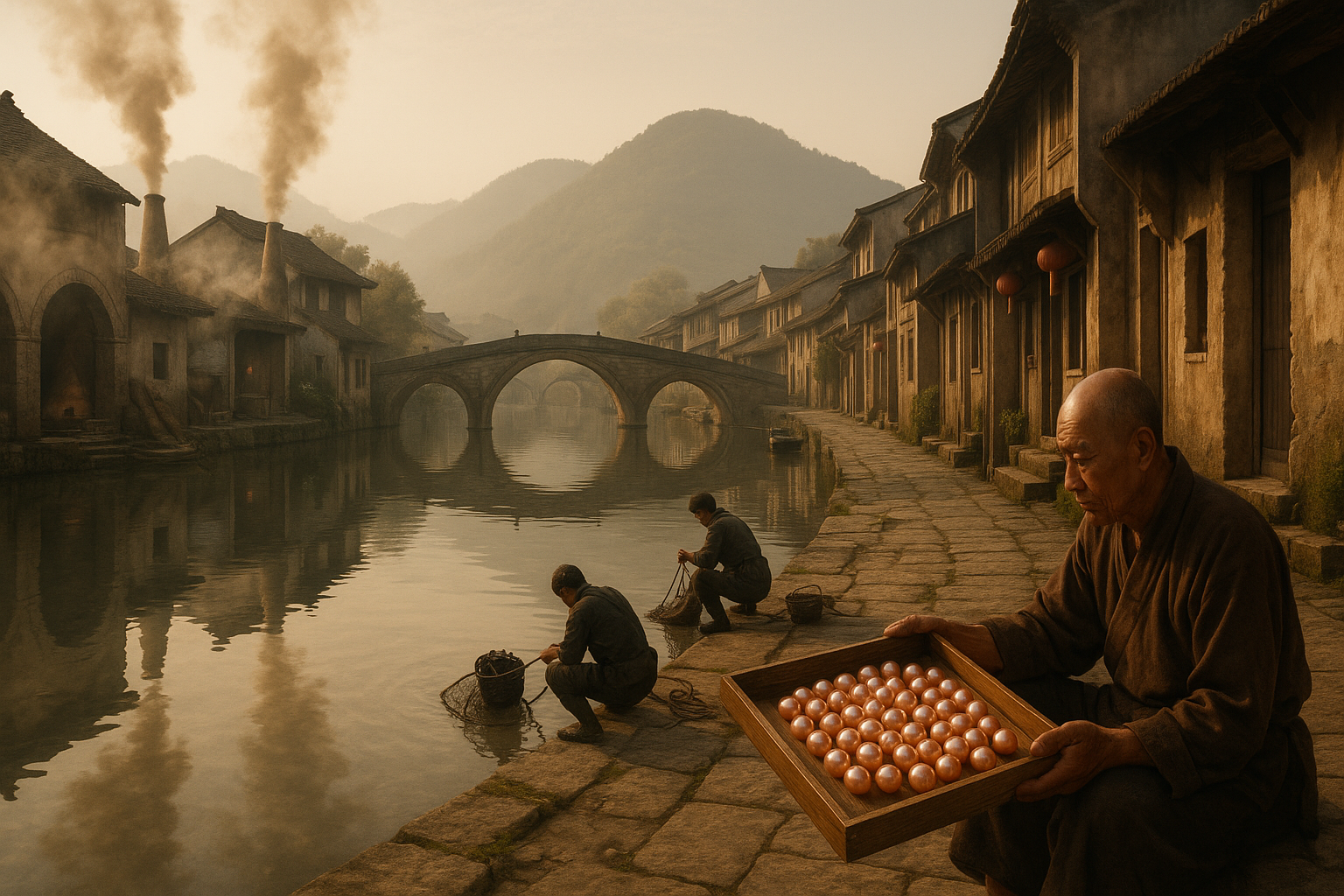
The Lian River earns its name here; the water is clear, with a slightly warm tint from the mineral content that gives it an amber quality in late afternoon light. Lishui's name, beautiful water, is accurate rather than aspirational. Visitors who expect a modest claim to be managing a modest waterway are surprised by the actual visual quality of the river at this location.
Lishui occupies both banks, connected by a covered wooden bridge that is the town's most architecturally distinctive structure; the roof is supported by carved wooden columns, and the carved elements are all river-themed in a tradition that the Shen family has maintained since the bridge's first construction. Pearl cultivation beds are visible from the bridge, downstream of the main settlement area: submerged baskets in a specific pattern that the divers manage on a rotation the Prefecture office administers.
Ceramic workshops are in the upper district, on the eastern bank: close enough to the river for clay access, elevated enough to avoid the flood zone. Glazes that use the Lian River clay's mineral content produce the characteristic warm-rose tone that appears in the pearl's luster, which the court's art buyers consider the town's aesthetic signature.
Geography & Setting
Lishui occupies the Lian River at a point where the water chemistry is optimal for freshwater pearl production; the specific mineral balance that comes from the confluence of the Lian's upper-course limestone drainage with the lower-course iron-rich deposits produces water that the mollusks require and that cannot be replicated by moving the cultivation to other sections of the river. Attempts to establish pearl cultivation in the Lian's upper or lower course have not succeeded; the pearl beds work only in this section.
Surrounding the town, the river plain is agricultural, rice and vegetable cultivation that takes advantage of the Lian's rich deposited soil. That agricultural capacity means the town is food-self-sufficient in most years, which is uncommon for a settlement whose economic foundation is a luxury good.
The People
Demographics
Lishui is predominantly human with a notable half-elf presence concentrated in the pearl-diving trade. The diving tradition requires extended underwater work; the breath-holding techniques and the physical endurance the work demands are more readily developed by individuals with longer working lifespans, and the half-elf community's three-generation presence in the trade has produced a community with accumulated technique that the human divers work alongside but have not fully replicated.
Economy
Pearl cultivation is the economic foundation. The Lian Pearl, named specifically for the river and recognized by the Gwajin court's procurement office as a distinct luxury category, is the town's primary commercial product. The cultivation combines managed mollusk populations (the pearl-producing species native to the Lian) with specific water management and the diving tradition that handles the harvest and maintains the cultivation beds.
River ceramics are the second commercial line. Clay available from the Lian's banks, combined with the specific mineral water used in the glazing process, produces the rose-tinted ceramic ware that the court's art buyers specify. Those workshops produce both utility items in the rose glaze and art pieces for the court collection.
Primary Exports
- Lian Pearls: The freshwater pearl variety; warm-rose luster; court procurement specification; premium luxury market
- River ceramics: Rose-glazed ware; court and luxury commercial markets; the glaze mineral content is the distinguishing characteristic
- Preserved Lian fish: A specific freshwater species found only in this river section; preserved forms exported as a specialty food
- Agricultural surplus: Rice and vegetables from the river plain
Key Industries
- The Pearl Cultivation Cooperative: Manages the cultivation beds, the diving rotation, and the pearl quality assessment; the half-elf community holds the most senior diving positions
- The Ceramic Workshops: Three family operations; the Prefecture oversees clay access rights and maintains the water-chemistry standards that the glaze requires
- The Agricultural Cooperative: The river-plain farming operation
Food & Drink
Lishui's cooking tradition is river-centered. The Lian fish, which appears in both fresh and preserved forms in the town's diet, is the foundation protein. The rice cultivation's proximity means rice is available fresh and high-quality throughout the season. The combination of river fish, premium rice, and the specific mineral herbs that grow along the Lian's banks produces a local cuisine that Gwajin food writers describe as the most understated excellent cooking in the eastern sphere.
Lishui's specialty drink is a clear spirit distilled from the river-water and rice combination; the mineral content of the Lian's water produces a flavor profile that is specific to this location. It is not widely traded; the volume is too small for commercial distribution and the local consumption is too enthusiastic to produce much surplus.
Culture & Social Life
Lishui's culture is unhurried in a way that the Gwajin court finds simultaneously admirable and slightly frustrating. The pearl cultivation operates on the mollusk's schedule, which is several years per cultivation cycle; the ceramic production's quality depends on the glazing process proceeding without shortcuts; the river fishing is seasonal. The community has organized its social life around these rhythms rather than against them.
Eastern Shoing's honor tradition is present; the specific emphasis here is on patience as an honorable quality. A diver who rushes a bed before the pearls are ready, or a ceramicist who shortens the glazing process, is understood to have done something dishonorable in the same way that a warrior who acts without sufficient assessment has.
Within the town, the half-elf diving community has a social presence specifically tied to the respect the diving tradition commands. The most senior divers, those with the deepest technique and the longest records, are the most socially significant figures in the diving community, and their social position extends into the broader town.
Festivals & Traditions
The Pearl Assessment
At the end of each cultivation cycle, when the dive rotation indicates that the pearl bed is ready for harvest, the full harvest is assembled, assessed by the Cooperative's senior divers, and formally graded. The Assessment is an annual event in good production years and a multi-year event when the mollusks require longer development. The results determine the year's commercial position and are presented to the Prefecture-Governor publicly.
The Bridge Ceremony
On the annual date commemorating the covered bridge's founding, which coincides with the Shen family's formal establishment of the prefecture, the town crosses the bridge from one bank to the other as a community, in a specific order that reflects the social structure, and gathers on the western bank for a meal that the Prefecture provides. The ceremony is simple and is taken seriously.
Music & Arts
The ceramic art tradition is the primary visual art. The best pieces from the three workshops are considered among the finest luxury goods produced in the Gwajin Realm's subject settlements, and the court art collection contains examples from every generation of the Shen prefecture's history. The rose-tone glaze's visual effect under different light conditions (it changes significantly from morning to afternoon to candlelight) is considered by the court's aesthetic tradition as an example of successful complexity.
The river music tradition is quiet and water-paced; the compositions are long and move at the speed of the Lian's current rather than the speed of performance convention. Outside the town, this is sometimes described as "slow." Inside the town, it is described as correct.
Religion
Primary Faith
Bridhel is honored as the still river's patience and the slow accumulation of beauty in pearl and clay.
Secondary / Minority Faiths
Ryujin is respected by divers and fishers who treat water as conscious. Caminus is honored by ceramicists and kiln-workers. Talbar appears in pearl contracts and the scenic trade that brings outsiders. Household ancestor shrines are ubiquitous, and Shen-Li is invoked in the diver guild's lineage oaths. Shinigami oversees funerals for drowning deaths and enforces timely rite.
Secret or Forbidden Worship
Little organized; the river community is too interwoven.
History
Founding
The Lian Pearl's specific properties have been known for as long as the river has been inhabited. The current town's organization (the pearl cultivation cooperative, the Prefecture governance, and the ceramic workshop tradition) was formalized approximately two hundred years ago by the first Shen Governor, who systematized practices that had been operating informally for at least a generation prior. The covered bridge is three generations younger than the formalization; its construction was the project that the second Shen Governor considered his most significant contribution.
Key Events
The Court Luxury Certification (approx. 120 years ago)
The Gwajin court's formal recognition of the Lian Pearl as a distinct luxury category eligible for court procurement at pearl-specific pricing. The certification was pursued by the Shen family over approximately fifteen years and required both quality demonstration and political navigation in the Ministry of Commerce.
The Half-Elf Diving Integration (approx. 80 years ago)
The formal integration of the half-elf diving community into the Pearl Cultivation Cooperative's governance structure. The integration, which gave the senior half-elf divers a formal role in the harvest assessment, was negotiated over several years and produced the hybrid governance structure that the Cooperative now operates under.
Current State
Lishui is stable and productive. The pearl production is consistent. The ceramic workshops are at full capacity. Prefecture-Governor Ami Shen is in her forties, experienced in the administration, and managing one active concern: a proposed trade agreement modification from the Gwajin Ministry of Commerce that would reduce the luxury pricing floor for Lian Pearls in the court procurement contract. The proposed modification is commercially significant and the Ministry's justification for it, "market normalization", does not, in Ami's assessment, reflect the actual market.
Leadership & Governance
House Shen: Overview
The Shen family holds the Prefecture-Governorship under Gwajin appointment. The governance is agricultural and commercial administration: the cultivation cooperative oversight, the ceramic workshop clay-rights management, and the court supply relationship are all within the Prefecture's domain. The military function is minimal; the river plain has been stable for generations.
Prefecture-Governor Ami Shen
Human, Female; mid-forties
Ami has been Prefecture-Governor for eleven years and has managed the court relationship effectively, including two previous attempts by the Ministry to modify the pricing arrangement, both of which she navigated without conceding the core term. That current attempt is more formally organized than the previous ones and has more Ministry support behind it; she is determining whether the previous approach will work again or whether she needs a different strategy.
Senior Diver Elan Brightwater: Half-Elf, Cooperative Lead
Half-Elf, Female; appears mid-thirties, actual age around eighty; the pearl beds
Elan is the senior diver and the Cooperative's half-elf governance representative. She has been diving the Lian Pearl beds for fifty years and has the most extensive record of the cultivation cycle's behavior of anyone in the town. Her harvest assessments are the quality standard against which the court procurement is measured. She is also the person who first noticed, approximately three years ago, that the Lian River's water chemistry is shifting slightly, not dramatically, but in a direction that the pearl mollusk's production quality may eventually reflect.
Notable Figures
Ceramicist Ori Vance: Senior Workshop Lead
Human, Male; sixties; the ceramic workshops
Ori manages the oldest of the three ceramic workshops and produces the art pieces that appear in the court collection. He is the most technically proficient ceramicist in the town and is approaching the point where training the next generation's master requires his full attention. He has one apprentice of significant promise and one of adequate promise, and he is aware that the choice of successor he makes will define the workshop's character for a generation.
River-Factor Saya Nomi: Trade Logistics
Human, Female; thirties; the market
Saya manages the trade logistics: the pearl and ceramic shipments to Gwajin, the agricultural surplus distribution, and the general commercial operations. She is the person who handles the practical implementation of the pricing arrangement and who has the most current view of what the Gwajin Ministry's "market normalization" argument is based on. Her analysis of the Ministry's supporting data contains a discrepancy she has not yet resolved.
Key Locations
Seat of Power
- The Shen Prefecture House: On the eastern bank, upstream of the bridge; the administrative and residential functions are in the same building; the pearl assessment records going back to the first Shen Governor are maintained in the archive room
Houses of Worship
- The Bridhel Still Temple: On the eastern bank, overlooking the pearl cultivation beds; the architectural approach allows the temple's reflection to be visible in the river below when conditions are still
Inns & Taverns
- The Bridge Inn: At the eastern bridge approach; the most significant accommodation for visitors; the covered bridge is visible from the main room
- The Diver's Rest: On the western bank near the cultivation beds; frequented by the half-elf diving community and the cultivation cooperative workers; the Lian spirit is available here
Shops & Services
- The Pearl Assessment Room: Part of the Cooperative's administration building; where the harvest assessment and commercial transactions occur; visitors by arrangement through the Prefecture office
- The Ceramic Workshop Salesrooms: Adjacent to each workshop; direct purchase available; the art pieces require advance arrangement
The Market
- The River Market: On the western bank near the bridge; open four days per week; agricultural products, preserved fish, lower-grade ceramic ware, and general goods
Other Points of Interest
- The Pearl Cultivation Beds: Downstream of the main settlement; the managed cultivation zones visible as submerged structured areas in the clear water; not accessible to non-cooperative members
- The Covered Bridge: The town's most distinctive architectural feature; the carved columns' imagery includes pearl mollusks, river fish, the rose-tinted ceramic form, and the Bridhel water symbol in a program that the Shen family has maintained and extended across three restorations
Secrets, Rumors & Hooks
- Elan Brightwater's observation of the Lian River's water chemistry shift is more significant than she has shared with the Prefecture. The shift's direction, which she has been tracking through the pearl quality data from the cultivation records, matches the pattern that would occur if the limestone drainage from the Lian's upper course is changing. The implication is that something in the upper course is different from what it was. She does not know what; she has been trying to determine whether to investigate or to manage the pearl production adjustments quietly.
- Saya Nomi's discrepancy in the Gwajin Ministry's "market normalization" data is this: the data appears to have been adjusted to exclude the past five years of actual court pearl purchasing records, which would show that the luxury pricing has been increasing rather than declining. The adjusted version shows the opposite trend. This is not an error; the adjustment is too consistent. Someone in the Ministry fabricated the market justification, and the trading house that is most positioned to benefit from the pricing floor reduction is the same trading house whose representative appeared at the last Ministry review.
- The Shen family's archive contains a document from the first Prefecture-Governor that the current family has never formally addressed. The document describes a second pearl-producing zone in the Lian River, in a section approximately ten miles upstream, that the first Governor chose not to develop. The reason given is "the condition of the upstream zone requires evaluation." No evaluation was subsequently recorded. The upstream zone is currently within the forest territory that borders the Luxiang Forest's western edge.
- Ori Vance's more-promising apprentice, who will likely be the workshop's successor, has been in quiet correspondence with a Gwajin art collector who has been expressing interest in acquiring the Lishui ceramic technique's documentation. The correspondence is not yet concerning; the interest appears genuine and non-commercial in the extractive sense. But the collector's identity, which Ori does not know but which the Prefecture's commercial correspondence files would reveal, is a member of the trading house involved in the pearl pricing adjustment.