Maha
Maha: The Great Crossroads
"Every road in the eastern interior passes through Maha at some point, or could. We have made this a policy."
Count-Marshal Petra Hana, on the town's road infrastructure investment philosophy
At a Glance
| Continent | Shoing |
| Region / Province | Central-eastern Shoing, Gwajin Realm: highland-plain transition, junction of the Eastern Road and the Southern Interior Route |
| Settlement Type | Town |
| Population | ~7,200 |
| Dominant Races | Human (majority), Half-Orc (garrison presence) |
| Ruler / Leader | Count-Marshal Petra Hana |
| Ruling Body | House Hana, hereditary Count-Marshalship under Gwajin Realm authority; the Marshal designation reflects the town's historical garrison function at the road junction |
| Primary Deity | Cael (deity of roads, safe passage, and the keeping of the way) |
| Economy | Road junction trade, garrison-support services, relay horses and courier infrastructure, agricultural processing for the surrounding plain |
| Known For | The most significant road junction in the central-eastern Shoing interior; the relay station network that the Gwajin Realm's courier system depends on; the garrison that has kept the junction open through multiple periods when travel was otherwise dangerous |
First Impressions
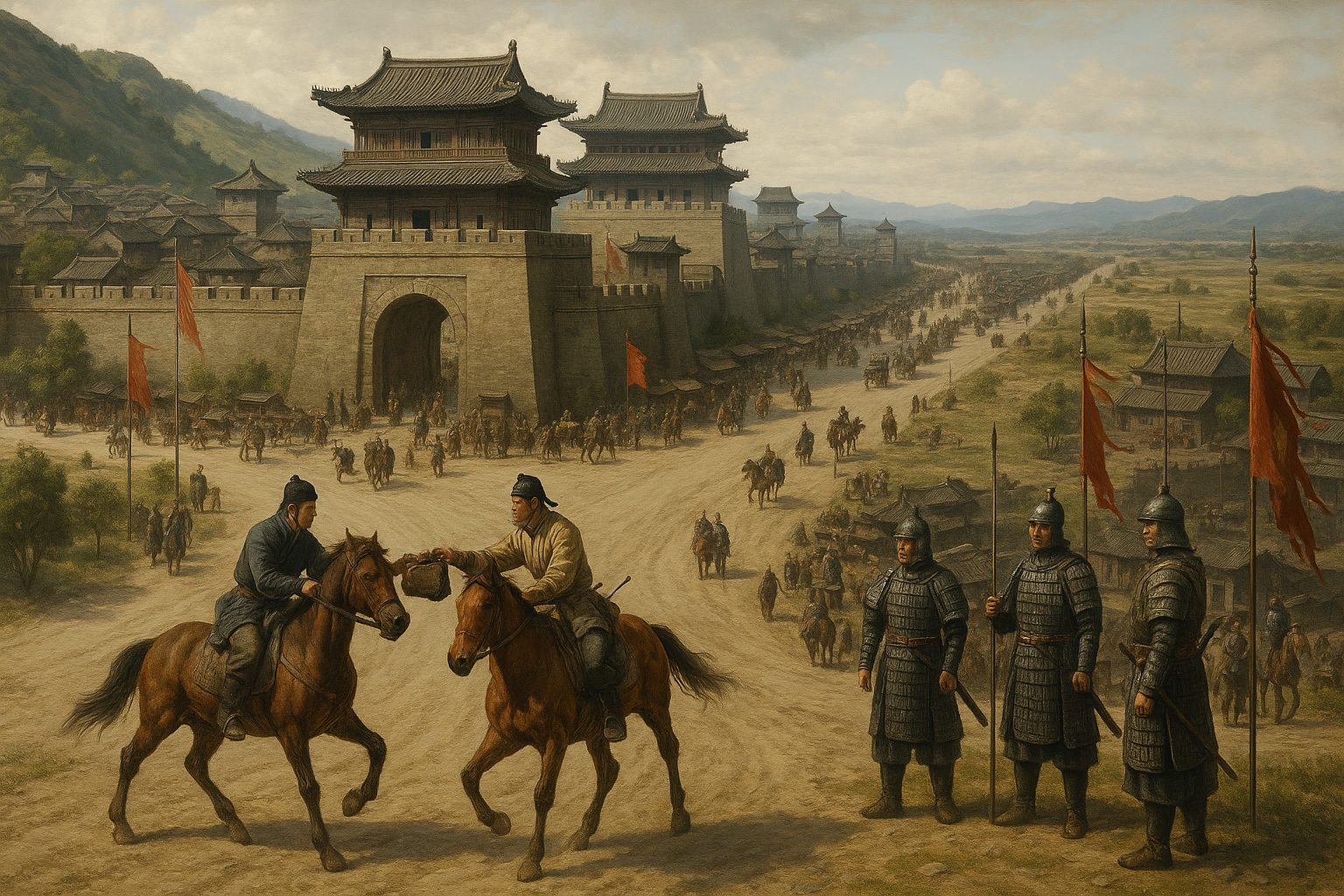
Four roads. That is the first impression: not the buildings, not the garrison, not the market. Four roads converge on the central plaza from four compass points, and each one is maintained to the Gwajin Realm's highest road standard because the military and commercial importance of the junction has kept the funding available consistently. Roads are straight where the terrain allows, paved with the local limestone, and wide enough for two loaded wagons to pass each other. By eastern Shoing standards, this is exceptional.
Around the junction, the town is practical in the specific way of a place built to service traffic rather than to impress it. Most operationally significant is the relay station, where the Gwajin courier system changes horses and dispatches. Together, the garrison barracks and the Count-Marshal's compound form the largest building complex. Around the junction plaza, the market, the inns, the farrier and wheel-wright shops cluster in the functional positions that a century of traffic demand has selected.
Geography & Setting
Maha sits at the transition between the eastern highland foothills and the broad central plain, which is the geographic reason the junction exists: the highland routes from the north and northeast meet the plain routes from the south and west at the topographic boundary where terrain forces convergence. Maha has simply made itself the necessary service point at that convergence.
Around it the plain is agricultural: grain, primarily, with some livestock grazing. Maha does not produce food in significant volume but is surrounded by producers who bring their goods to the Maha market as the closest significant commercial center.
The People
Demographics
Maha's permanent population is predominantly human, with a notable half-orc presence concentrated in the garrison and physical security operations. The half-orc community arrived with the garrison's expansion approximately three generations ago and has been integrated into the town's labor economy beyond the military function: the most physically demanding work in the farrier, wheel-wright, and heavy cargo handling operations is disproportionately performed by the half-orc community.
Transient population is significant; the junction's commercial function means that travelers, couriers, and merchants are present in the town at all times, and the ratio of transient to permanent population varies from roughly equal in slow periods to three or four to one during the peak trade months.
Economy
The junction itself is the economy. Every caravan, courier, and traveler that passes through the junction requires provisioning, rest, vehicle and animal maintenance, and often information about road conditions. The businesses that serve these needs (the inns, the relay station's contracted provisioners, the farriers, the wheel-wrights, the market) are the town's commercial core.
Gwajin's courier relay contract is the most financially stable income in the town: the relay station's operational funding comes directly from the Ministry of Communication and is the most reliable payment the town's economy receives.
Primary Exports
- Courier relay services: The operational infrastructure for the Gwajin courier system; funded by Realm contract
- Road junction logistics: The provisioning, animal care, and vehicle maintenance services for commercial traffic
- Agricultural processing services: The milling, storage, and market functions that convert the surrounding plain's production into tradeable goods
Key Industries
- The Gwajin Courier Relay Station: The most institutionally significant operation; changes horses, transfers dispatches, and provides secure temporary storage for sensitive communications
- The Market Plaza: The commercial hub; the largest gathering space in the town and the most commercially active
- The Garrison: The Count-Marshal's military force; road security, junction order, and the rapid-response capability that makes the junction's claimed security guarantee credible
Food & Drink
Maha eats functionally well. The junction's traffic ensures that food staples are available at competitive prices; the competition among provisioners for travelers' business keeps the market honest. The local cooking tradition is eastern Shoing's practical variety rather than the refined court tradition. The town's one specific culinary distinction is the garrison stew, a specific preparation that the half-orc cook tradition contributed to the town's common food culture and that is now available in most of the inns.
The drink is the eastern Shoing standard. There is nothing Maha-specific, which the town's residents do not find a problem.
Culture & Social Life
Maha's culture is junction culture: practical, oriented toward making the traffic flow, and somewhat disconnected from the more specific cultural identities of settlements organized around a single industry or heritage. The eastern Shoing honor tradition is present; the specific emphasis here is on the keeping of the way: road maintenance, courier integrity, and the security guarantee that the garrison represents are all understood as honorable functions. Disruption of the junction's operation is dishonorable in Maha's specific cultural terms.
Half-orc integration into the town's social fabric is more complete than in most eastern Shoing settlements of comparable size; the specific functions they perform are clearly valuable, and the garrison relationship gives the community a recognized position that other settlements' half-orc populations often lack.
Festivals & Traditions
The Road Festival
Once per year, on the anniversary of the Gwajin Realm's formal establishment of the junction as a protected relay point, the town closes the roads briefly for the Road Festival: a day of market activity, community eating, and acknowledgment of the junction's function. The Count-Marshal formally reports the year's traffic volume and road condition to the assembled town. The festival includes a blessing of the roads by the Cael temple's priest.
Religion
Primary Faith
Cael - the road and the keeping of the way - is honored as the crossroads' governing spirit, with rites focused on safe passage and the maintenance of open routes.
Secondary / Minority Faiths
Talbar thrives in relay contracts and courier accounting. Jula is respected by the garrison and mediators as the hard work of keeping peace on a dangerous junction. Martus is invoked in wagers, travel risk, and the luck of arrivals. Household ancestor shrines are present in every inn, and Shen-Li is named in guest-books that treat memory as obligation.
Vessikar has shrines near weighhouses and market courts; honest measures are treated as civic peacekeeping. Caldrin is honored at gates, bridges, and caravan yards for safe passage, true directions, and upheld guest-right. Nesara is honored at wells and river shrines, and in irrigation councils: water held in trust for everyone downstream. Sylira keeps whisper-shrines in inns and social halls: places to trade news, manage reputation, and pretend it isn't politics.
Secret or Forbidden Worship
Shinigami's clergy are called when bandit killings or delayed burials threaten to produce restless dead.
History
Founding
The junction predates the Hana family's governance. The current town's formalization (the relay station, the garrison, the road maintenance obligation) was established approximately one hundred eighty years ago when the Gwajin Realm recognized the junction's strategic importance and appointed the Hana ancestor as Count-Marshal.
Key Events
The Great Road Attack (approx. 90 years ago)
A significant bandit force attempted to seize the junction during a period of Gwajin Realm internal instability. The Hana garrison repelled the attack, maintaining the junction's operation through a three-week period of conflict. The event is the foundation of the garrison's institutional pride and is the origin of the standing security guarantee that the Realm's courier contract includes.
Current State
Maha is functional and stable. Count-Marshal Petra is in her forties and is an effective administrator with a specific military background that makes her the most credible security guarantee the junction can provide. The active concern is a deteriorating road section on the Southern Interior Route: approximately fifteen miles south of the junction, where the plain's drainage has undermined the road base. The repair estimate is beyond the town's maintenance budget. The Ministry of Roads has been informed. The Ministry's response schedule is the current frustration.
Leadership & Governance
Count-Marshal Petra Hana
Human, Female; mid-forties
Petra has been Count-Marshal for ten years and has spent them maintaining the junction's function and the garrison's readiness. She is a veteran of the garrison system; she held the garrison command position before taking the Count-Marshal role, which gives her specific credibility with the military component of the governance. She is politically competent enough to have managed the Ministry of Roads situation without escalating it prematurely and is approaching the point where escalation becomes necessary.
Notable Figures
Relay-Master Borin Stonewall: Half-Orc, Courier System Lead
Half-Orc, Male; forties; the relay station
Borin manages the Gwajin courier relay station's operations: the horse management, the dispatch handling, and the courier scheduling. He is the most operationally important figure in the town for the Realm's administrative function and has specific knowledge of the courier traffic content at a level that is professionally necessary and personally sensitive.
Market-Factor Dena Yell: Junction Trade
Human, Female; fifties; the market
Dena manages the market plaza's administrative functions and is the person whose price assessments the traveling merchants treat as the reference for the eastern interior. She has been in the role for twenty years and has an accurate view of the eastern Shoing interior's commercial patterns that the Gwajin Ministry of Commerce would benefit from consulting more frequently than it does.
Key Locations
Seat of Power
- The Hana Count-Marshal Compound: Adjacent to the garrison barracks; the administrative, residential, and military command functions are in the same complex
Houses of Worship
Inns & Taverns
- The Four Roads Inn: The largest and most established accommodation; at the plaza; the common room is always active
- The Garrison Annex: Technically for garrison use; practically available to travelers who know to ask and can demonstrate respectability
Shops & Services
- The Farrier District: Multiple operations; the most competed commercial sector in the town given the volume of animals requiring attention
- The Gwajin Courier Relay Station: Not a shop; the operational center for the courier system; the most institutionally significant building in the town
Secrets, Rumors & Hooks
- Relay-Master Borin's knowledge of courier traffic content is professional and protected; he does not read dispatches. He does, however, know the origin and destination of every dispatch that passes through the relay station, and the pattern of a specific regular dispatch, originating from an address in Gwajin's foreign ambassador district and destined for a location outside the Realm, has been consistent for fourteen months. The pattern is not anomalous by itself. The specific destination, which Borin has had traced by a contact in the courier system, is a routing address that does not correspond to any legitimate commercial or diplomatic entity.
- The Southern Interior Route's road deterioration is not drainage failure. The base was undermined deliberately: specifically, the drainage channels that feed the deterioration were modified in a way that accelerates the undermining. The modification was made by a work crew that the Ministry of Roads dispatched approximately two years ago for a different repair project, and it was not in the crew's official work orders. Petra has not yet connected these facts.
- Market-Factor Dena's price assessments, which she provides to the Ministry of Commerce on a quarterly basis as part of the relay station's administrative function, have been systematically excluding data from one specific trade category for the past eighteen months. The category's data would, if included, show price suppression inconsistent with natural market behavior. She excluded it initially because she thought it was a data error. She has since confirmed it is not, and has been deciding what to do about it.