Minxain
Minxain: The Town at the High Pass
"The pass is open or it is closed. When it is open, the traders pass and we tax them. When it is closed, we wait and we are warm, and the traders are cold somewhere lower. The mountain decides. We implement."
Warden-Baron Serek Koval, at the annual Karubo Highland assembly
At a Glance
| Continent | Shoing |
| Region / Province | North Shoing, Karubo Highlands: northern slope of the Hangyin Mountains, Fenling Pass approach |
| Settlement Type | Town |
| Population | ~2,600 |
| Dominant Races | Human (majority), Dwarf (garrison and pass infrastructure) |
| Ruler / Leader | Warden-Baron Serek Koval |
| Ruling Body | House Koval, hereditary Warden-Baronship under Karubo Highlands authority; the Warden designation reflects the pass-control function |
| Primary Deity | Fujin (deity of wind, weather, and the mountain's passage) |
| Economy | Fenling Pass transit tolls, highland wool production, mountain herb trade, garrison-support services |
| Known For | The most-used northern passage through the Hangyin range; the transit toll that funds the Karubo Highlands' pass infrastructure; the highland fleece that eastern Shoing's finest weavers specify by name |
At a Glance (continued)
Geographic Note: Minxain is positioned on the northern slope of the Hangyin Mountains at high elevation, below the Fenling Pass summit. The settlement is the last inhabitable position on the northern approach before the pass itself becomes too exposed for permanent habitation. The alpine foothill terrain is treeless above the settlement's upper edge; the lower approaches are conifer-forested. The cool alpine climate produces conditions severe enough in winter that the pass itself is seasonally closed.
First Impressions
The road up to Minxain is the first thing traders remember. Not because it is particularly dangerous (the Koval family has maintained it for a century and it is in better condition than most mountain roads in Shoing) but because it does not allow the traveler to forget the elevation. Each switchback reveals a broader view of the northern approach behind, until the valley below is a distant green smudge and the wind, which was present lower down, has become a structural fact of the environment.
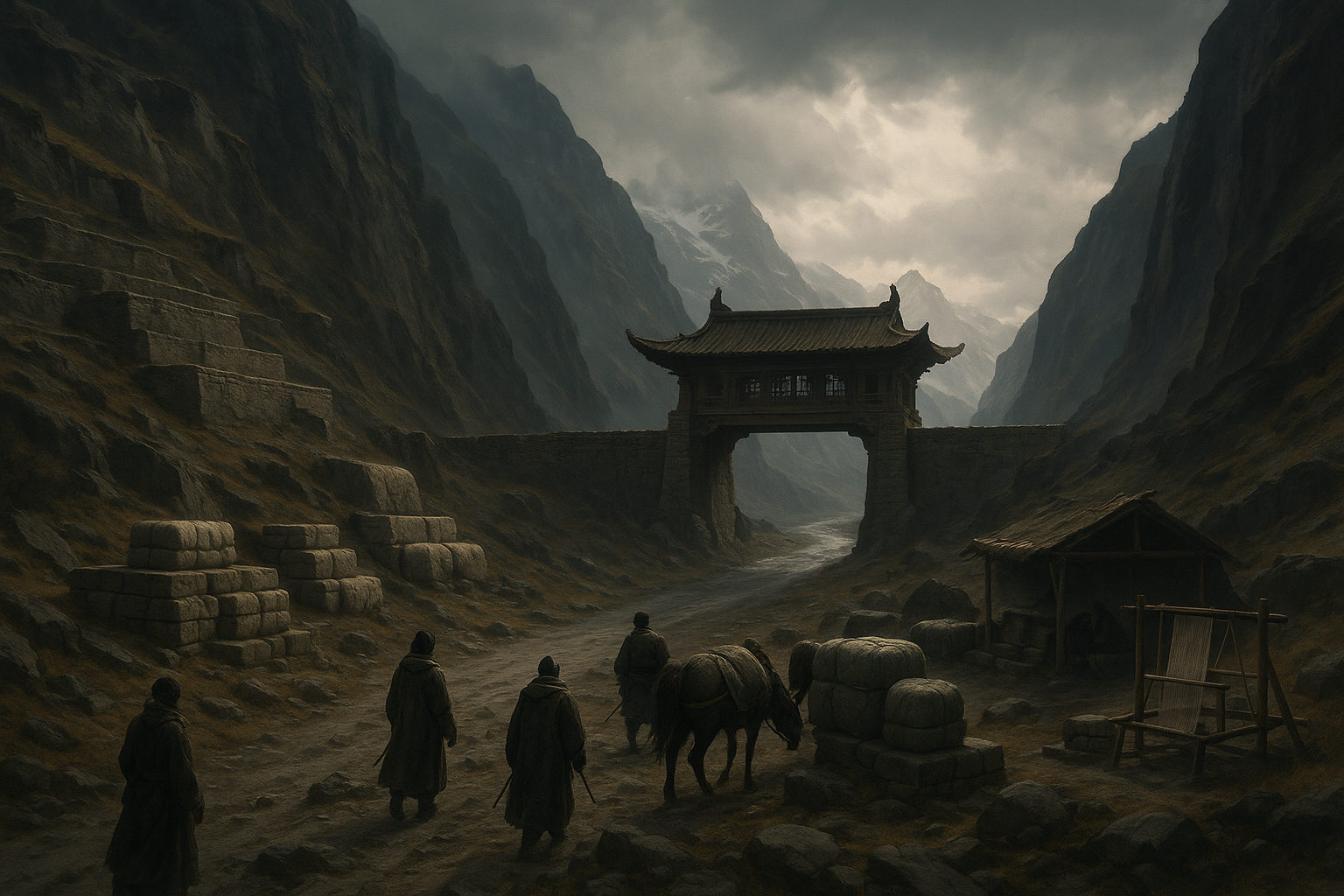
Minxain itself sits in the one relatively sheltered position on the northern slope's upper approach; a rock formation deflects the prevailing wind enough to make permanent habitation practical. Buildings are low and stone throughout, no timber above foundation level because the treeline is below. Roofs are weighted rather than pitched, because snow removal is a daily practice for part of the year and pitched roofs become projectile hazards.
The pass gate, the Koval family's toll infrastructure, is above the town, visible from the upper residential area. It is less imposing than the word "gate" implies; it is a stone-and-timber checkpoint structure across the road, staffed year-round, with a garrison building adjacent. What it represents, the control point for the most-used northern Hangyin crossing, is more imposing than its physical appearance.
Geography & Setting
Minxain occupies the Fenling Pass's northern approach at the highest elevation where permanent habitation is practical. Above the town, the pass route continues to the summit, which is accessible only in the summer months and marginal in spring and autumn. Below the town, the northern slope descends through the conifer forest belt to the broader northern plain: the approach road that connects Minxain to the northern Shoing settlements and, ultimately, to the Koko Nor coast.
Terrain is alpine foothill: rocky, exposed above the treeline, with the specific highland flora that the pass area supports. Minxain's water comes from snowmelt-fed springs that are reliable in the thaw months and from a maintained cistern system in the winter freeze. Agricultural capacity is minimal; the growing season at this altitude is too short for anything except the fastest-maturing highland herbs.
Sheep pasture is on the lower slopes, below the settlement, in the highest reaches of the conifer belt where summer grass supports the highland wool breeds. Sheep are moved to lower winter pastures, managed jointly with the lower-slope settlements, under a grazing agreement that the Koval family administers.
The People
Demographics
Minxain's permanent population is small and consistent; the altitude keeps it from growing beyond the environmental capacity, and the altitude also keeps people who were not born to it from settling comfortably. The dwarf garrison component, the engineers and stone-workers who maintain the pass infrastructure, has been permanent for approximately four generations and is culturally integrated into the town without being culturally merged.
The transient population is significant. Traders waiting for the pass to open, or sheltering from pass conditions that turned severe, or resting after the crossing are a constant presence in the inn and wayhouse district. In good-weather months, the transient population may exceed the permanent population. In winter, when the pass is closed, the town's population drops to its permanent core.
Economy
The pass toll is the foundation. Every merchant party, trade caravan, or individual traveler using the Fenling Pass pays a toll at the Koval gate. The toll rate is set by the Karubo Highland assembly and collected by the Koval garrison; the Koval family retains the administrative portion and remits the infrastructure portion to Karubo. The toll revenue is the most consistent income in the town's economy and the financial basis for everything else.
Highland wool is the second pillar. The specific wool breed maintained on the northern Hangyin slopes (the Koval Grey, named for the family that standardized the breeding program) produces a fiber that the eastern Shoing weaving tradition prizes for its specific density and insulating properties. Yarn is prepared in Minxain and exported to weaving operations in the eastern and western spheres.
Primary Exports
- Fenling Pass transit tolls: Not a product; the commercial service that defines the town's position; remitted to Karubo with the Koval administrative portion retained
- Koval Grey wool and yarn: The highland breed fiber; recognized quality standard; exported to eastern and western weaving operations
- Mountain herbs: Dried; alpine varieties that grow at this elevation and nowhere lower; medicinal and culinary specialty market
- Pass-stop services: Accommodation, provisioning, equipment repair for the transient trade population; not export but income
Primary Imports
- Food staples: The altitude cannot feed the permanent population without regular supply from lower elevations; grain, preserved goods
- Timber and fuel: The treeline is below the settlement; all fuel comes up the road
- Manufactured goods: Tools, metalwork, equipment for the pass infrastructure and the garrison
Key Industries
- The Koval Pass Administration: The toll collection and pass-management operation; the Koval family's core function
- The Wool Cooperative: The breeding, grazing, and preparation operation; several families jointly manage the Koval Grey herd
- The Wayhouse District: The inn and provisioning operations that serve the transient trade population; independently operated but dependent on the pass traffic the Koval administration generates
- The Herb Cooperative: The harvesting and processing of the alpine herb varieties; seasonal; employs the permanent population's non-specialist members during the harvest window
Food & Drink
Minxain eats for altitude. The cooking tradition emphasizes caloric density and preservation; the long winters and the physical demands of the pass environment produce a cuisine that is nourishing and specific and not particularly concerned with variety. Preserved meats, dried herbs, stored root vegetables from the lower farms, grain from the supply road. The sheep are not primarily eaten (they are the wool production), but culled animals contribute to the preserved meat supply.
Minxain's signature food is a dense spiced bread made with highland herb combinations that gives travelers sustainable energy for the pass crossing. Wayhouses sell it pre-made in sealed forms that survive the crossing in a pack. Traders who have made the pass multiple times specify it at the provisioning stop.
The altitude spirit, a distilled product made from the highland herbs and whatever grain the cook's recipe requires, is specific to the Hangyin mountain range and is not available at lower elevations. Koval household maintains a better quality version than the wayhouses.
Culture & Social Life
Minxain's culture is the product of altitude and purpose. The pass-control function gives the community a defined role in the larger Shoing political economy, and the definition is clear enough that it shapes the culture's self-understanding: they are the people who manage the crossing, and that management has honor and requirement and technique. The Karubo Highlands honor tradition is present; the specific expression emphasizes reliability: a warden who does not maintain the pass infrastructure in condition, or who applies the toll inconsistently, or who closes the pass inappropriately is as dishonored as one who fails in combat.
Constant presence of the transient trade population has produced a community that is practiced at hospitality without being particularly open. Travelers are served well. They are not integrated. That distinction is maintained without hostility.
The dwarf garrison component's cultural presence is most visible in the pass infrastructure itself: the stone construction technique, the engineering of the checkpoint and the wayhouses, and the maintenance protocols are all products of dwarf professional culture that the human population has adopted as functional practice while maintaining its own social traditions.
Festivals & Traditions
The Pass Opening
When winter ends and the Fenling Pass becomes navigable again, a determination made jointly by the Warden-Baron and the senior garrison engineer, the opening is marked by a ceremony at the gate. The first merchant party through pays a ceremonially reduced toll and receives formal acknowledgment from the Warden-Baron. The town eats together the evening after the first crossing.
The Wool Weighing
At the end of the summer shearing season, the total yield of the Koval Grey herd is weighed, graded, and formally recorded. The Wool Cooperative's members receive their share assessments, and the export allocation is confirmed. This is commercial ceremony but the community attaches significance to the annual result as an indicator of the highland conditions and the herd's health.
Music & Arts
The musical tradition is wind-informed, the sustained notes and specific rhythm of mountain wind music that developed at this altitude and does not translate well to lower-elevation performance. Minxain's musicians are known within the Karubo Highlands sphere as practitioners of this tradition.
Visual arts focus on the specific alpine imagery (the mountain, the pass, the Koval Grey sheep) and on the textile tradition that the wool production supports. Finest Koval Grey yarn pieces produced by the cooperative's best finishers are art objects as well as luxury goods.
Religion
Primary Faith
Fujin is the high pass made personal: wind, storm, and the refusal to pretend the mountain can be tamed.
Secondary / Minority Faiths
Talbar is honored in toll ledgers and caravan terms. Ryujin is respected where rivers begin and snowmelt becomes travel. Household ancestor shrines are maintained with unusual seriousness, and Shen-Li is invoked in the pass-guard genealogies. Cameth is common in hearth-rooms and garrison kitchens. Shinigami oversees funerals for those lost to avalanche and exposure.
Secret or Forbidden Worship
None stable; the garrison watches the pass too closely.
History
Founding
The Fenling Pass has been used for as long as the northern Shoing settlements have traded with the central basin. The settlement at its northern approach is old, older than the Koval family's governance. The Koval family arrived approximately two hundred years ago and formalized the pass-management function under Karubo Highland authority, establishing the toll structure that replaced the informal payment tradition of the pre-formalization period.
Key Events
The Koval Toll Compact with Karubo (approx. 195 years ago)
The formalization of the Fenling Pass toll under Karubo Highland administrative authority, with the Koval family as the implementing Warden-Baron. The compact's revenue-sharing structure and the infrastructure maintenance obligations have been the legal framework for the pass management since.
The Winter Collapse (approx. 70 years ago)
An early and severe winter caught a significant merchant caravan in the pass approach zone (above the town, below the summit) when the pass closed prematurely. The rescue operation, led by the Koval garrison and involving the entire permanent population, saved the majority of the stranded travelers. The event established the current early-closure trigger protocols that the garrison uses to prevent future similar situations.
The Infrastructure Expansion (approx. 30 years ago)
The Karubo Highland assembly approved a significant expansion of the pass infrastructure: additional wayhouse capacity, improved road surface in the most deteriorated sections, and new garrison facilities. The expansion was funded by a temporary toll surcharge over eight years. The improved infrastructure significantly increased the pass's usable-season length and the volume of trade it can handle.
Current State
Minxain is stable and functionally effective. The pass is well-maintained. The toll revenue is consistent. The Koval Grey herd is healthy. Warden-Baron Serek is experienced and respected in the Karubo assembly. The active concern is a trade route shift; two seasons ago, a competing pass further west opened under improved conditions that reduced the Fenling Pass's traffic volume by an estimated fifteen percent. Whether this is a temporary routing choice by merchants seeking novelty or a permanent structural shift is not yet determinable.
Leadership & Governance
House Koval: Overview
The Koval family holds the Warden-Baronship under Karubo Highland authority. The governance is specifically organized around the pass function: toll administration, infrastructure maintenance, garrison management, and the traffic authority that determines when the pass opens and closes. The family's commercial interest in the Koval Grey wool operation is managed separately but is understood by everyone as related to the governance position.
Warden-Baron Serek Koval
Human, Male; late fifties
Serek has been Warden-Baron for twenty-two years and has spent them maintaining the infrastructure, managing the Karubo relationship, and keeping the pass open as many days per year as the weather allows. He is experienced in the pass conditions at a level that allows him to second-guess the garrison's weather readings, which the garrison finds mildly irritating and occasionally useful.
He has a son, Davan, who manages the wool cooperative and is being prepared for the succession. The Karubo relationship concerns him more than the traffic route shift; the assembly has been discussing restructuring the toll revenue split in ways that would reduce the Koval family's administrative portion, and Serek believes the discussion is more serious than it has been in previous cycles.
Davan Koval: Wool Cooperative Director
Human, Male; mid-thirties
Davan manages the Koval Grey breeding program and the cooperative's commercial operations. He is less interested in the pass management than in the wool trade, which concerns his father, and more effective at the wool trade than Serek expected, which pleases him. His primary commercial concern is finding new buyers for the Koval Grey yarn in markets that the current distribution channels don't reach.
Notable Figures
Senior Engineer Dora Stonewright: Dwarf, Garrison Infrastructure Lead
Dwarf, Female; fifties; the garrison and pass infrastructure
Dora manages the engineering and maintenance operations for the pass infrastructure (the road, the checkpoint, the wayhouse structural maintenance) and is the person whose weather-reading the Warden-Baron's informal overrides are occasionally in tension with. She is the institutional knowledge of what the Fenling Pass's physical condition requires. Her family has been in the garrison for four generations.
Wayhouse Manager Orla Vend: Inn District Lead
Human, Female; forties; the wayhouse district
Orla manages the largest wayhouse and is the de facto coordinator of the wayhouse district's operations: the provisioning schedule, the accommodation allocation during high-traffic periods, and the information flow about road conditions that the district provides to arriving travelers. She is the first significant contact most visitors have with Minxain's permanent population and is practically effective at the communication role this requires.
Head Shepherd Mara Dunwald: Koval Grey Breeding
Human, Female; sixties; the lower pastures
Mara has been managing the breeding program for thirty years and is responsible for the specific qualities that distinguish the Koval Grey from other highland wool breeds. She trains the younger shepherds in the breeding selection protocols that maintain the herd's fiber quality. She is also the person who first noticed that the herd's size has been declining slightly for three years, not dramatically, but consistently.
Key Locations
Seat of Power
- The Koval Warden House: Positioned between the town's upper residential area and the pass gate; stone construction; the administrative and residential functions are combined; the passage route is visible from the upper windows
Houses of Worship
- The Fujin Wind Post: A stone post at the settlement's highest point, carved with wind direction markers accumulated over generations; not a building; the primary worship practice involves observing conditions at the post and the formal recording of significant weather events in the associated log
Inns & Taverns
- The Crosser's Inn: The largest wayhouse; Orla Vend's operation; the essential provisioning stop for the pass route; the spiced traveling bread is produced here
- The Summit View: A smaller wayhouse aimed at the longer-stay visitor market; better quality than the Crosser's; the view of the pass from the upper room is the establishment's primary selling point
Shops & Services
- The Wool Cooperative Office: Where the Koval Grey yarn and fiber is sold in commercial quantities; direct retail available but not the primary commercial channel
- The Herb Drying House: The alpine herb processing operation; seasonal; direct purchase from the cooperative during the processing period
The Market
- The Pass-Side Market: Open twice weekly during the pass season; primarily provisioning goods for travelers, plus the local producers' output; the herb and yarn are the primary local products
Other Points of Interest
- The Fenling Pass Gate: The toll checkpoint above the town; the physical implementation of the Koval family's authority; staffed year-round; the view from the gate southward into the central basin is available to anyone who pays the toll
- The Lower Sheep Pastures: Below the settlement in the upper conifer zone; where the Koval Grey herd spends the summer; visible from the approach road
Secrets, Rumors & Hooks
- The competing western pass that has been drawing Fenling traffic is not operating under normal commercial conditions. Senior Engineer Dora has been tracking the western pass's maintenance records through the dwarf engineering network, and the infrastructure investment being made there is significantly beyond what the toll revenue would support. Someone is subsidizing it, and the most likely reason is that they want to divert specific cargo flows away from the Karubo-monitored Fenling route.
- Warden-Baron Serek's concern about the Karubo assembly's toll revenue restructuring discussion is more acute than he has expressed publicly. He has seen the draft proposal that will be presented at the next assembly session, and its terms, if passed as written, would reduce the Koval administrative portion to a level that does not fund the infrastructure maintenance the pass requires. He believes the proposal is being driven by a specific Karubo faction whose interest in reducing the Koval position is not purely financial.
- Mara Dunwald's observation about the herd size decline is correct. The breeding records she maintains show a consistent reproductive rate reduction that is not explained by the environmental conditions or the pasture quality. The pattern matches something in the oldest breeding records, an event approximately one hundred twenty years ago that the records describe as "the mountain sickness" that affected the herd for two seasons and then resolved. What caused it then and what is causing it now is not in the records.
- There is a structure in the upper pass, above the treeline and below the summit, that the garrison is aware of and does not formally acknowledge. It was present when the Koval family arrived and was present in the oldest maps of the route. Its origin is unknown. Dora Stonewright's most recent inspection of the pass infrastructure included a survey note on the structure that reads only: "stable, unchanged, no action required." She has been saying this for fifteen years.