Patok
Patok: The Town at the River's Mouth
"The delta gives us the timber and the fish. The Rhodian Ocean gives us the buyers. The arrangement is clear and has been working for two hundred years. We are not interested in optimizing it."
Harbor-Baron Ino Sarko, to a Gwajin commercial consultant's efficiency proposal
At a Glance
| Continent | Shoing |
| Region / Province | Eastern Shoing, Gwajin Realm: Rhodian Ocean coast, Sarko River delta |
| Settlement Type | Town |
| Population | ~5,500 |
| Dominant Races | Human (majority), Half-Elf (timber trade) |
| Ruler / Leader | Harbor-Baron Ino Sarko |
| Ruling Body | House Sarko, hereditary Harbor-Baronship under Gwajin Realm authority; the Harbor designation reflects the founding family's combined governance and maritime commerce role |
| Primary Deity | Ryujin (sea, rivers, and the safe passage between them) |
| Economy | Coastal timber export, river fish preservation, Rhodian Ocean fishing, small-vessel construction |
| Known For | The coastal forest hardwood that the eastern Shoing shipbuilding industry specifies for specific hull components; the Sarko delta smoked fish that the Gwajin court's preserved fish buyer requests by name; the river-mouth harbor that is the most significant Rhodian Ocean port north of the Gulf of Siem |
First Impressions
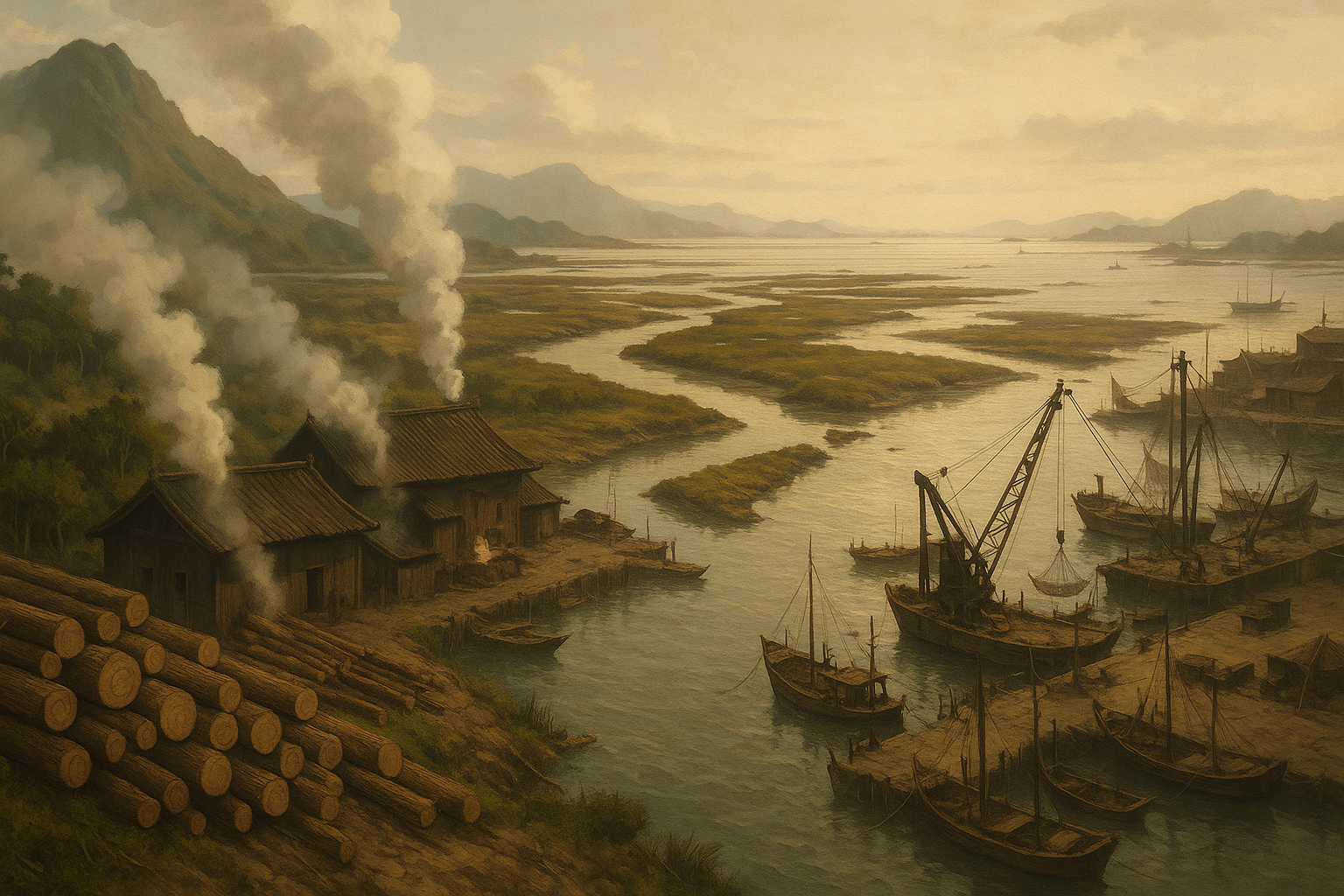
The Sarko River delta is the town's geography. Four channels spread across a broad flat mouth where the river meets the Rhodian Ocean, and the town occupies the elevated ground between the two most navigable channels, elevated meaning perhaps ten feet above the highest flood level, which is enough to have kept the residential areas dry for the past century. On the western channel's bank are the timber yards: enormous stacked logs from the coastal forest that begin here for their journey to the eastern Shoing shipyards and construction sites.
Patok's harbor is the eastern channel's inner reach, protected from the Rhodian's open-ocean conditions by the delta's own sandbar configuration. Smoked fish operations are on the eastern bank, downwind of the residential area, in a district that the town's residents describe as productive and visitors describe as memorable.
Geography & Setting
Patok sits at the Sarko River's delta, where the coastal forest that lines the eastern Shoing coast transitions into the delta flatland. Coastal forest, old-growth hardwood and dense mixed woodland, extends inland for several miles and provides the timber that the town's commercial identity is built on. The river and delta provide the fish. The Rhodian Ocean provides the maritime access.
Harbor depth is maintained by the river's current pushing against the tidal inflow, a natural phenomenon that has kept the harbor navigable without dredging for the entire recorded history of the settlement. Delta sandbar configuration shifts seasonally but the primary channel has been consistent.
The People
Demographics
Patok is predominantly human with a half-elf presence in the timber trade; the same long-working-lifespan commercial advantage applies here as in other eastern Shoing cities. The river fishing community includes families that have been working the Sarko delta for multiple generations and whose knowledge of the delta's specific channels, fishing grounds, and seasonal behavior is the practical foundation of that industry.
Economy
Timber is the primary commercial product. The coastal forest hardwood that the Sarko basin produces, specifically the old-growth varieties that provide the hull planking components the eastern Shoing shipbuilding industry requires for specific structural functions, is exported by barge and coastal vessel to the yards at Gwajin, Kegun, and the smaller eastern ports. The Half-Elf timber brokers who have been managing the trade relationships for the past three generations have the most current buyer contacts.
Smoked fish is the premium secondary product. Combined with the specific smoking technique that the Sarko fishing families have developed over generations, the Sarko delta's specific fish varieties produce the Gwajin court's preferred preserved fish product. Specification by name from the court buyer is the most commercially significant endorsement the town's food production has received.
Primary Exports
- Coastal forest timber: Old-growth hardwood hull planking; specified by eastern Shoing shipyards; exported by water
- Sarko smoked fish: Court-specification preserved product; the most premium secondary export
- River fish in volume: General preserved forms; commercial trade good without the court specification
- Small vessel construction: The town's own shipyard produces small craft for the delta fishing and coastal trade
Key Industries
- The Timber Yard Operations: Multiple family operations managing the harvest, floating, and staging of the coastal forest timber
- The Smoked Fish Cooperative: The fishing families' collective organization for the premium preservation product
- The Harbor-Baron's Customs Administration: The Sarko family's direct commercial function alongside the governance role
Food & Drink
Patok eats fish with the specificity of a community that has been fishing the same waters for generations. The Sarko smoked fish that is the export product is consumed locally at a quality level that the court buyer would recognize as equivalent to what is being shipped. The coastal game (sea birds, coastal mammals taken in specific seasons) supplements the fish diet. River greens and root vegetables from the delta flat's agricultural plots round out the diet.
Delta-community tea, made with delta stream water and specific marsh herb varieties, is specific to this environment and is the most distinctive non-fish aspect of the local food culture.
Culture & Social Life
Patok's culture is the river delta's culture: specific knowledge of a specific place, organized around the seasonal rhythms that the delta imposes. The eastern Shoing honor tradition is present; the specific expression here centers on the delta knowledge: a fisher who claims expertise they don't have, or a timber broker who misrepresents a log grade, is dishonored in terms that the community understands as equivalent to more obviously social honor violations.
Sarko's long commercial engagement with the harbor function has produced a governance tradition that is practically oriented rather than ceremonially oriented; the Harbor-Baron's prestige comes from the harbor's operation rather than from the family's social position.
Festivals & Traditions
The First Smoke
When the autumn fishing season produces the year's first premium smoking batch (the specific timing is the fishing cooperative's determination), the First Smoke ceremony marks the beginning of the production season. The Harbor-Baron receives the first sealed unit from the batch; the court buyer's annual order is formally accepted; the cooperative begins production.
The Timber Float
When the seasonal river conditions are right for floating the timber from the interior harvest points to the delta staging yards, typically in the spring high-water period, the Float is organized as a community event. All available labor participates in moving the timber. The completion of the Float, which may take several days, is celebrated with the town eating together.
Religion
Primary Faith
Ryujin is Patok's river-mouth truth: sea and river meet, and safe passage between them is treated as sacred.
Secondary / Minority Faiths
Talbar is strong in timber export contracts and preserved fish brokerage. Caminus is honored by small-vessel builders and sawyers. Cameth is a household faith in dock neighborhoods that live by storms. Household ancestor shrines are universal and explicitly tied to Shen-Li in ship-family lineages. Martus thrives in risky departures.
Vessikar has shrines near weighhouses and market courts; honest measures are treated as civic peacekeeping. Caldrin is honored at gates, bridges, and caravan yards for safe passage, true directions, and upheld guest-right. Nesara is honored at wells and river shrines, and in irrigation councils: water held in trust for everyone downstream. Sylira keeps whisper-shrines in inns and social halls: places to trade news, manage reputation, and pretend it isn't politics.
Secret or Forbidden Worship
Shinigami is the primary death authority; their rites govern drowning deaths and the consecration of graves in the wet delta soil.
History
Founding
The Sarko River delta has been used for fishing and timber access since before the current settlement's organization. The Sarko family's governance (and the Harbor-Baronship) was established approximately two hundred years ago under Gwajin Realm administrative initiative.
Key Events
The Court Smoke Specification (approx. 70 years ago)
The Gwajin court's formal specification of the Sarko smoked fish as its preferred preserved fish product. The specification is the town's most commercially significant historical event and the foundation of the premium trade that distinguishes the smoked fish cooperative's output from general preserved fish production.
Current State
Patok is stable and productive. The timber trade is consistent. The smoked fish specification is maintained. Harbor-Baron Ino is in his forties, experienced, and managing one specific concern: the coastal forest's old-growth sections, which produce the premium hull-planking timber, have been harvested at a rate that the half-elf timber brokers' projections indicate is not sustainable beyond another generation at current volumes. The adjustment to sustainable harvest rates will reduce the premium timber volume and the associated revenue.
Leadership & Governance
Harbor-Baron Ino Sarko
Human, Male; mid-forties
Ino has been Harbor-Baron for thirteen years and has spent them managing the commercial operations and the Gwajin administrative relationship. He is effective and specifically aware of the old-growth timber situation; he has had the half-elf brokers' projections reviewed twice by independent assessors and the result has been the same each time. He is deciding when and how to present the situation to the Gwajin Ministry of Commerce.
Notable Figures
Timber-Factor Lera Brightvale: Half-Elf, Timber Trade
Half-Elf, Female; appears mid-thirties, actual age around seventy; the timber yards
Lera manages the timber trade relationships with the eastern Shoing shipyards. She has held the role for forty years and has the institutional knowledge of the buyer relationships that makes her effectively irreplaceable. She is the person who produced the old-growth sustainability projections, which she presented to Ino two years ago and which he has been sitting on since.
Smoke-Master Haku Tetsu: Fishing Cooperative Lead
Human, Male; sixties; the smoked fish cooperative
Haku manages the cooperative and is the person whose quality assessment the court buyer's specification is based on. He trained under his father and is training his daughter. The specific smoking technique that produces the Sarko specification product is held in the Tetsu family's practice.
Key Locations
Seat of Power
- The Sarko Harbor House: On the elevated ground between the two harbor channels; the administrative and residential center; the harbor is visible from every upper room
Houses of Worship
- The Ryujin Delta Temple: At the main channel junction; oriented toward both the river and the sea approaches
Inns & Taverns
- The Timber Float Inn: The primary accommodation; in the market district between the timber yards and the harbor; the smoked fish is served here at the premium quality
Secrets, Rumors & Hooks
- Lera Brightvale's old-growth sustainability projections include a section that she has not shared with Ino: an alternative analysis of the coastal forest's old-growth population that suggests the decline rate she measured is not from harvest volume but from a specific forest pathology affecting the target species. If this analysis is correct, reducing harvest rates will not solve the problem. The pathology's cause is not identified in her notes.
- Smoke-Master Haku's smoking technique includes a specific component (a particular wood variety added in the final phase) that comes from the Luxiang Forest region. The supply of this wood has been reliable for thirty years through a specific supplier network that Haku manages personally. Three months ago, the supply was disrupted without explanation. Haku has been working around the gap but the court buyer's next assessment will detect the quality difference if the gap continues.
- The harbor's sandbar configuration, which has been naturally stable for the recorded history, showed an unusual shift in last season's survey. The shift is minor and could be within normal variation. It could also be the beginning of the same kind of delta movement that has been occurring at Zazua's Third Finger. The harbor survey authority, which is the Harbor-Baron's office, has not yet determined which.