Pingyi
Pingyi: The Town at the World's Edge
"The Koko Nor does not care about Galshi politics, or Gwajin trade routes, or what the southern courts think of anything. The Koko Nor cares about the season. We have learned to agree with it."
Count Boro Ketai, in correspondence with the Galshi court
At a Glance
| Continent | Shoing |
| Region / Province | Northwest Shoing, Koko Nor Ocean coast: polar coastal plain |
| Settlement Type | Town |
| Population | ~1,900 |
| Dominant Races | Human (majority) |
| Ruler / Leader | Count Boro Ketai |
| Ruling Body | House Ketai, hereditary Count; nominal subject to Galshi Western Coast but effectively autonomous due to distance and terrain |
| Primary Deity | Cael (weather, winter sea-storms, endurance); Ryujin secondary |
| Economy | Marine mammal hunting, ice fishing, rendered whale oil, sea-mammal ivory and fur trade |
| Known For | The most remote permanently inhabited settlement in Shoing; whale oil that burns cleaner and longer than any other available; the hunters who pursue prey in conditions that would strand any southern ship |
First Impressions
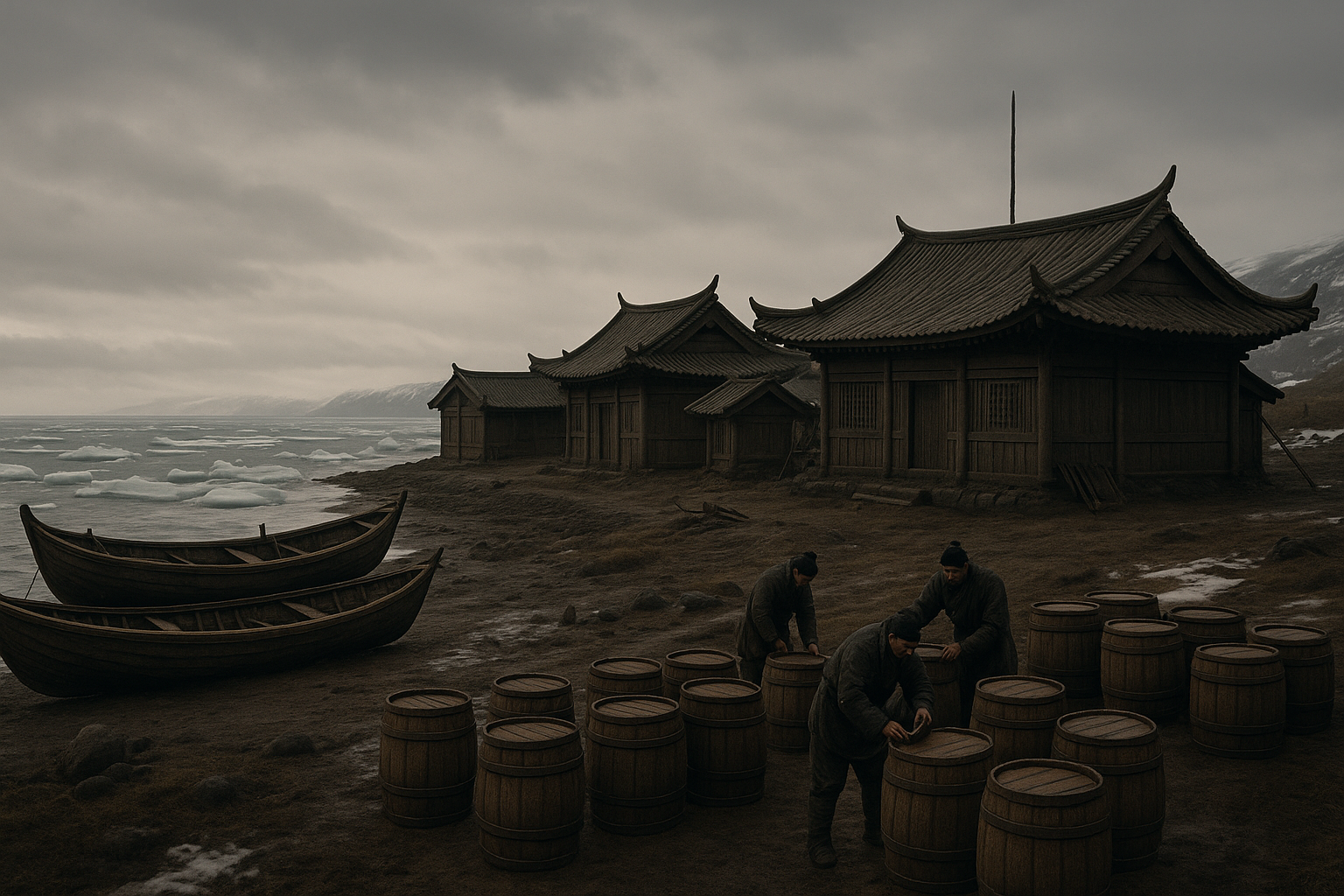
The first sign of Pingyi on the Koko Nor approach is smoke. Not fire: smoke, heavy and low, from the rendering houses where the whale oil is processed. Pingyi itself is visible only when you are close enough that turning back is no longer the obviously better option. It sits on a flat coastal shelf between the frozen plain and the sea, built low and close to the ground the way that structures in serious wind learn to be. Architecture is sod-roofed stone, turf banked against the outer walls, the windows small and shuttered. Every building faces slightly away from the prevailing northwest wind. This is not coincidence.
The harbor, such as it is, is a natural break in the sea ice where a rock formation disrupts the current enough to keep a channel open through most of the winter. Hunting boats are pulled up on the ice shelf when not in use, not anchored. A boat left at anchor in the Koko Nor is a boat you may not see again.
The rendering houses are downwind from the residential area, which in Pingyi means they are east, which means on most days the whole settlement smells of whale oil processing. Residents do not notice this. Visitors do, uniformly, and comment on it, once.
Geography & Setting
Pingyi occupies one of the few sections of northwest Shoing's polar coast where the ground is stable enough to build on and the sea access is reliable enough to hunt from. The frozen coastal plain extends north into the Koko Nor's seasonal ice shelf in winter and becomes a flat, marshy, insect-rich tundra in the brief summer, brief enough that "summer" feels like an optimistic description of three months where the temperature rises above freezing.
The Koko Nor here is colder than its eastern sections. Throughout the year, the northwest current brings ice floes from the polar regions; in winter, the sea surface freezes to a usable degree for several miles out. Hunters work from the ice edge when the season allows and from boats when it does not. That distinction matters less than southerners assume; the experienced Pingyi hunters are equally competent at both.
Behind the settlement the interior is low tundra, essentially uninhabited. There are no forests. Timber for the settlement's construction and maintenance has been arriving by ship from the south for as long as the settlement has existed. One of the most important supply deliveries each year is timber. Second most important is grain.
The People
Demographics
Pingyi is predominantly human, predominantly of families that have been here for multiple generations, and not particularly interested in new arrivals. The community is small enough that everyone knows everyone's capabilities: not just socially, but practically, in the sense of knowing whose judgment to trust in a storm and whose not to. This level of mutual assessment produces a social environment that is specific in its hospitality: strangers are adequately provided for, but full integration is a long process.
Emigration rate is effectively zero and the immigration rate is barely positive. Population growth comes from births, not from arrivals. Settlement size has been approximately stable for a century.
Economy
Whale hunting is the foundation. The Koko Nor's northwest waters support several whale varieties that do not appear in the eastern sections, and the rendered oil from the northwest whale is notably cleaner-burning than alternatives available elsewhere in Shoing. This is the settlement's primary commercial value to the wider world: the oil, in sealed ceramic containers, loaded onto the southern supply ships that come twice a year when the ice conditions allow.
The secondary products (ivory from the marine mammals, the furs of the sea animals taken as incidental catch, preserved fish from the intensive summer ice-fishing season) are commercially significant in aggregate and represent most of the population's daily work outside of the whale hunts.
Primary Exports
- Northwest whale oil: The defining product; clean-burning; in demand across Shoing for lighting and lubrication; arrives in the south twice yearly
- Marine mammal ivory: Carved raw; the southern craftspeople finish it; rarer and more valuable than the oil by weight
- Sea-mammal furs: Cold-water varieties not obtainable elsewhere; warmth properties recognized as exceptional
- Preserved fish: Dried and salted; consumed locally and exported as surplus in good years
Primary Imports
- Timber: Every beam in every building came from the south; critical; the supply ships' most essential cargo
- Grain: The tundra produces nothing sufficient; the settlement eats what comes by ship
- Metal goods: Iron tools, weapons, ship fittings; nothing is smelted locally
Key Industries
- The Hunting Cooperative: All active hunters operate collectively; the whale hunts require coordinated effort that makes individual enterprise impossible; income from major hunts is distributed collectively with specific shares for the Count, the boat captains, and the crews
- The Rendering Houses: Three operations on the eastern edge of town that process the whale catch into exportable oil; managed by specialist families
- The Bone and Ivory Workshop: One family that processes the raw material into trade-ready form
Food & Drink
Pingyi eats protein and fat with a thoroughness that reflects the caloric demands of the climate. Whale meat (which is not exported, being too bulky and too heavy for the shipping economics) is the primary protein source for much of the year. Preserved fish supplements it. The summer months produce a short window of gathered greens from the tundra, valued intensely. Grain from the south is rationed and managed carefully.
Cooking tradition has developed specific techniques for the available ingredients: long preparations that extract maximum nutrition from whale-derived materials, fermented fish preparations that preserve through winter, specific uses of rendered fat in the cooking itself. The result is food that is unfamiliar to southerners and nutritionally complete.
The drink is a fermented preparation made from whatever grain surplus allows. The Count's household maintains a small store of southern spirits for significant occasions. Day-to-day, the town drinks water and the fermented grain beverage and does not discuss the topic of variety.
Culture & Social Life
Pingyi's culture is built around competence and collective survival in conditions that consistently punish both incompetence and individualism. The honor culture of western Shoing is present but modified: honor here is less about lineage and more about demonstrated capability under the specific conditions of the northwest coast. A Count's household can be dishonored by poor hunting judgment as readily as by a personal slight.
Pingyi's relationship with the Galshi Western Coast political sphere is nominal. The Count pays the appropriate tribute when the supply ships arrive, maintains the formal correspondence, and is otherwise autonomous. Galshi's court is aware that sending enforcement or inspection to Pingyi is impractical and has decided it is also unnecessary.
The community is not isolated in spirit; the supply ship arrivals are significant events, and the news and goods they bring are consumed with genuine interest. But the self-sufficiency that the location requires has produced a population that is, in practice, organized around its own priorities.
Festivals & Traditions
The Ice Opening
When the Koko Nor's spring thaw opens the hunting grounds for the season's first major whale pursuit, the entire town participates in a formal preparation. The boats are launched with specific ceremony, the hunters receive acknowledgment from the community, and the Count performs a brief invocation of Cael's patience. The ceremony is practical as much as spiritual; it is also the coordination point for the season's hunting plan.
The Supply Ship Festival
When the annual supply ships arrive (typically twice per year, in the two seasonal windows when the ice permits it), the town treats it as its primary social event. The unloading is communal work, the goods are inventoried publicly, and the evening following is the closest thing Pingyi has to a general celebration.
Music & Arts
The musical tradition is vocal (instruments don't survive the environment well) and consists of hunting songs, seasonal narrative songs, and a specific genre of long-form oral composition that tells the stories of significant hunts. These compositions are taken seriously as historical record as well as artistic expression.
Visual arts run to carved ivory and bone, produced during the long interior winter months. Quality is high because the time investment is significant and because the work gives the carvers something to do during the months when outdoor activity is severely curtailed.
Religion
Primary Faith
In Pingyi, the weather and the sea are worshipped as the real powers: Cael is honored for endurance against storm, and Ryujin for the conscious will of the cold water.
Secondary / Minority Faiths
Household ancestor shrines are maintained with fierce seriousness, and Shen-Li is invoked in the settlement's seasonal remembrance lists. Cameth is honored in warming rooms where shelter is survival.
Secret or Forbidden Worship
Shinigami is primary for death rites at the edge of the world; funerals are strict, timely, and uncompromising.
History
Founding
The settlement predates the Ketai family's governance. It began as a seasonal hunting camp (a place from which the northwest whale grounds could be accessed) and became permanent when a group of hunters decided that wintering on-site was preferable to the return journey south before each season. The timing of this decision is lost. The Ketai family arrived approximately two hundred years ago and formalized governance of a community that had been functionally self-governing before them.
Key Events
The Ketai Compact with Galshi (approx. 190 years ago)
The first Ketai Count negotiated the formal relationship between Pingyi and the Galshi Western Coast governance structure: tribute in oil and ivory, administrative autonomy in exchange, and the supply ship schedule guaranteed by Galshi. The compact has been renewed by each subsequent Count and has not changed substantively.
The Great Ice Year (approx. 60 years ago)
A winter of unusual severity froze the Koko Nor solid far further than the normal seasonal pattern, preventing the spring hunting season entirely and delaying the supply ships by three months. The town survived on stored whale fat and fish reserves. The Count at the time, Boro's grandfather, made decisions about reserve distribution that the community's oral tradition credits with the survival of the entire population. The year established the current reserve storage requirements that have been maintained since.
Current State
Pingyi is stable in the specific way of a community organized around consistent annual rhythms that the environment enforces. The supply ships are arriving on schedule. The hunting seasons have been productive for three consecutive years. Count Boro is in his mid-forties, experienced, and trusted. The one active concern is a change in the whale migration timing; the northwest whale's seasonal pattern has shifted slightly over the past decade, requiring the hunters to pursue further from the established grounds. Whether this is a long cycle variation or something new is not yet clear.
Leadership & Governance
House Ketai: Overview
House Ketai holds the County by compact with Galshi, and the authority by the community's ongoing practical consent. A Count who cannot make sound hunting and resource decisions in Pingyi does not remain Count through any mechanism that requires naming. The Ketai family has, for seven generations, been good at the job. The governance is practical and specific: supply management, hunting coordination, tribute compliance, and the maintenance of the Cael rites that structure the season.
Count Boro Ketai
Human, Male; mid-forties
Boro has been Count for fourteen years, following his mother's death. He is experienced in the hunting grounds in the direct sense; he ran his own boat for six years before taking the title, and he can still crew one competently. His governance is practical and his community relationships are strong. He is managing the whale migration change with attention and a degree of concern he does not share publicly.
He has two sons, both active hunters. The succession is clear in the formal sense. Whether the elder son has the judgment the role requires is a question Boro is observing without pressure.
Nara Ketai: Boat-Captain, Boro's Niece
Human, Female; mid-twenties
Nara is Boro's niece, the daughter of his deceased sister, and the most capable hunter of her generation in Pingyi. She commands the town's largest hunting boat, makes decisions in the field that have twice saved crew members in dangerous conditions, and has a relationship with her uncle that is professionally excellent and personally complicated by the fact that she would be a better Count than either of his sons.
Notable Figures
Elder Mast Sugin: Rendering Specialist
Human, Male; sixties; the rendering houses
Sugin manages the primary rendering operation and is responsible for the oil quality that the Galshi buyers specify and pay for. He trained his technique from his father, who trained from his father. The specific process that produces Pingyi's characteristically clean oil is not written down. It is held in the Sugin family's practice.
Supply-Keeper Ora Deshi: Trade Logistics
Human, Female; thirties; the harbor
Ora manages the supply ship correspondence, the inventory of the town's export stockpile, and the negotiation with the ship captains when they arrive. She is the town's primary contact with the outside world and has developed opinions about it that she expresses carefully and only to people she trusts.
Key Locations
Seat of Power
- The Ketai House: The Count's residence; stone and turf, on the settlement's one rise; less imposing than most noble residences but better insulated than anything else in the town
Houses of Worship
- The Cael Shore Stone: A specific large rock at the harbor's edge where the pre-hunt invocations are performed; not a building; the stone has been marked with accumulated carvings for as long as the settlement has existed
Inns & Taverns
- The Rendering District Wayhouse: Technically an inn; practically a place for supply ship crews to sleep; not designed for extended stays; the smell from the rendering houses is strongest here
Shops & Services
- The Bone and Ivory Workshop: The Toma family operation; raw material processed here; visitors can arrange purchases of unfinished ivory work at prices well below what the southern markets charge for the finished product
The Market
- The Supply Dock Exchange: Not a formal market; when the supply ships arrive, the dock area becomes the town's commercial center for the duration of the unloading and reloading
Other Points of Interest
- The Rendering Houses: East of the residential area; downwind; the three operations that turn the catch into exportable oil
- The Ice Shelf Access: The point where the land meets the seasonal sea ice; where the boats are stored and from which the ice-hunting is conducted; the most practically significant location in the settlement's economy
Secrets, Rumors & Hooks
- Count Boro knows the whale migration shift is more significant than a cycle variation. The hunters' reports from the past decade show a consistent directional change that, if it continues, will put the northwest whale grounds beyond practical range in approximately twenty years. He has not told Galshi, because the practical response options that would require Galshi involvement are all worse than managing it quietly from Pingyi's side.
- Nara Ketai, during a deep-ice pursuit three seasons ago, found a structure on the ocean floor visible through a pressure crack in the ice shelf. The structure is not natural. It is large enough that she could not determine its full extent. She has not reported this to her uncle. She has been back twice. The structure does not appear on any chart or in any record she has been able to access.
- The Sugin family's oil-processing secret involves a specific mineral collected from a coastal shelf deposit approximately four miles east of the settlement. The deposit is finite. Mast Sugin's preliminary estimate, shared only with his eldest daughter, is that the deposit will be exhausted within thirty years. After that, the Pingyi oil will be chemically indistinguishable from the lesser northern varieties.
- One of the supply ship captains, a regular on the Galshi-Pingyi run for twelve years, has been quietly trading information about the town's oil stockpile levels to a third party in the south whose identity Ora Deshi has not confirmed. The information is commercially valuable in terms of timing acquisitions; whether the buyer is a market speculator or someone with more specific interest in Pingyi's productive capacity is not yet clear.