Saraburi
Saraburi: The Town That Was Watched
"We were a tool. We did not know we were a tool. The League penalized us for having been used. We accepted the penalty because the League is what keeps the sea open for all of us, and an institution that cannot enforce its standards is not an institution worth protecting. We are not bitter. We are careful."
Council-Representative Asha Dorne, Saraburi's first statement on reinstatement to the League Council of Seven
At a Glance
| Continent | Shoing |
| Region / Province | Southern Shoing, Cracked Sea archipelago: the Saraburi island cluster |
| Settlement Type | Town |
| Population | ~5,200 |
| Dominant Races | Human (majority), Smaling (island navigation) |
| Ruler / Leader | Provost Yim Dorne |
| Ruling Body | House Dorne, hereditary Provostship; the Provost title replaced the previous noble designation after the Indrani Affair's governance reform |
| Primary Deity | Talbar (honest exchange and the accountability that commerce requires) |
| Economy | Island fishing, Cracked Sea trade brokerage, pearl harvesting, inter-island transport services |
| Known For | The Indrani Affair: thirty years after the Gwajin intelligence operation that ran through Saraburi for fifteen years was exposed; the community that lost its League seat and was reinstated; the vetting protocols that the League now uses for all membership assessments |
First Impressions
Saraburi's island cluster is beautiful; the Cracked Sea's island variety is represented here in a specific favorable configuration, with the cluster's protected inner harbor and the outer island's reef providing shelter from the open sea while keeping the maritime access viable. The beauty is noted; it is not the first thing visitors who know Saraburi's history think about.
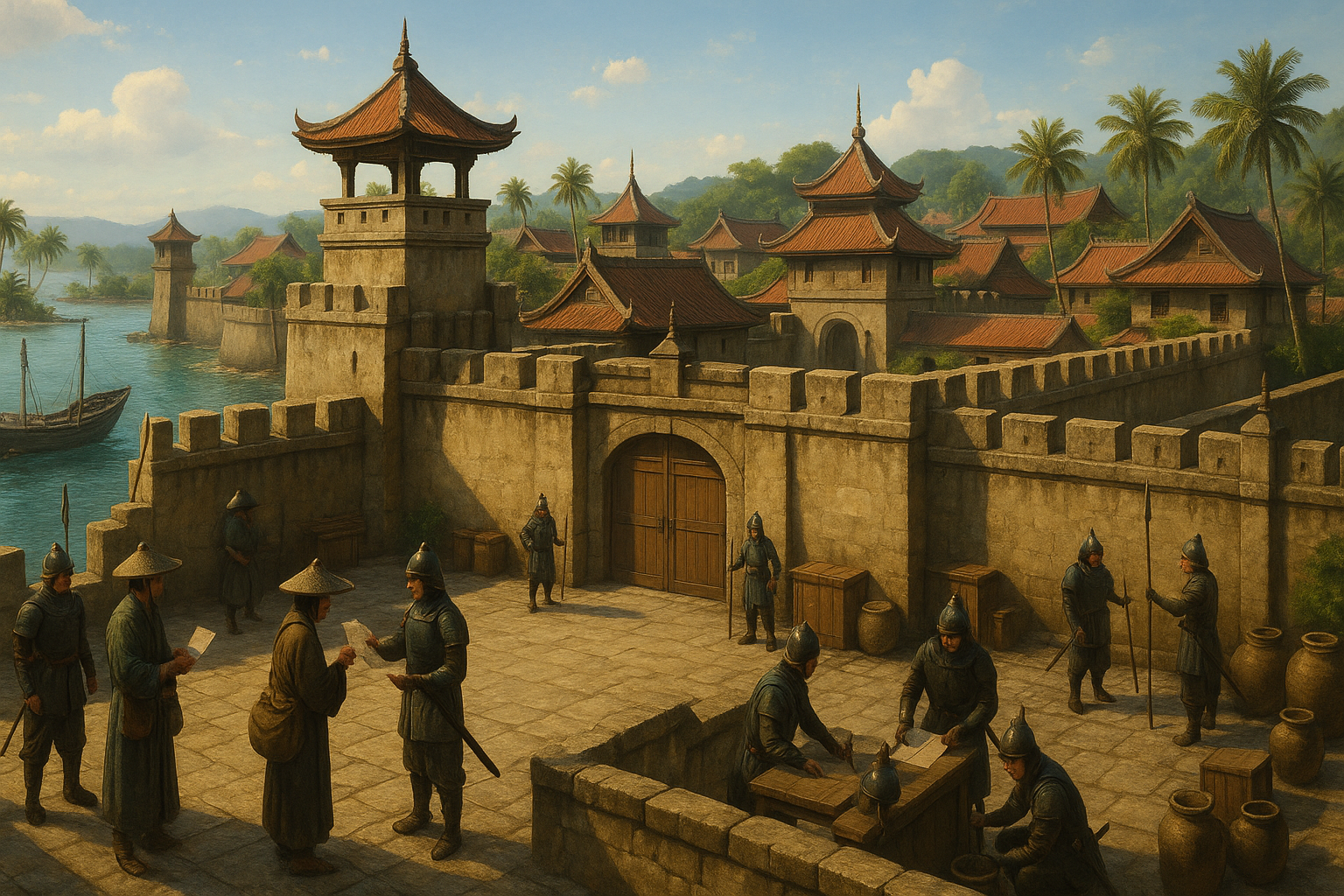
On the main island, the town occupies the harbor's inner shore. Architecture is island-practical: light-framed, open to the sea breeze, built on the assumption that the sea can be managed rather than excluded. Harbor facilities are well-maintained; the Dorne family's reconstruction following the Affair's aftermath included significant harbor investment funded by the difficult decade that followed.
The Talbar temple is the most prominent building in the town's commercial district, which is not the standard priority for an island fishing community. That prominence is deliberate; the town's post-Affair identity has made commercial transparency a governing value, and the temple's visibility reflects this. The accountability register that the Talbar practice requires, the public documentation of commercial relationships and ownership, is maintained here at a standard that exceeds any other Cracked Sea League port.
Geography & Setting
Saraburi's island cluster consists of four islands: the main island where the town sits, two smaller outer islands that provide reef and navigation shelter, and one small uninhabited island on the cluster's eastern edge. Protected by the outer island reef configuration, the cluster's inner harbor is accessible through two navigable channels. Maritime climate is temperate and consistent with the Cracked Sea's generally moderate conditions.
The main island's terrain is low; the highest point is a coral limestone rise on the island's northern end, approximately forty feet above sea level, where a navigation tower has operated continuously for two centuries. Fishing grounds accessible from the cluster extend across a productive area of the Cracked Sea where the reef system supports significant fish populations.
The People
Demographics
Saraburi is predominantly human with a Smaling presence in the island navigation and inter-island transport operations. The population is deeply conscious of its recent history; there is no one in the town over the age of thirty who does not know exactly what happened in the Indrani Affair and what the decade-long League seat removal meant. The consciousness of this history has produced a community culture organized partly around ensuring it does not happen again.
The population is stable but slow-growing; the Affair's aftermath was economically difficult enough that emigration exceeded immigration for nearly a decade. Reinstatement to the League Council has brought commercial recovery that is still recent enough to be felt.
Economy
Island fishing is the commercial foundation. The Cracked Sea's reef-associated fishing grounds around the Saraburi cluster are productive, and the town's fishing fleet has the access and the technique developed over generations. The pearl harvesting from the cluster's shallow reef sections is a secondary commercial product: Cracked Sea reef pearls rather than the river pearls of Lishui, with their own specific quality characteristics.
The trade brokerage function, which is the League port function that makes Saraburi's membership commercially valuable, has been significantly reformed following the Affair. Its accountability register system is the most visible reform: every commercial relationship that passes through the Saraburi brokerage is documented in a public register with ownership chains traced to actual individuals. This makes Saraburi the most commercially transparent League port and, its proponents argue, the most trustworthy one.
Primary Exports
- Cracked Sea fish: The fishing fleet's primary output; processed and preserved for export through the League trade network
- Reef pearls: The Saraburi cluster's specific variety; Cracked Sea pearls with characteristics distinct from the Zazua river-pearl trade
- Trade brokerage services: The League port function; reformed accountability structure since the Affair
- Inter-island transport: The Smaling navigation community's services connecting the Cracked Sea island settlements
Key Industries
- The Fishing Cooperative: The collective organization of the island fleet's operations
- The Accountability Register: The Dorne family's commercial transparency institution; the most distinctive administrative feature of the post-Affair governance
- The Pearl Harvesting Collective: The reef-pearl operation; smaller than the fishing industry but commercially significant
- The Inter-Island Transport Network: The Smaling-managed connecting service
Food & Drink
Saraburi eats island food: the specific Cracked Sea island cooking tradition that draws on the maritime catch, the island-grown tropical varieties, and the preserved goods that inter-island trade makes available. The cooking tradition is specific and good; the island communities of the Cracked Sea have, over generations, developed a culinary tradition that the mainland Shoing settlements underestimate.
The island drink is a fermented fruit preparation from a tropical variety grown on the cluster's main island. It is not exported in significant quantity. It is consumed locally with the specific appreciation that a community's own product commands.
Culture & Social Life
Saraburi's culture is the Affair's legacy, actively worked with rather than suppressed. The community has developed a specific social practice around the accountability register concept: in daily social life, the expectation of transparency about relationships and interests is more explicit here than in other Shoing settlements. People state their commercial relationships and affiliations more directly. The opacity that the Gwajin intelligence operation exploited for fifteen years has been countered by a cultural norm that finds opacity suspicious.
The honor tradition in Saraburi is specifically oriented around transparency as an honorable quality. A community member who conceals a commercial relationship, or who fails to document an affiliation in the register, is dishonored in terms that the community takes seriously.
The League membership is not taken for granted; the decade without a Council seat was economically and politically damaging enough that the restoration of the seat is understood as a continuing responsibility rather than a permanent achievement.
Festivals & Traditions
The Reinstatement Day
The annual acknowledgment of the League Council seat's restoration, which occurred twelve years ago after the decade-long removal. The ceremony is specific: the Provost reads the Council reinstatement document aloud at the harbor, the community acknowledges the obligation it represents, and the Accountability Register's annual summary is presented publicly. The ceremony is somber and attended by the full community. It is the town's most important annual event.
The Reef Festival
The peak of the pearl harvesting season, when the diving conditions and the pearl maturity align, is marked with a community festival at the reef. The harvesting results are assessed publicly, the year's commercial allocation is confirmed, and the evening is the most festively celebratory event in the town's calendar. The Reinstatement Day is more important; the Reef Festival is more fun.
Music & Arts
The island's artistic tradition is the Cracked Sea's inter-island style, the music and visual arts that have developed across the archipelago's connected communities. Saraburi's specific contribution is the transparency-themed textile work that the post-Affair craft tradition has developed: woven patterns that use the accountability register's documentation symbols as design elements. The pieces are distinctive and have begun attracting interest from mainland collectors who appreciate both the quality and the story they encode.
Religion
Primary Faith
Talbar is Saraburi's public god: honest exchange, accountability, and the idea that records can be trusted even after betrayal.
Secondary / Minority Faiths
Themela is honored in the vetting protocols and the League's reassessment rites - judgment and evidence as holy disciplines. Ryujin is respected by fishers and pilots. Shen-Li is prevalent in household ancestor halls and in the community's memorial work after the Affair. Martus thrives in the trade-broker culture.
Vessikar has shrines near weighhouses and market courts; honest measures are treated as civic peacekeeping. Caldrin is honored at gates, bridges, and caravan yards for safe passage, true directions, and upheld guest-right. Nesara is honored at wells and river shrines, and in irrigation councils: water held in trust for everyone downstream. Sylira keeps whisper-shrines in inns and social halls: places to trade news, manage reputation, and pretend it isn't politics. Tixa is kept alive by performers and satirists; her shrines tend to hide backstage or in back rooms where authority is humorless.
Secret or Forbidden Worship
Shinigami operates quietly where bodies and secrets intersect; necromancy is treated as treason.
History
Founding
Saraburi's island cluster has been inhabited since before the Cracked Sea League's formation. The settlement's early period is standard island-community history: fishing, reef resource management, gradual integration into the inter-island trade network that eventually formalized as the League. The Dorne family's governance predates the League membership by approximately fifty years.
Key Events
The Indrani Affair (approx. 30 years ago)
A Gwajin Realm intelligence operation had been operating through Saraburi's trade brokerage for approximately fifteen years, using the League port's access to the Cracked Sea trade network to collect intelligence on island maritime movements. The operation was discovered following a clerical discrepancy in a League trade record that a Zazua secretariat official investigated. The investigation revealed the operation, identified the Gwajin connections, and triggered the Council emergency session. Saraburi's Council seat was removed for a decade. The governance reform (the accountability register, the Provost title replacing the previous noble designation) was implemented in the year following the Affair's exposure.
The Reinstatement (approx. 12 years ago)
The League Council's vote to restore Saraburi's Council seat, following the decade-long removal and a formal assessment of the accountability reforms. The reinstatement was not unanimous (two Council members abstained on the grounds that the decade was insufficient), but the majority vote carried. Asha Dorne's reinstatement statement, quoted above, was made at the Zazua Council meeting and is the document that Saraburi's governance reform is built around.
Current State
Saraburi is in recovery. The commercial position is improving. The Council seat is active and exercised responsibly. Provost Yim, Asha Dorne's son, has been in the role for eight years and has managed the ongoing reputation rehabilitation with consistent attention. The active concern is a specific commercial relationship that the accountability register has flagged: a trade partner operating through the Saraburi brokerage has a partially incomplete ownership chain documentation that the Register requires fully traced before the relationship can be confirmed. The partner has been providing supplemental documentation for four months. The documentation is arriving slowly.
Leadership & Governance
House Dorne: Overview
The Dorne family holds the Provostship under the post-Affair governance reform that replaced the previous title and created the accountability-focused administrative structure. The Provost's authority includes the Register's administration, the League representation, and the standard governance functions. The Register's role in the governance is the most distinctive aspect.
Provost Yim Dorne
Human, Male; late thirties
Yim has been Provost for eight years, having taken the role from his mother Asha following her retirement. He grew up in the Affair's aftermath (he was seven when it was exposed) and has no personal memory of the community before the reform. This gives him a specific relationship with the accountability norm: for him, it is not a reform response to a crisis but simply the way things should work. He is effective, careful, and specifically attentive to the Register's incomplete documentation situation.
Council-Representative Asha Dorne: Retired Provost
Human, Female; sixties; community elder
Asha wrote the reinstatement statement, built the accountability reform, and handed the Provostship to Yim when she considered him ready. She is retired from formal governance but not from community life. Her opinion on the Register's incomplete documentation situation, which she has formed independently from her son, is that the slow documentation arrival is not bureaucratic difficulty but deliberate delay while the partner assesses whether Saraburi's verification will go as far as it has gone before deciding whether to complete the disclosure. She has told Yim this. He is inclined to agree.
Notable Figures
Register-Priest Kama Suran: Talbar Temple
Human, Female; forties; the Talbar temple
Kama administers the accountability register and is the Talbar temple's priest. The combined role is unusual; it is specific to Saraburi's post-Affair structure. She is the person whose technical assessment of the incomplete documentation chain determines whether the relationship can proceed. She has given the partner two extensions and is not inclined to give a third.
Fleet-Captain Mori Desh: Fishing Cooperative
Human, Male; fifties; the harbor
Mori leads the fishing fleet and is the most commercially experienced figure in the town's seafaring community. He has fishing ground relationships with the other Cracked Sea island communities, relationships that the accountability norm requires him to document in the Register and that he documents without complaint. He also has informal information relationships that the Register's requirements have made him careful about, because he has learned to distinguish what requires disclosure from what is simply professional conversation.
Key Locations
Seat of Power
- The Dorne Provost House: In the town's administrative district, adjacent to the Talbar temple; the governance offices and the Register's main archive are in the same building
Houses of Worship
- The Talbar Accountability Temple: The most prominent building in the commercial district; the Register is maintained in the temple's primary record room; transparency is the practice
Inns & Taverns
- The Inner Harbor Inn: The primary accommodation; positioned at the inner harbor where the arriving inter-island vessels dock; the common room is the town's most commercially active social space outside the temple
Shops & Services
- The Accountability Register Office: Technically part of the temple administration; practically the most important institutional facility in the town for any commercial visitor; registration of commercial relationships is required for League port brokerage services
The Market
- The Island Market: Open four times weekly; island-produced goods, fishing catch, reef pearls, imported goods from the inter-island network
Secrets, Rumors & Hooks
- The trade partner with the incomplete accountability register documentation is not a Cracked Sea island trader. The ownership chain, which Kama Suran has traced three levels further than the partner knows she has traced it, leads to a commercial front that Register-Priest Kama has seen before; it was one of the Gwajin operation's document structures during the Indrani Affair. She has not told Provost Yim because she is still verifying whether the structure is the same organization or a similar methodology used by a different actor. If it is the same organization, then the Gwajin intelligence operation is attempting to reestablish its position in Saraburi through the new accountability structure rather than around it.
- Asha Dorne's understanding of the Indrani Affair is more complete than the official account. She was not the Provost during the Affair's active period (she took the role in its aftermath), but her investigation in the first years of her governance produced documentation about the operation's scope that she has kept in a private archive rather than the public record. The documentation includes the names of individuals in the League's other port communities who provided assistance to the Gwajin operation. Two of those individuals are still in positions of commercial influence in their respective communities.
- Fleet-Captain Mori's fishing ground relationships include one that he has not registered, not because it is commercially significant, but because the relationship is with a fishing community that is not formally part of the League network and whose presence in the Cracked Sea is not acknowledged in the official maritime records. They have been there for longer than the League has existed and they would prefer not to be documented.