Xinyi
Xinyi: Where the Rivers Keep Records
"Xinyi produces two things that the rest of Shoing relies on: tea and paperwork. The tea is excellent. The paperwork, I am told, is also excellent, though I confess I cannot read most of it."
A Shoing merchant from the coast, after his first visit to the interior
At a Glance
| Continent | Shoing |
| Region / Province | Central Shoing, Yalu-Fei river confluence delta |
| Settlement Type | Town |
| Population | ~6,200 |
| Dominant Races | Human (majority), Gnome (administrative and scholastic roles) |
| Ruler / Leader | Prefect Liang Wuzheng, appointed by the Regional Directorate |
| Ruling Body | The Xinyi Administrative Directorate; formal bureaucratic governance with examination-based advancement |
| Primary Deity | Solis |
| Economy | Tea cultivation and processing, official document production, administrative services, rice agriculture |
| Known For | The Xinyi red-ink calligraphy tradition used for all official seals and records across central Shoing; for the annual Administrative Examination that draws candidates from across the region; and for a tea variety specific to the local hill cultivation that has not been successfully replicated elsewhere |
First Impressions
Xinyi announces itself through the smell of tea processing and the sight of the document seals. Red-ink seals are everywhere: on doorways, on market stalls, on the boats that operate the river delta channels, on the official notices posted at the town's administrative gates. In most of Shoing, red ink is functional; in Xinyi, it is an identity. Craftspeople who produce the vermillion ink paste and the scribes who apply it are the town's most respected professionals.
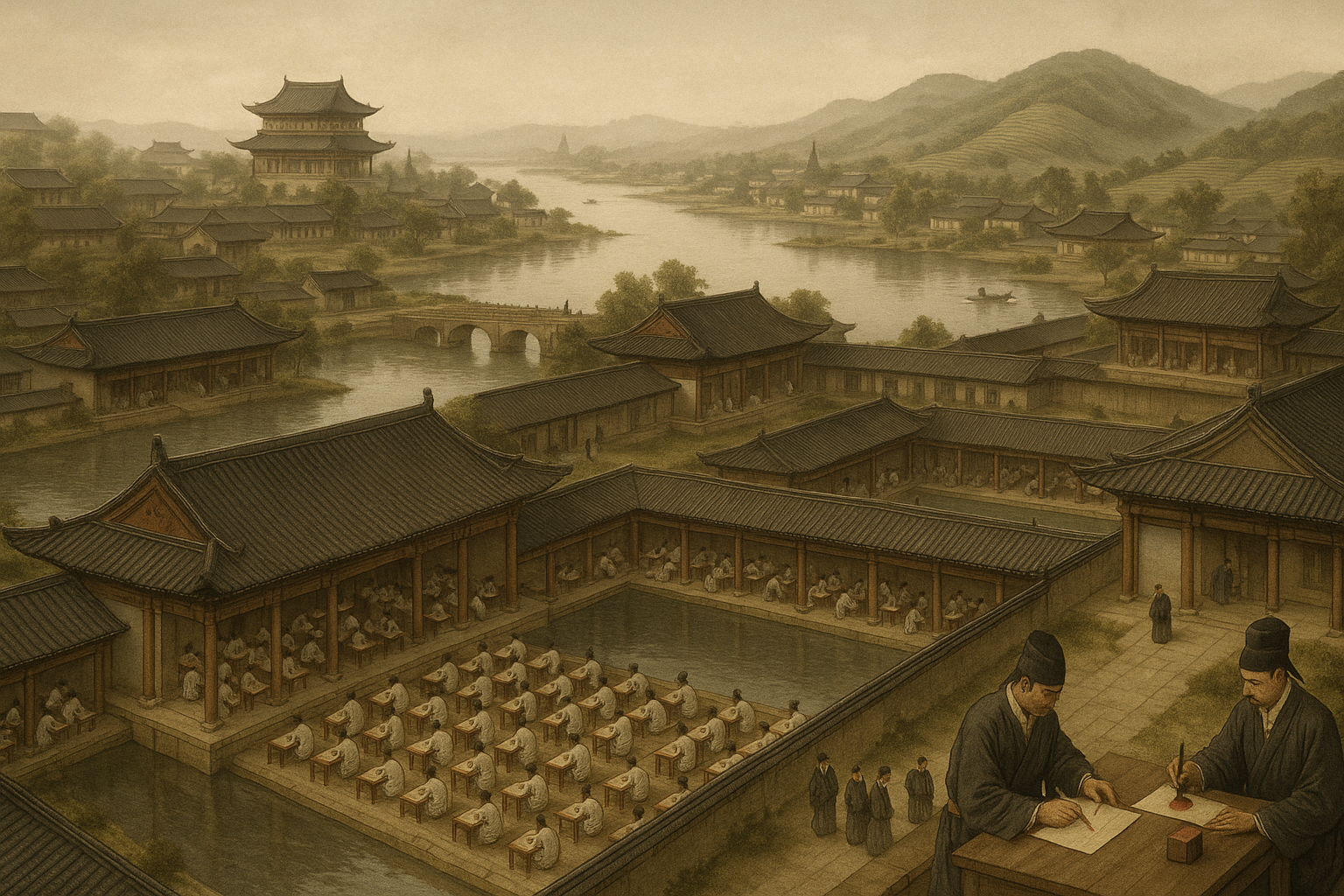
Delta geography makes the town's layout distinctive: Xinyi is built on a series of river islands and connected banks where the Yalu and Fei rivers join before continuing south, and the town's main thoroughfares follow the water channels rather than running perpendicular to them. Travel within Xinyi involves regular bridge crossings, and the bridges are the social gathering points in the way that market squares are elsewhere.
Administrative buildings are the largest structures, not because Xinyi's governance is oppressive but because the governance function is the town's most significant service export. Officials from across central Shoing come here to file documents, obtain certifications, have contracts witnessed, and receive training in the administrative procedures that the Regional Directorate requires. The main document hall is always busy.
Tea scent comes from the hillside processing yards that step up from the delta's edge: long, low wooden structures where leaves are dried, rolled, and sorted in practices that the town's tea families have been refining for two centuries.
Geography & Setting
The Yalu and Fei rivers meet several miles upstream from Xinyi's current location, and the resulting delta spreads into the flat central Shoing lowlands in a network of channels and islands that the town has organized around over three centuries of settlement. That delta provides fertile alluvial soil for the rice agriculture that feeds the town's population, good water access for the document and ink production industries, and the river transport connections that make the administrative service economy viable.
Hills rising to the north and east of the delta are where the tea cultivation occurs, a specific altitude and soil composition that the Xinyi families have identified as producing the particular astringency and floral note that the local variety is known for. Tea cannot be grown in the delta itself; the cultivation and the town center are connected by a series of switchback paths that are maintained as part of the administrative infrastructure.
The People
Demographics
Xinyi's population is predominantly human in the way that most of central Shoing's interior is, with a Gnome community that has grown over generations around the document and record-keeping industries. Gnome dexterity for fine calligraphy work and Gnome longevity for the long study periods that mastery requires have made them disproportionately prominent in the town's most prestigious profession, which has produced a social dynamic where the highest-status occupation in the town is dominated by the smaller demographic.
The examination-based advancement system means that family origin does not formally determine professional standing, though the families with the longest histories in the document tradition have advantages that the formal examination structure does not entirely counteract.
Economy
The red-ink calligraphy and document certification function is the prestige economy; the tea is the commercial volume economy; the rice agriculture is the subsistence economy. All three run simultaneously and each is dependent on the others: the tea income funds the advanced calligraphy training that maintains the document tradition's quality; the document certification function attracts the administrative traffic that gives the tea market its best customers; the rice keeps everyone fed.
That certification function is specifically valuable because the Regional Directorate has formally recognized Xinyi's document seals as the standard for central Shoing official records. This recognition was achieved through two generations of advocacy by the Administrative Directorate and is maintained through the quality that makes the recognition legitimate.
Primary Exports
- Xinyi tea: The hill-cultivation variety; sold in the delta markets and transported north by river; a premium product in central Shoing's tea trade
- Document certification services: Officials and merchants from across the region use Xinyi's certification function; the fees are the Administrative Directorate's primary revenue
- Red-ink calligraphy materials: The vermillion ink paste formula is a controlled trade secret; the materials produced here are sold to qualified scribes across the region
Primary Imports
- Metals and tools: The delta and the tea hills produce nothing metal; all metalwork comes in by river
- Luxury goods: For the Directorate officials and the examination candidates who stay during the testing periods
Key Industries
- The Xinyi Administrative Directorate: The document certification and administrative training function; the town's institutional identity
- The Tea House Families: Five major families manage the hill cultivation; the Wuzheng family's operation is the largest; Prefect Liang's appointment creates a significant conflict of interest that the Directorate manages through specific recusal protocols
- The Red Ink Masters: The calligraphy tradition; the senior Masters are the town's most respected individuals
Food & Drink
Xinyi's cuisine centers on the delta's rice and the river's fish, prepared in a style that the tea influence has shaped over generations: the cooking uses a restrained hand with spice, emphasizing the natural flavors that tea-culture values, and the meals that accompany examination periods or formal certifications are specific and traditional. Tea pairings for each course of a formal Xinyi meal are documented in their own reference texts.
Specific Xinyi tea varieties (Spring Pick, the first harvest of the year; Summer Deep, the more robust second; and the rare Autumn Mist, produced in small quantities from the highest hill plots) are available in the tea houses that serve the document trade.
Culture & Social Life
The examination system shapes the social culture more than any other single institution. Each year, the Administrative Examination draws candidates from across central Shoing who spend months in the town preparing, and the preparation period and the results period each have their own social rhythms. Families who host examination candidates have a specific hospitality tradition that dates to the examination's establishment; the relationships formed during examination stays are often the foundation of the regional administrative network.
The calligraphy tradition is the aesthetic culture. In the Directorate's archive, the best work of the Red Ink Masters is preserved and viewed as art objects as well as functional records. A specific challenge of producing calligraphy in the vermillion paste, which dries faster and less forgivingly than standard inks, has made Xinyi's Masters technically among the most demanding in Shoing.
Festivals & Traditions
The Examination Opening
The annual Administrative Examination is the town's most significant event, formally opened with a ceremony in the main document hall that involves the Prefect, the senior Red Ink Masters, and the Solis temple's senior cleric. The ceremony is solemn in a way that acknowledges what the candidates are attempting. The examination itself runs three days. The results are announced on the fourth day, and the announcement ceremony (held at the main bridge, where both the successful and unsuccessful candidates are acknowledged) is a public event.
The Spring Pick Ceremony
When the first tea harvest of the year is ready, the Wuzheng family and the other hill cultivation families perform the picking ceremony that marks the season. The first picked leaves are presented to the Prefect, to the senior Masters, and to the Solis temple before the commercial harvest proceeds. The ceremony has the character of a collective acknowledgment that the year's most important product is being taken from the hill with appropriate care.
Music & Arts
Calligraphy is the primary art form, and in Xinyi, it is understood as music made visible: the rhythm and breath of the stroke, the weight and movement of the character, the specific decisions that the Master makes in the moment of writing. The Red Ink tradition has produced a body of theory about what the calligraphy is and how it should be evaluated that has been developing for a century and that the scholarly community at the Directorate publishes and debates.
Music exists alongside this in a more conventional form, the lute and flute traditions that are common in Shoing's interior settlements, performed at the tea houses and at the examination celebration dinners.
Religion
Primary Faith
Solis is honored as clarity, honest light, and the exposure of what is hidden - a natural match for a town that makes records and seals.
Secondary / Minority Faiths
Talbar is strong in administrative accounting and document exchange. Themela is honored by exam judges and magistrates who treat law as discipline. Zopha is present in scholarship and the examination preparation culture. Household ancestor halls are abundant, explicitly under Shen-Li where family lore and state record become the same practice. Shinigami oversees funerals and grave consecration; delayed rites are treated as administrative failures and spiritual risks.
Vessikar has shrines near weighhouses and market courts; honest measures are treated as civic peacekeeping. Caldrin is honored at gates, bridges, and caravan yards for safe passage, true directions, and upheld guest-right. Nesara is honored at wells and river shrines, and in irrigation councils: water held in trust for everyone downstream. Sylira keeps whisper-shrines in inns and social halls: places to trade news, manage reputation, and pretend it isn't politics.
Secret or Forbidden Worship
Rare; Xinyi is too paperwork-heavy for secrets to stay secret.
History
Founding
The delta confluence was a natural provisioning point for river traffic well before permanent settlement, and the first formal settlement was a waystation for the administrative caravans that served the Regional Directorate's predecessor. The document certification function was established as a response to the existing traffic rather than as a reason to create it; the traffic was already present because the geography made it necessary.
Key Events
The Directorate Recognition (approx. 120 years ago)
The Regional Directorate's formal recognition of Xinyi's document seals as the standard for central Shoing official records was the result of a sustained advocacy campaign by the Administrative Directorate's third generation of leadership. The recognition transformed the town's economic position from a useful waystation to an essential service hub. The Directorate's archive contains the original recognition documents, sealed in the Xinyi red ink that made the recognition both self-referential and appropriate.
The Tea Blight (approx. 50 years ago)
A fungal infestation destroyed approximately a third of the hill cultivation plots over two seasons. The recovery involved the Wuzheng family's aggressive replanting program, assistance from the other cultivation families, and a specific biological knowledge contribution from Zopha-aligned natural philosophers that the cultivation families still acknowledge in their spring ceremony. The blight's long-term effect was a more diverse cultivation distribution across the hills, which has made the crop more resilient.
The Examination Standardization (approx. 30 years ago)
The Administrative Examination's current format (three days, specific subject areas, the acknowledgment ceremony) was established after two generations of varying formats that produced inconsistent results. The current format was designed by the senior Red Ink Masters in collaboration with the Regional Directorate and has been stable since. The pass rate hovers around twenty percent, which is considered appropriate by the Directorate and brutal by the candidates.
Current State
Xinyi is stable and functioning at the level its geography and institutions allow. The examination and certification functions continue to grow as the regional administrative network expands. The specific concern is the vermillion ink formula: the head Red Ink Master, Hao Mingzhu, has reached an age where succession planning is necessary, and the number of candidates who have completed the full apprenticeship to the level of formula-keeper is two. Both are qualified; their respective approaches to specific aspects of the formula's maintenance are not compatible, and Hao has not yet determined which is correct.
Leadership & Governance
The Administrative Directorate: Overview
The Directorate administers through examination-based appointment at every level. The Prefect is the most senior appointment; the document certification masters, the examination administrators, and the record keepers are each appointed by examination within their specific functions. The system produces technically competent governance and a specific kind of conservatism; the people who succeed in the examination system tend to value the examination system.
Prefect Liang Wuzheng
Human, Male; fifties
Liang is the head of the largest tea cultivation family and the Prefect of the town, which is a conflict that the Directorate manages through formal recusal protocols whenever tea trade matters come before the governing body. His appointment was by examination, not by family connection (he passed with the highest score in the year he sat), but the overlap between his family interests and his governance function is a structural problem that his predecessors have also managed and that Liang manages with more transparency than most.
His specific governance concern is the ink formula succession, which affects the town's most significant institutional function. He has been advised that the situation is being managed; he has been advised of this four times, and the situation has not yet been managed.
Head Red Ink Master Hao Mingzhu
Gnome, Female; age indeterminate; the Directorate's calligraphy hall
Hao has held the senior Master position for forty years and is the most respected individual in Xinyi regardless of official title. Her calligraphy work is the standard by which all other practitioners' work is evaluated. Her knowledge of the vermillion ink formula is the institutional knowledge that the town's entire document certification function depends on. Succession is the question she is managing with the specific attention that forty years of responsibility for something irreplaceable produces.
Notable Figures
Master Shen Bojin: Examination Administrator
Human, Male; forties; the examination hall and the Directorate archive
Shen manages the annual examination with a fairness and a rigor that the candidates appreciate in the years after they have passed and resented in the days before. His reputation for not being moved by family connections or administrative influence is the examination's primary institutional asset. The Directorate trusts him; the cultivation families who want exceptions to the scoring criteria have stopped asking.
Mei Wuzheng: Tea House and Cultivation Manager
Human, Female; thirties; the hill cultivation and the main tea house
Liang's cousin, who manages the Wuzheng family's tea operations while the Prefect manages governance. The arrangement is functional; Mei is better at the tea operations than Liang would be, and the formal separation of family business from official function is clearly delineated. She is also more interested in the tea operations than in the governance question, which is a useful clarification of priorities.
Key Locations
Seat of Power
- The Administrative Directorate Hall: The main document hall; the largest building in the town center; the records going back to the Directorate Recognition are maintained here; the vermillion seal drying racks are visible from the main corridor
Houses of Worship
- The Solis Temple: Adjacent to the examination hall; the light from the south-facing windows is the brightest interior light in Xinyi; used for examination dedications, significant certifications, and the scholarly community's regular observances
Inns & Taverns
- The Examination Inn: The primary accommodation for candidates during the examination period; larger than most visitors expect; the proprietor maintains a specific policy about examination discussions on the premises that the candidates do not always observe
- The Delta Tea House: The premier tea establishment in Xinyi; Mei Wuzheng's operation; the seasonal varieties are served in their ceremonial order; the room where formal certification occasions are celebrated is booked months in advance
Shops & Services
- The Certification Office: The public-facing function of the Administrative Directorate; open on specific days; the waiting line during the pre-examination period is significant
- The Red Ink Supply: The controlled distribution point for the vermillion ink materials; available to qualified scribes with Directorate certification; not retail
The Market
- The Bridge Market: Each of the town's major bridge crossings has a permanent market segment; the combined effect is a distributed market that runs along the water channels; tea, rice, and administrative supplies are the primary commodities
Other Points of Interest
- The Archive Bridge: The specific bridge where the examination results are announced; the posting boards are maintained on both sides; the crowd on results day is the largest gathering of the year
- The Cultivation Path: The switchback trail from the delta to the tea hills; the walk takes approximately two hours; the view from the top of the first switchback, looking back at the delta's channel network, is the most-described view in Xinyi's letter-writing tradition
Secrets, Rumors & Hooks
- The vermillion ink formula's most critical component is a mineral compound derived from a specific deposit in the Yalu riverbed that Hao located forty years ago and that she has been harvesting quietly since. The deposit is finite, and Hao's estimate, which she has not shared, is that the deposit has approximately twenty years of material remaining. The formula cannot be replicated with substitute materials; she has tried.
- The Directorate archive contains documentation of a certification that was issued forty years ago for an organization that does not appear in any subsequent record: not dissolved, not renamed, simply absent. The certification was for a large land area north of the tea hills that is currently unclaimed and unoccupied. The vermillion seal on the certification is authentic; the examining Master at the time was Hao Mingzhu, who was in her first year as a full Master.
- The examination scoring system has a specific statistical anomaly: candidates from two specific family names consistently score in the highest decile at a rate that is beyond what the examination's design should produce. Shen Bojin has identified the pattern and does not yet have an explanation that is not uncomfortable.
- The tea blight recovery fifty years ago involved a Zopha-aligned practitioner who contributed a biological treatment for the fungal infestation. The treatment worked. The practitioner left Xinyi without identifying themselves and without being identified. The Wuzheng family's spring ceremony includes a specific acknowledgment of "the unnamed scholar" that the other cultivation families have adopted. No one has identified who it was.