Zazua
Zazua: Where the River Bows to the Sea
"The League has no throne. The League has a table, and the table has seven chairs, and whoever fills them that season is the League. This is not chaos. This is the delta: always moving, always arriving."
Raja Suresh Dharmakar, to a Gwajin envoy who had asked where power resided
At a Glance
| Continent | Shoing |
| Region / Province | Southern Shoing, Perian Sea: Chanda River delta mouth |
| Settlement Type | City |
| Population | ~9,500 |
| Dominant Races | Human (majority), Smaling (substantial), Half-Elf |
| Ruler / Leader | Raja Suresh Dharmakar |
| Ruling Body | House Dharmakar, hereditary seat as League convening authority; the Zazua Cracked Sea League Council of Seven meets here |
| Primary Deity | Ryujin (patron of rivers, the sea, and trade routes); Talbar secondary |
| Economy | Pearl redistribution, delta trade brokerage, river piloting services, cracked-sea shipping coordination |
| Known For | Capital of the Zazua Cracked Sea League; the largest pearl exchange in southern Shoing; the most dangerous harbor approach on the Perian coast; river pilots who command extraordinary fees and earn every coin |
First Impressions
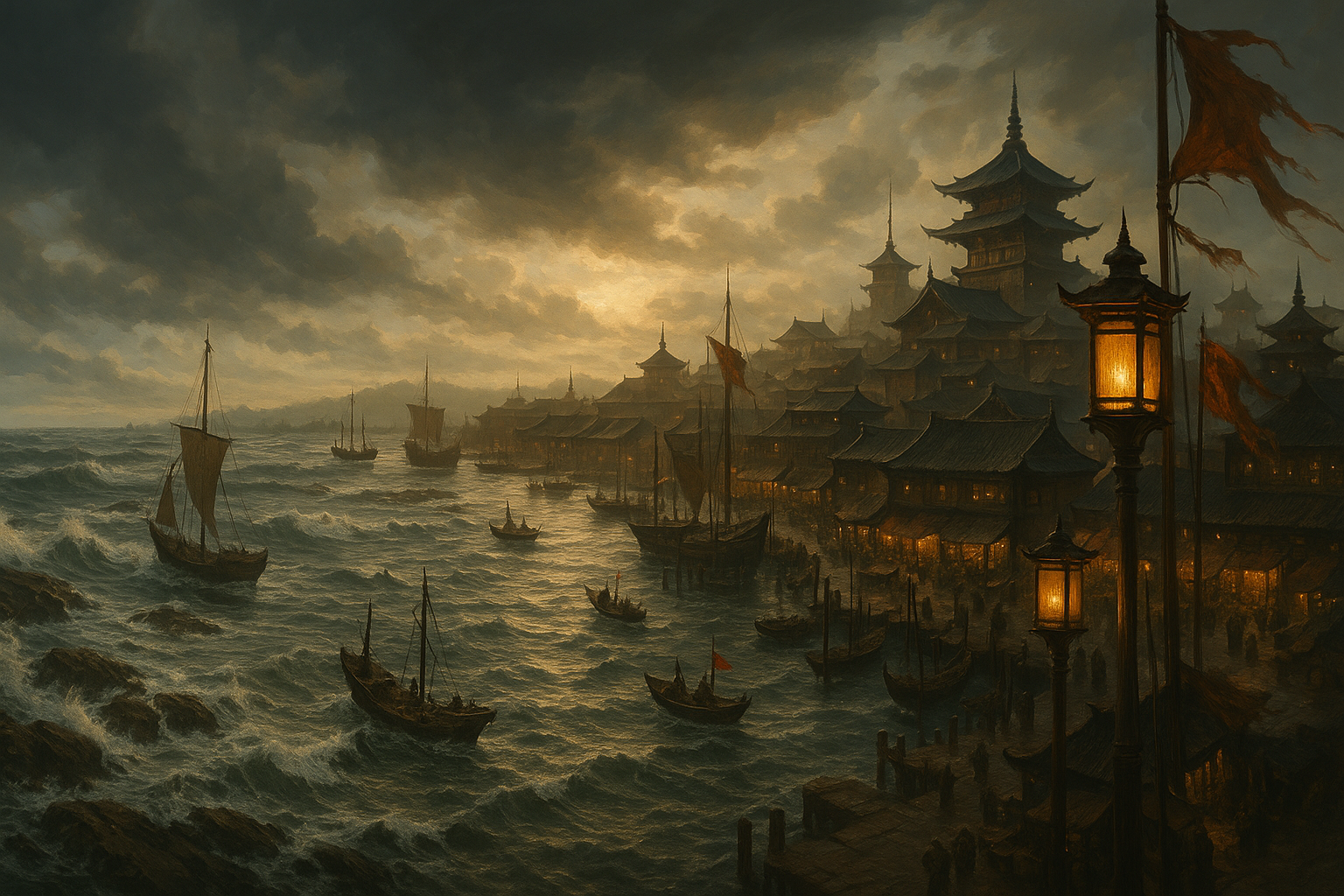
Zazua arrives in layers. From the Perian Sea, a visitor first sees the signal towers on the outer sandbars: tall, painted in alternating white and deep red, flying no flag because the League has no single flag. Then the river mouth opens, four braided channels called the Fingers spreading across the delta flat, and somewhere among them is the Third Finger, the deep one, the only passage a loaded ship can take. Finding the Third Finger without a Zazua pilot is not strictly impossible. Harbor records suggest it has been done successfully perhaps three times in the last century.
Inside the channel, the city resolves: a flat, low-built sprawl of whitewashed stone and timber, raised on pilings where the delta mud makes solid footing unreliable. Along the waterfront, chaos is organized by long practice: barges from the river interior lashed against sea-going vessels, pearl buyers moving between anchored ships with locked satchels, pilots returning from the outer sandbars looking satisfied with themselves. The Raja's house sits back from the waterfront on the highest solid ground in the city, which is not very high, but is distinguished from the rest by the carved stone gate at its entrance and the two old lacquer trees that somehow thrive in the salt air.
Zazua smells of brine, river mud, and something floral from the pearl cultivation beds to the east. The sound is commerce.
Geography & Setting
Zazua occupies the mouth of the Chanda River where it meets the Perian Sea, a delta system of four distributary channels that local geography calls the Fingers. First and Second Fingers are navigable by small craft; the Fourth Finger is shallow and braided and suits fishing vessels and nothing larger. The Third Finger is deep enough for ocean-going ships, consistent in its main channel, and the reason Zazua exists at all in its current form.
The delta itself is low (almost no elevation) and subject to seasonal flooding. Zazua's building tradition accounts for this: ground-floor spaces in older buildings are storage and flood-ready, with living and commercial activity on upper floors accessible by exterior stairs. Newer construction uses piling foundations that allow water to move beneath structures during high-water events.
Outer sandbars shift seasonally. Signal towers are repositioned as needed. The Third Finger is the one channel whose depth is maintained by the river's own current, but its position within the delta is not fixed, and this is the central geographic fact that shapes everything about the city's future.
The People
Demographics
Zazua is a southern Shoing city, and its cultural character is firmly in that tradition: the Indian-inflected honor culture, the noble title of Raja, the cooking, the religious practice. The harbor population includes a substantial Smaling community, some of the most skilled close-water navigators in the Cracked Sea region, who run the smaller pilot vessels and the inner-delta traffic management. Half-elves appear throughout the merchant class; the longer working lives suit a trade city where relationship networks are everything.
Economy
Pearl redistribution is the anchor. The Cracked Sea islands produce pearls in significant quantities, but the island ports are not equipped for the volume of buyers, the documentation requirements, or the credit arrangements that a major exchange market requires. Zazua is. The Pearl Exchange on the waterfront processes more pearl volume than any other single point in southern Shoing, and the Raja's family takes a documented percentage of every transaction that funds the city's administration and a significant portion of the League's collective functions.
River trade is the second pillar. The Chanda River runs deep into southern Shoing's interior, and Zazua is where that interior trade meets the sea. Goods from the highland growing regions, the mountain herb producers, and the inland manufacturing towns arrive by barge and are transshipped to Perian Sea-going vessels. Piloting services and the transshipment infrastructure (warehousing, barge management, stevedoring) employ a large fraction of the city's non-merchant population.
Primary Exports
- Pearl Exchange services: Commission brokerage on Cracked Sea island pearl production; the Exchange takes no position but charges for matching, documentation, and credit verification
- River trade transshipment: Interior goods redistributed to Perian Sea routes; Zazua adds no production but significant logistics value
- Pilot services: Third Finger approach navigation; non-negotiable for loaded vessels; the pilots' cooperative controls access to the channel
Primary Imports
- Finished goods from Gwajin Realm: Luxury items, lacquerwork, court-standard ink; Zazua is a consumer market for eastern Shoing production
- Cracked Sea island products: Pearls, exotic materials, preserved fish, items that don't appear on mainland Shoing in quantity
- Grain and provisions: The delta produces little food; the city is dependent on river supply from the interior
Key Industries
- The Zazua Pearl Exchange: The commercial institution that defines the city's economic position; governed by a board drawn from the major buyers and sellers; not owned by the Raja but operating under his administrative authority
- The Pilots' Cooperative: Seventeen licensed pilots who hold exclusive rights to Third Finger approach navigation for loaded vessels; one of the most profitable small organizations in southern Shoing
- The Delta Barge Collective: Controls the inner-delta traffic; mostly Smaling-operated; less prestigious than the Pilots' Cooperative but essential
- The Cracked Sea League Secretariat: Administrative office that coordinates the League's collective functions; funded by the seven member ports; located in Zazua because the Raja holds the convening authority
Food & Drink
Zazua eats in the southern Shoing tradition with a strong seafood emphasis that the location makes inevitable. Pearl oysters are not generally eaten (they are commercial product) but the delta produces other shellfish, and the Perian Sea fishing grounds supply fish varieties that do not appear in inland Shoing markets. River fish from the Chanda interior are dried, smoked, and fermented and appear as flavoring components throughout the cooking rather than as primary protein. Rice comes from the interior by barge. The spice tradition is southern Shoing's (not timid), and the cooking of the harbor district, which draws on influences from every island and coastal port the Cracked Sea touches, is more varied than the city's size would suggest.
Zazua's drink is a tamarind-based cooled preparation sold by vendors throughout the market and waterfront. Tea exists but is an interior habit. The waterfront runs on the tamarind drink, river water boiled clean, and the rice spirit produced upriver that arrives in ceramic jugs and is consumed without apology.
Culture & Social Life
Zazua operates on the southern Shoing honor framework, but the commercial environment modifies it in specific ways. Honor in a trade city is significantly expressed through deal integrity: a merchant who defaults on an agreement, or a pilot who misrepresents the channel conditions, faces a social consequence comparable to what a noble might face for a personal insult. The Pearl Exchange's founding documents codify this explicitly: the Exchange's reputation is its members' collective honor, and a member who damages it damages everyone.
The Raja's household models the broader cultural expectation of dignified restraint in expression of power. House Dharmakar does not own the Exchange or the Cooperative; it governs the city and hosts the League. That distinction is maintained carefully.
Festivals & Traditions
The First Flood Festival
At the annual high-water mark, when the Chanda's flooding reaches its seasonal peak, the city marks the water level on the central pillar of the market's covered arcade. The accumulated marks, decades of them, form an informal climate record. The day of marking is treated as a festival: the Raja formally records the measure, the harbor is closed for the day, and the city eats together in the market arcade.
The Pearl Opening
When the first significant pearl shipment of the season arrives from the Cracked Sea islands, the Exchange conducts a formal opening ceremony. The senior buyer and the senior seller each hold one pearl from the shipment and make a brief declaration of mutual dealing intent. This is commercial ritual, not spiritual, but it is taken seriously.
Music & Arts
The city's artistic tradition reflects its position as a delta trading hub rather than a cultural center. Music in Zazua is waterfront music: practical, rhythmic, designed for outdoor performance in noisy contexts. The Smaling community maintains a distinct performance tradition in the inner delta neighborhoods that is more considered and has attracted occasional outside attention. The Raja's household employs two resident musicians who perform in the court tradition of southern Shoing at formal occasions.
The visual arts run to painted maritime subjects (delta channels, Cracked Sea islands, signal towers) and to the decorative work on the pilot vessels, which are maintained to a standard that reflects their operators' pride.
Religion
Primary Faith
Ryujin is the League's river-and-sea god, and Talbar the broker of exchange; together they define Zazua's identity as dangerous harbor and necessary market.
Secondary / Minority Faiths
Shen-Li is prevalent in pilot-family lineage shrines and the League's memorial lists for those lost on the approach. Themela is honored in harbor courts where truth must be established quickly or ships die. Martus thrives in the risks the pilots take and the wagers outsiders make. Gormandus appears in the League's feast culture after successful seasons.
Vessikar has shrines near weighhouses and market courts; honest measures are treated as civic peacekeeping. Nesara is honored at wells and river shrines, and in irrigation councils: water held in trust for everyone downstream. Caldrin is honored at gates, bridges, and caravan yards for safe passage, true directions, and upheld guest-right. Sylira keeps whisper-shrines in inns and social halls: places to trade news, manage reputation, and pretend it isn't politics. Lantha is a quiet night-faith; watchfolk, sailors, and those who need privacy after dark leave thin offerings.
Secret or Forbidden Worship
Shinigami is the primary death authority; their monks police grave purity and hunt undeath in the harbor slums.
History
Founding
Zazua's founding is obscured by delta geography; the city has moved, in the sense that the Third Finger has shifted over centuries, and settlements built around prior channel configurations are now either submerged or stranded in shallow water on the inner delta. The current city location represents approximately two hundred years of stable development around the Third Finger's present course.
The Cracked Sea League predates the current Raja's family's convening authority. In some form it is as old as the island trade. The Dharmakar family's role as convening hosts is a function of their governance of Zazua and is approximately one hundred fifty years old.
Key Events
The Compact of Seven Ports (approx. 150 years ago)
The current League structure (seven member ports, a Council of Seven, coordinated navigation and piracy-response protocols) was formalized under the second Dharmakar Raja. The compact document is held in the League Secretariat and is the legal foundation for everything the League does collectively.
The Great Flood of the Third Finger (approx. 80 years ago)
A seasonal flood of unusual severity rerouted the Third Finger approximately two hundred meters east of its previous course over the span of three days. The city adapted. New signal tower positions were established within a season. The pilots re-surveyed the approach within a week; they had been tracking the shift for years. The official record treats this as evidence of the city's resilience; the older pilots' oral tradition treats it as evidence that the channel does what it wants and the city had better stay ready.
The Indrani Affair (approx. 30 years ago)
A League member port, Saraburi, was found to have been operating as a front for a Gwajin Realm intelligence operation for approximately fifteen years. The Council of Seven met in emergency session in Zazua. The result was a new vetting protocol for League membership, the removal of Saraburi's Council seat for a decade, and a significant deterioration in Zazua-Gwajin diplomatic relations that has not fully recovered.
Current State
Zazua is commercially prosperous and politically stable in the sense that the League is functioning and the Raja has managed the Council relationships competently for twenty-two years. The underlying tension is the Third Finger, which the pilots know is shifting, which the city's administrative leadership knows is shifting, and which the broader League membership is not yet aware of in the specific terms that would require collective action.
Leadership & Governance
House Dharmakar: Overview
The Dharmakar family holds the Rajaship by hereditary claim within southern Shoing's minor noble structure, and holds the League convening authority by compact provision. Their governance is administrative rather than mercantile; they do not own the Exchange or the Cooperative, they govern the city and host the League. The distinction has been maintained carefully through several generations, and it is the foundation of the Raja's legitimacy with the Council: he is seen as a neutral convener, not a commercial competitor.
Raja Suresh Dharmakar
Human, Male; late fifties
Suresh has been Raja for twenty-two years and has spent that time managing a coalition that has strong mutual interests and weak mutual trust. Seven member ports cooperate on navigation, piracy response, and trade facilitation because it benefits them. They compete in every other domain. The Raja's function is to make the cooperation possible without the competition destroying it. He is good at this. He is also carrying information about the Third Finger that he has not shared with the Council, and he is not certain he is handling that correctly.
He has a son, Arjun, who manages the Secretariat's administrative functions and is quietly building the coalition support he will need when his father is gone. Suresh is aware of this and approves of the methodology if not always the specific targets.
Arjun Dharmakar
Human, Male; early thirties
Arjun runs the Secretariat day-to-day and attends Council sessions as his father's administrative representative. His competence is real and his ambition is calibrated; he understands that the convening authority is a position that requires everyone else's consent to function, and he has been building those consent relationships for a decade. He also knows about the Third Finger, and unlike his father, he thinks the Council needs to be told.
Notable Figures
Harbor Chancellor Priya Nair: Exchange Administrator
Half-Elf, Female; fifties; the Pearl Exchange
Priya manages the Exchange's administrative operations and is its public face for everything short of the highest-level buyer relationships. She has been in the role for twelve years and is as responsible as anyone for the Exchange's current reputation for rigorous dealing documentation. She is one of three people who fully understand the Third Finger situation, having been briefed by the Raja two years ago. She has since quietly rerouted the Exchange's long-term facility expansion plans away from the eastern waterfront.
Devraj Thampi: Senior Pilot
Smaling, Male; mid-forties; the Pilots' Cooperative
Devraj has taken more vessels through the Third Finger approach than any other currently active pilot. He did the survey work that identified the channel's eastward shift and brought the findings to the Raja. He finds the Raja's management of the information, keeping it from the Council, difficult, but he understands the political calculation and has not broken confidence. He has, however, updated the Cooperative's internal training to account for the current channel position and the projected position five years out.
Sita Vardhan: Pearl Exchange Senior Broker
Human, Female; forties; the Pearl Exchange floor
Sita runs the Exchange's highest-volume buyer relationships and is the person that major Cracked Sea island producers deal with when they want to ensure their shipment moves quickly and at fair price. She is not part of the city administration and is not briefed on the Third Finger situation. She is, however, one of the city's most commercially influential private figures and has relationships with four of the seven League member ports' leading merchants.
Captain Bima Harun: Harbor Patrol
Human, Male; thirties; the harbor
Bima commands the city's harbor patrol, two armed vessels and a shore complement that manage inner-delta security and serve as the first response to any League-related security incident. He is effective and straightforward in a city where most of the influential figures are neither. He is also the first person who would be informed if the harbor approach became genuinely dangerous, and he does not yet know what he would be dealing with.
Key Locations
Seat of Power
- The Dharmakar House: The Raja's residence and administrative center; stone gate, two lacquer trees, the highest solid ground in the city; the League Secretariat occupies the adjacent wing
Houses of Worship
Inns & Taverns
- The Third Finger Inn: Primary accommodation for visiting merchants and buyers; named for the approach channel; the common room is where most informal commercial relationship-building happens
- The Sandbar: Harbor district tavern; the pilots drink here after completing approaches; not comfortable for outsiders but very informative
Shops & Services
- The Pearl Exchange: The commercial institution; visitors by appointment arranged through the Harbor Chancellor's office; not a retail location
- The Pilots' Cooperative: Offices at the harbor's edge; pilot services contracted here; rates are posted; they are non-negotiable
The Market
- The Delta Market: The covered arcade; open daily; heavy on river-interior goods, dried fish, provisions, and the commercial overflow that doesn't go through formal Exchange channels. The tamarind drink vendors are concentrated here.
Other Points of Interest
- The Signal Towers: The outer sandbar navigation aids; the most recent repositioning was eighteen months ago; the towers are maintained by a Cooperative subsidiary and are the most important navigational infrastructure on this stretch of the Perian coast
- The Pearl Cultivation Beds: East of the city proper; the delta shallows where farmed pearl cultivation supplements the island wild-harvest; not accessible to casual visitors
- The First Finger Shallow: The northernmost distributary; navigable only by small craft; there is a structure partially visible at low water in the inner bend that local delta fishers have been aware of for decades and that no one has formally investigated
Secrets, Rumors & Hooks
- The Third Finger is shifting east at approximately twelve feet per year. At the current rate, the deep-water channel will no longer be navigable for loaded ocean-going vessels in approximately fifteen years. The Raja, the Harbor Chancellor, and the senior pilot all know this. The League Council of Seven does not. The Raja is managing the disclosure timeline to avoid a panic that destabilizes the League before alternative arrangements can be identified. His son believes the timeline of disclosure is already too late.
- The League member port of Kon Tum has been operating under ownership that is not what it appears for approximately eight years. The apparent owners are Cracked Sea island traders. The actual beneficial interest is a continental-power intelligence operation that has been using Kon Tum's League position to monitor dragon egg movement through the Cracked Sea shipping network. The Raja suspects this but has not confirmed it. The Pilots' Cooperative's senior membership, who see every vessel that comes through the Third Finger approach, has confirmed it among themselves and has not told anyone.
- The structure visible in the First Finger at low water is not a natural formation. The local delta fishing families have a generation-old tradition of not investigating it and not discussing it with outsiders. One of the fishing community's elders knows significantly more than the general silence suggests.
- The Pearl Exchange's founding compact from one hundred fifty years ago includes a provision that has never been invoked: if the Third Finger becomes impassable, the Exchange's operating authority transfers to whichever League member port can demonstrate navigable access to the Perian Sea for loaded vessels. This provision was inserted by the second Dharmakar Raja during the compact negotiation. What he knew about the channel that made him include it is not recorded.
- A buyer at the Exchange, operating under a Gwajin Realm merchant identity, has been systematically acquiring documentation on pearl shipment routes, volumes, and schedules for three seasons. The documentation is commercially available through normal Exchange processes; no fraud is involved. The accumulation pattern, however, suggests someone is building a complete picture of Cracked Sea island production for purposes that are not commercial.