Fort Angoth - Settlement Profile
Fort Angoth: Where the Pact Became a City
"Three things endure in the Second Lands: stone, stubbornness, and the memory of what it cost to put them here. Angoth Keep is all three, stacked on top of each other beside the De Grey River."
Lord-Warden Edric Galemore, in correspondence to the Continental Council, 1931 ME
At a Glance
| Continent | The Second Lands |
| Region / Province | Northwestern edge of the Gowehn Rainforest; De Grey / Pallinup River confluence |
| Settlement Type | City |
| Population | ~5,400 |
| Dominant Races | Human (65%), Dwarf (18%), Elf (12%), Other (5%) |
| Ruler / Leader | Lord-Warden Edric Galemore |
| Ruling Body | The Wardenship, hereditary office descended from the original expedition's command structure |
| Primary Deity | Zopha, Echo, Gramil |
| Economy | Trade, Stone Crafting & Masonry |
| Known For | The most fortified city in the Second Lands; the Songmaidens tradition; Callum's Royal Library; the Gardens of Ayla |
First Impressions
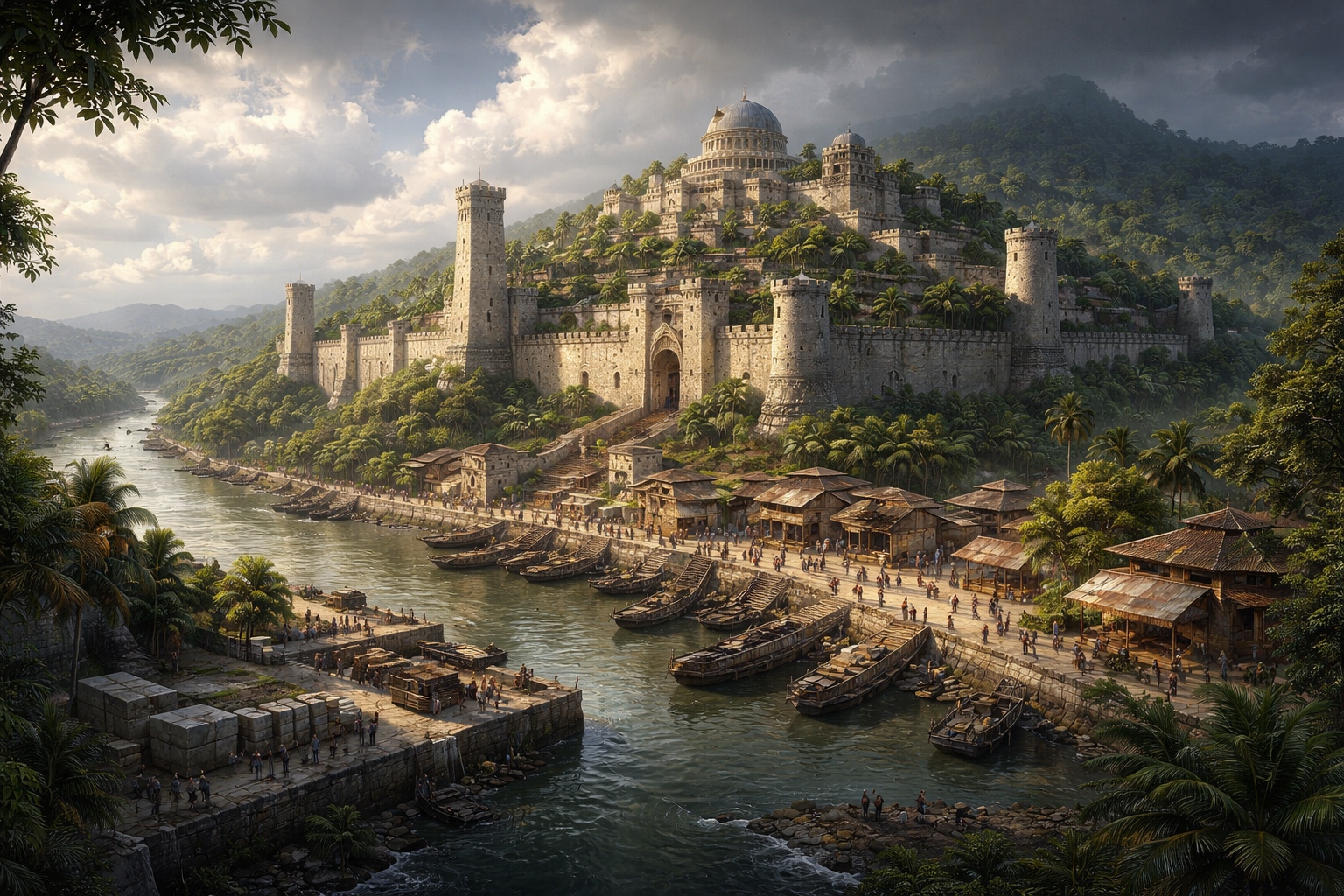
Angoth Keep announces itself before you see it: the towers breach the jungle canopy and hold the sky above the treeline for half a mile before the road clears. They are limestone, which in this land means they have been quarried and hauled and argued over and cursed at and laid by people who understood that what they were building had to last, because there would be no rescue if it didn't. In this they succeeded.
The main gates stand beneath an arched keystone that carries, if you look closely, a carved inscription in four languages: the royal tongues of Irna, Rochdale, Marwen, and Frosthaven. Most travelers don't notice it until a local points it out with the particular pride of people whose history is visible on the architecture. Once you've seen it, you don't stop seeing it.
Within the walls, the city breathes. Markets line the river quarter. The smell of cooking fires competes with the tang of the river and the limestone dust that never quite settles in the stonemasons' district. The Songmaidens perform in the market square on festival evenings; their voices carry, and people stop whatever they were doing. This is not considered unusual. It has been happening for centuries.
The city feels like what it is: a place that was not supposed to exist, and that decided to exist anyway, and that has been making that argument persuasively ever since.
Geography & Setting
Angoth Keep sits at the confluence of the Pallinup and De Grey Rivers, where the western edge of the Gowehn Rainforest begins to thin toward the river lowlands. The founders chose the site for its natural defensibility (elevated ground flanked by two rivers, with the forest providing both a natural barrier and a constant source of timber), and the choice has proven sound across centuries of pressure.
The jungle remains close on three sides. The cleared zone around the city walls is maintained aggressively; the forest has a way of testing the perimeter if left alone for a season. The rivers provide fresh water, fish, and a navigable supply route to the coast. The limestone ridges a few miles inland still supply the quarries that Durgon's crews first opened, and the quality of the stone, whatever Durgon said about it, has proven sufficient for every construction project the city has undertaken.
The climate is warm and humid, the Gowehn's influence making itself felt in regular heavy rains that the city's drainage systems have been engineered to handle. The growing season is long; the farms in the river lowlands are productive.
The People
Demographics
Angoth Keep's population is predominantly human, drawn from the founding nations and their descendants, but the dwarven community has been present since the beginning: Durgon's lineage and the stonemasons' tradition have made them a permanent and influential minority. The elven population traces partly to Princess Carys Slvanna's influence and partly to subsequent immigration; they hold a notable presence in the Songmaidens order and the city's administrative traditions.
Outsiders arrive regularly and are received with the measured hospitality of a city that has seen a great many interesting people and retains the right to be cautious. Adventurers passing through for the interior, merchants supplying the city, scholars drawn by the Royal Library: all are welcome as long as they observe the Keep's laws, which are enforced.
Economy
The Keep's economy rests on three pillars: river trade with the coastal settlements, stone masonry and craftsmanship exported to the wider Second Lands, and the steady flow of coin from scholars and adventurers who use the city as a base of operations.
The limestone industry that began with the founding quarries remains active and well-organized; the Masons' Guild that traces its lineage to Durgon's original crews is the oldest continuous institution in the city and operates with the professional pride of people who know it. Agricultural production in the river lowlands is sufficient for local needs with modest surplus.
Primary Exports
- Quarried limestone and worked stone: The De Grey ridge quarries produce consistently high-quality limestone; finished stonework from Angoth's masons is considered the finest available in the Second Lands
- Preserved fish and river goods: Salted river fish, smoked eel, and freshwater crustaceans from the Pallinup reach the coast and beyond
- Historical reproductions and scholarship: Copies of texts from the Royal Library, Songmaiden recordings, and historical documentation command premium prices in continental markets
Primary Imports
- Iron and metalwork: The Second Lands' interior does not yield abundant iron; most tools and weapons come from the mainland
- Textiles and luxury goods: The city's population has tastes that outpace local production; fabric, dyes, and crafted goods arrive regularly
- Medical supplies and alchemical components: The jungle's dangers require consistent access to remedies not locally producible
Key Industries
- Masonry & Stone Craft: The Masons' Guild, successor to Durgon's original crews, employs nearly one-fifth of the city's workforce and produces stonework exported throughout the Second Lands
- River Trade & Transport: The De Grey and Pallinup provide the city's commercial lifeline; a fleet of flat-bottomed transport barges runs between Angoth Keep and the coast
- Scholarship & Archives: The Royal Library draws researchers from across the continent and employs a permanent staff of archivists, copyists, and translators
Food & Drink
The city's cooking reflects its founding history, four national traditions compressed into a regional cuisine that is distinctly its own. River fish prepared in the Marwen style, dwarven stoneground bread baked hard enough for the frontier, Frosthaven spiced stews adapted to local ingredients. The market stalls along the river quarter offer all of this and the particular produce of the Gowehn's edge: jungle fruits, wild herbs, smoked meats from game the hunters won't identify unless pressed.
The inn most frequented by visitors is the Angoth Arms, which serves a house ale brewed from local grain and a river-fish stew that has been on the menu, in some variation, since the city's founding generation. The Songmaiden's Cup, in the arts quarter, serves lighter fare to the scholars and performers who favor it, and on festival evenings can be heard from three streets away.
Culture & Social Life
Angoth Keep's culture is shaped by the awareness that it exists improbably: the Second Lands should not have permitted this city, and the city has never forgotten it. There is a characteristic groundedness to the inhabitants, a tendency toward practicality and a distrust of grandiosity, combined with a genuine and specific pride in the place and its history.
The founding story is not merely history here; it is civic identity. Tristan, Callum, Ayla, and Carys are referenced in daily conversation the way other cities reference weather. The Angoth Keep phrase for "doing the right thing under pressure" is, literally, "climbing the wagon", a reference to Carys's descent to the commons yard that has been in continuous use for centuries.
The dwarven population maintains their own cultural practices and the Masons' Guild holds a semiformal social function that non-dwarves attend by invitation. The elven community centers around the Songmaiden tradition and the Archive Quarter. Relations between communities are generally cooperative, with the pragmatic tolerance of people who have been sharing walls for a very long time.
Festivals & Traditions
The Day of Bonds
Observed annually in late autumn. The city's primary festival, marking the date (disputed in some details, celebrated in all of them) when Angoth arrived and redirected the colony's history. The day involves public recitations of the founding chronicle, a ceremonial performance by the Songmaidens of Carys's compositions, the Masons' parade through the gates, and an evening feast in the commons yard that is, by tradition, open to everyone without cost. The lord-warden contributes from the civic treasury; the guilds each provide a dish. It is the one day per year when rank is set aside in the commons yard, deliberately and by tradition going back to Angoth's own instructions.
The Keystone Ceremony
Annual, midsummer. On the anniversary of Castle Fortuna's completion and renaming, the lord-warden places fresh flowers on the carved arch above the main gates and recites the names of those who built it. A small ceremony, attended primarily by the Masons' Guild and the city's elders. Surprisingly moving, according to visitors who stumble into it without expecting to be.
Music & Arts
The Songmaidens of Angoth Keep are the city's most distinctive cultural institution and its most internationally recognized. The order traces directly to Princess Carys Slvanna and maintains a continuous tradition of the magical ballads attributed to her composition. Their performances are not merely entertainment; the Songmaiden tradition carries an elven resonance that produces, in attentive listeners, a genuine emotional response that scholars have variously described as "ancestral memory," "empathic transfer," and "whatever she put in those walls coming back out." They perform publicly in the market square on festival evenings and in the Songmaiden Hall on formal occasions.
The Archive Quarter also supports a tradition of illustrated manuscript production (maps, historical records, copies of documents held in the Royal Library) that has developed its own distinctive visual language over the centuries.
Religion
Primary Faith
Zopha, patron of knowledge, scholarship, and the accumulation of understanding, holds the city's primary devotion, a direct inheritance from Prince Callum's scholarly influence on the colony's culture. The Temple of Zopha stands in the Archive Quarter, adjacent to the Royal Library, and functions as both house of worship and center of intellectual life. The clergy are scholars as often as priests; the distinction is considered largely semantic.
Gramil, the deity of ancient growth, temporal endurance, and the sacred patience of forests, holds a deep and foundational place in Angoth Keep's spiritual life, though it is expressed less in formal ceremony than in a pervasive awareness of the Gowehn Rainforest pressing at three walls of the city. Those who live here long enough develop a relationship with Gramil that is not chosen so much as arrived at: the forest has been here longer than anything the founders built, and Gramil is the name the Second Lands gives to that patient, watching permanence. The Gowehn edge hunters are its most devoted practitioners, but the city's founders, who spent years learning to coexist with rather than conquer this landscape, are considered by many to have lived Gramil's lessons before they had words for them.
Secondary / Minority Faiths
Echo, the deity associated with memory, music, and things that persist, holds a secondary place of honor in the city, a direct connection to the Songmaiden tradition and to Princess Carys Slvanna's legacy. A shrine to Echo stands within the Songmaiden Hall, and the Songmaidens observe Echo's festivals with particular devotion.
Dwarven religious practice within the city maintains its own traditions, primarily observed within the Masons' Guild Hall and not advertised to outsiders.
Bronthe is honored by masons and miners; offerings go into foundation-stones and tunnel mouths where failure would be fatal. Nesara is honored at wells and river shrines, and in irrigation councils: water held in trust for everyone downstream. Vessikar has shrines near weighhouses and market courts; honest measures are treated as civic peacekeeping. Caldrin is honored at gates, bridges, and caravan yards for safe passage, true directions, and upheld guest-right. Sylira keeps whisper-shrines in inns and social halls: places to trade news, manage reputation, and pretend it isn't politics.
Oruka, deity of beasts, hunting, predation, and the food chain, is quietly honored at the Gowehn edge and in the hunters' quarter of the market. The hunters who cross the cleared perimeter into the Gowehn each morning make their offerings before departure and their thanks on return; this practice predates any formal organization and requires none. Angoth Keep could not feed itself from the river alone, and Oruka is the acknowledgment of what keeps the city's tables supplied through lean seasons and difficult years.
Thulgard, deity of protection, community resilience, and the collective strength of ordinary people, is woven into the city's identity in ways its residents often don't recognize as religious practice at all. The tradition of the open commons-yard feast at the Day of Bonds, where rank is set aside and everyone eats together, is Thulgard's expression without Thulgard's name. The founding story itself is a Thulgard story: workers who held together until justice was done, a community that proved stronger than the violence threatening to break it. The Masons' Guild maintains the most overt Thulgard devotion, understanding that their labor-in-common is both practical necessity and spiritual statement.
Nyxollox, deity of peaceful death and the gentle transition between life and what follows, maintains a quiet presence in Angoth Keep that is felt without being often named. Frontier cities see more death than their continental counterparts, and the Keep has known enough of it (in its founding wars, in the jungle's ongoing toll) that the city's inhabitants have developed a practical, unsentimental relationship with mortality. Nyxollox shrines appear at the cemetery gates and in the homes of the bereaved; the clergy of Nyxollox conduct the majority of the city's funeral rites, regardless of what other faith the deceased observed in life.
Secret or Forbidden Worship
A small cult within the city maintains devotion to whatever entity the tribal shamans of the Gowehn served, drawn in by curiosity about the curse that targeted the founding colony and convinced that the original tribes possessed knowledge the city has not yet understood. They meet quietly and are not violent, but they have been accessing the Royal Library's restricted collection without authorization.
Amnyth, deity of death, poison, vengeance, and the dark knowledge of the dead, is worshipped in secret by a scattered few within the city: most of them individuals marked by the frontier's particular brutality, who found in the wilderness something that ordinary piety could not answer. The founding crisis (a curse placed with surgical precision on a young man's private grief, a shaman who weaponized loneliness) left wounds that Zopha's scholarship and Nyxollox's gentle transitions could not fully address. Amnyth's secret followers are not numerous, and they are not organized, but they exist: those who have looked at what the Second Lands can do and decided that understanding it requires going somewhere darker than the approved temples permit.
History
Founding
Angoth Keep was founded by the children of four Continental rulers (Princess Ayla Frost of Frosthaven, Prince Callum Irna, Prince Tristan Vloc of Rochdale, and Princess Carys Slvanna of Marwen) under the terms of the Pact of the Second Lands, signed at Castle Valemar in Harken. The original settlement was named Fortuna; it was renamed Angoth Keep following the intervention of the sage Angoth, whose visit transformed a colony on the verge of violent collapse into the foundation of a lasting city.
For the full account of the founding, see Fort Angoth (Chronicle).
Key Events
The Renaming (Year of Founding + 7)
Following Angoth's intervention and the resolution of the Lynda crisis, the castle's completion was celebrated with the renaming from Fortuna to Angoth Keep, a decision made by unanimous acclamation of the four young royals and subsequently ratified by the settlement's population. The founding chronicles record this as the moment the colony became a city in spirit, before it was one in size.
The Tribal Peace (Year of Founding + 40 – 80)
Princess Carys Slvanna devoted approximately forty years to building diplomatic relationships with the indigenous tribes of the Gowehn edge. Progress was gradual, setbacks were significant, and the results have never been fully stable, but the framework she established allowed the city to expand without the constant warfare that characterized every other Second Lands settlement's relationship with the interior. The Carys Accords, such as they are, remain in effect in modified form.
The Great Expansion (680 – 740 ME, approximately)
The city's most significant period of physical growth, during which the current market districts, river quarter, and Archive Quarter were established. Population roughly doubled in sixty years, driven by the stability of the Wardenship system and the growing reputation of the Royal Library as a continental scholarly resource.
Current State
Angoth Keep is stable, prosperous by Second Lands standards, and governing itself with the institutional confidence of a city that has been doing so for a very long time. The current Lord-Warden, Edric Galemore, is a capable administrator whose family has held the Wardenship for three generations. He is well-liked and competent, though the Masons' Guild and the Songmaidens' council each hold significant informal influence that occasionally tests the Wardenship's formal authority.
The primary tensions are practical: the tribal relationships along the Gowehn edge require constant maintenance; the jungle has been pushing the cleared perimeter with unusual persistence over the past several seasons; and the restricted collection in the Royal Library has been accessed by parties unknown, which the archivists are treating as a scholarly emergency and the city guard is treating as a security matter.
Leadership & Governance
The Wardenship: Overview
Angoth Keep is governed by a Lord-Warden, an office that evolved from the command structure of the original expedition and was formalized across the first two centuries of the city's existence. The Wardenship is hereditary within the ruling family but requires ratification by the Council of Guilds, which functions as a check on the office's authority and a source of genuine legislative power on civic matters. In practice, the Wardenship and the Guild Council operate in cooperative tension that has served the city adequately for generations.
Lord-Warden Edric Galemore
Human, Male: a man in his early fifties
Broad-shouldered and deliberate, with the careful movements of someone who learned early that decisions made in Angoth Keep have consequences that outlast their makers. He keeps his iron-grey hair close-cropped and his office meticulously organized: a habit of mind that extends to his governance, which is methodical, consultative, and occasionally frustrating to those who would prefer faster action.
He is motivated by continuity rather than ambition: the city worked before he arrived and should work after he leaves, and his role is to maintain that chain rather than rewrite it. His blind spot is an occasional over-caution that allows problems to persist longer than they should while he builds consensus.
The people respect him, trust him modestly, and would strongly prefer he handled the jungle situation more decisively.
Master Archivist Velle Sorn: Royal Library
Elf, Female: appears to be in her early thirties; has held the position for sixty years
Precise, dry-humored, and possessed of the particular stubbornness of someone who has been building something for six decades and is not going to allow it to be disrupted by persons unknown accessing materials they have no authorization to touch. She is the de facto second-most-powerful person in the city and is entirely aware of this. What she wants: the unauthorized access stopped and the responsible parties identified. What she knows: more than she has shared with anyone.
Maestra Ilyna Bright: Songmaidens Order
Half-Elf, Female: mid-forties
Head of the Songmaidens and keeper of the tradition that traces to Carys Slvanna. She has Carys's voice, by all accounts, and something of her stubbornness: the Songmaidens under her leadership have become more politically engaged than at any point in the order's history, which the Lord-Warden finds both useful and occasionally inconvenient.
Guildmaster Torvin Stoneback: Masons' Guild
Dwarf, Male: appears old even by dwarven standards; no one is certain of his age
The Masons' Guild has been led by a Stoneback since the founding generation. Torvin is the current bearer of that continuity and carries it with the gravity of someone who understands what he represents. He attends Council sessions with the Guild's full weight and votes accordingly. He has opinions about the jungle perimeter situation that he has been airing in Council for two seasons and that the Lord-Warden has been absorbing without acting on.
Guard & Militia
The City Watch of Angoth Keep numbers approximately three hundred, organized into four companies that cover the walls, the market district, the Archive Quarter, and the river approaches respectively. They are professional soldiers drawn from the city's own population, equipped with city-issued arms, and commanded by Captain Serwen Holt, a human woman in her forties whose competence is unquestioned and whose patience for the unauthorized library access is running distinctly thin.
Law & Order
Angoth Keep law follows the founding compact's framework, evolved over centuries into a system that balances the Wardenship's authority against guild protections and individual rights inherited from the four founding nations. Justice is administered by Hearing Wardens, appointed officials who hear cases and render judgment, with appeal to the Lord-Warden on significant matters. The founding story's weight is felt in the legal tradition: the city's law is unusually sensitive to crimes of coercion and exploitation, a direct inheritance from the Lynda crisis and its resolution.
Notable Figures
Dovna Thatch: Head Innkeeper, Angoth Arms
Human, Female: The Angoth Arms, River Quarter
Stocky, brisk, and constitutionally unable to be impressed by anyone who hasn't earned it, which in her reckoning takes at least three visits. The Angoth Arms has been in her family for four generations. She knows everything that happens in the river quarter and will share it selectively. What she wants: for the jungle situation to be resolved before it affects trade. What she knows: which merchant came in at what hour, what they ordered, and who they spoke to.
Brother Fen: Temple of Zopha
Human, Male: The Temple, Archive Quarter
Young for his office, earnest to a fault, and genuinely brilliant in the way that occasionally makes him a poor judge of what his brilliance should be applied to. He has become quietly obsessed with the unauthorized library access, not from a security perspective but from an academic one, convinced that whoever is accessing the restricted collection is onto something. He has been taking his own notes.
Sable Etch: Hunter, Gowehn Edge
Half-Elf, Male: The outer gates, morning market
One of a handful of people who regularly crosses the cleared perimeter into the Gowehn and comes back with both game and information. He has noticed that the jungle has been active in specific ways this season: not random growth, but deliberate encroachment in particular directions. He hasn't fully worked out what this means and would appreciate the company of someone to think through it with.
Lirra: Songmaiden, Second Rank
Elf, Female: Songmaiden Hall, Arts Quarter
The most gifted voice in the current order beneath Maestra Ilyna, and the only person in the city who has actually read the original Carys fragments in the restricted collection, which she did legitimately, with documented authorization, eighteen months ago. She has since been unusually quiet about what she found. She sings beautifully, answers questions indirectly, and appears to be waiting for something.
Key Locations
Seat of Power
- The Wardenship Hall: The original Castle Fortuna, expanded across centuries into the city's administrative and judicial center. The great hall where the founding hearing took place is preserved as a ceremonial space; the Wardenship's working offices occupy the newer eastern wing. The arch above the main gates bears the inscription in four languages. Visitors may enter the public galleries; the working chambers require appointment.
Houses of Worship
- Temple of Zopha: The primary temple stands in the Archive Quarter, intentionally built adjacent to the Royal Library. A substantial stone building with an astronomical dome, used for both devotion and observation. Clergy are scholars; the head archivist and the head priest have joint authority over the temple's operations.
- Shrine of Echo: Within the Songmaiden Hall, a small and deeply felt devotional space. The Songmaidens tend it; outsiders are welcome but quiet is expected.
Inns & Taverns
- The Angoth Arms: The city's oldest inn, in the river quarter. Four generations of the Thatch family. Ale, stew, clean rooms, no frills, and more information than you paid for. Dovna Thatch runs a tight establishment and expects guests to behave accordingly.
- The Songmaiden's Cup: Lighter fare, better wine, and a location in the arts quarter that makes it the gathering place for the city's scholars, performers, and people who prefer conversation to noise. Quieter than the Arms; more interesting on festival evenings.
Shops & Services
- The Guild Hall Market: The Masons' Guild operates a formal market for stonework, tools, and crafted goods three days per week in the Guild Quarter.
- Aldric's Remedies: An apothecary in the market district that stocks a comprehensive range of treatments for Gowehn-adjacent ailments, maintained by a gnome who has been here long enough that no one remembers when he arrived.
- The Cartographer's Corner: Copies of Royal Library maps, updated with current expedition data, available for purchase. Run by the Archive Quarter's unofficial mapmaking collective.
The Market
- The River Market: Daily, dawn to midafternoon, along the De Grey riverfront. Produce from the lowland farms, fish from the river, trade goods arriving from the coast. The city's commercial center; the place where Gowehn edge hunters bring their finds and where merchants from the coastal vessels do their first business.
Other Points of Interest
- The Royal Library: Prince Callum's original collection, expanded across centuries into one of the most significant archives in the Second Lands. Scholars from the continent travel here specifically. Public collections are accessible; the restricted archive requires demonstrated scholarly credentials and warden authorization.
- The Gardens of Ayla: The gardens surrounding Angoth Keep's outer walls, planted by Princess Ayla in the founding years and maintained continuously ever since. The northern garden, bearing her name, is considered the finest maintained garden in the Second Lands and is improbable in this climate.
- The Commons Yard: The open ground between the old castle and the workshops where the standoff occurred. Preserved as a public space by tradition. The supply wagon, obviously, is long gone; there is a low stone marker in its place that most residents know the significance of.
Guilds & Organizations
- The Masons' Guild: The city's oldest and most powerful guild, tracing directly to Durgon's founding crews. Controls stone quarrying, construction, and much of the skilled labor market. Guildmaster Torvin Stoneback.
- The Songmaidens Order: The musical and spiritual order tracing to Carys Slvanna. Holds cultural authority that intersects with political influence; the Maestra is a de facto member of the city's leadership council. Maestra Ilyna Bright.
- The River Traders' Consortium: The commercial organization coordinating trade between Angoth Keep and the coastal settlements. Nominally independent of the Wardenship; in practice, closely cooperative.
The Criminal Element
Organized crime in Angoth Keep is low-key and professional, as befits a city where the Masons' Guild and the Wardenship both prefer things that way. A small smuggling operation moves Second Lands artifacts to continental collectors through the river quarter; the city guard knows it exists and has been unable to locate its distribution point for three seasons, which is quietly embarrassing. Dovna Thatch at the Angoth Arms knows more than she has shared.
Secrets, Rumors & Hooks
- The unauthorized access to the Royal Library's restricted collection is connected to the jungle's unusual encroachment: the restricted materials include Prince Callum's original unexpurgated account of the tribal curse that was placed on the colony, which describes the entity behind the shamans in more detail than the official history acknowledges.
- The Gardens of Ayla contain one section, in the western corner, where nothing will grow, a patch that has defeated every gardener since the founding generation. The soil tests clean. The stones beneath test clean. The Songmaidens avoid the area without explaining why.
- Maestra Ilyna Bright has received a written communication from an entity identifying itself as a descendant of the shaman interrogated during the founding crisis, requesting a formal meeting. She has not told the Lord-Warden. She has not decided what to do.
- The Carys Accords with the tribal communities of the Gowehn edge have been quietly breaking down: not through hostility, but through the emergence of a faction within the tribes who argue that the Accords were made under duress and are not binding. The city's diplomatic representative at the edge communities has been reporting this for eight months and has been told to manage it locally.