Shilder's Outpost - Settlement Profile
Shilder's Outpost: The Frontier That Refused to Fail
"You'll hear people say the Second Lands break everything eventually. Come back after you've seen the Hall of Stone. Come back after you've met Nella. Then tell me what you think the Second Lands breaks."
Tannir Broadback, third-generation resident, overheard at the Rusty Fork Inn
At a Glance
| Continent | The Second Lands |
| Region / Province | Northeastern coast, Durack River mouth; edge of Kenner Woods |
| Settlement Type | Town |
| Population | ~260 |
| Dominant Races | Human (35%), Dwarf (28%), Smaling (18%), Elf (12%), Gnome (7%) |
| Ruler / Leader | Nella Faridsdottir |
| Ruling Body | Headwoman's Council: Nella chairs; four guild representatives hold votes |
| Primary Deity | Thulgard, Raphma, Gramil |
| Economy | Fishing & Agriculture, Adventurer Services |
| Known For | The Hall of Stone; the legend of Avalar; the most welcoming port on the northeastern coast |
First Impressions
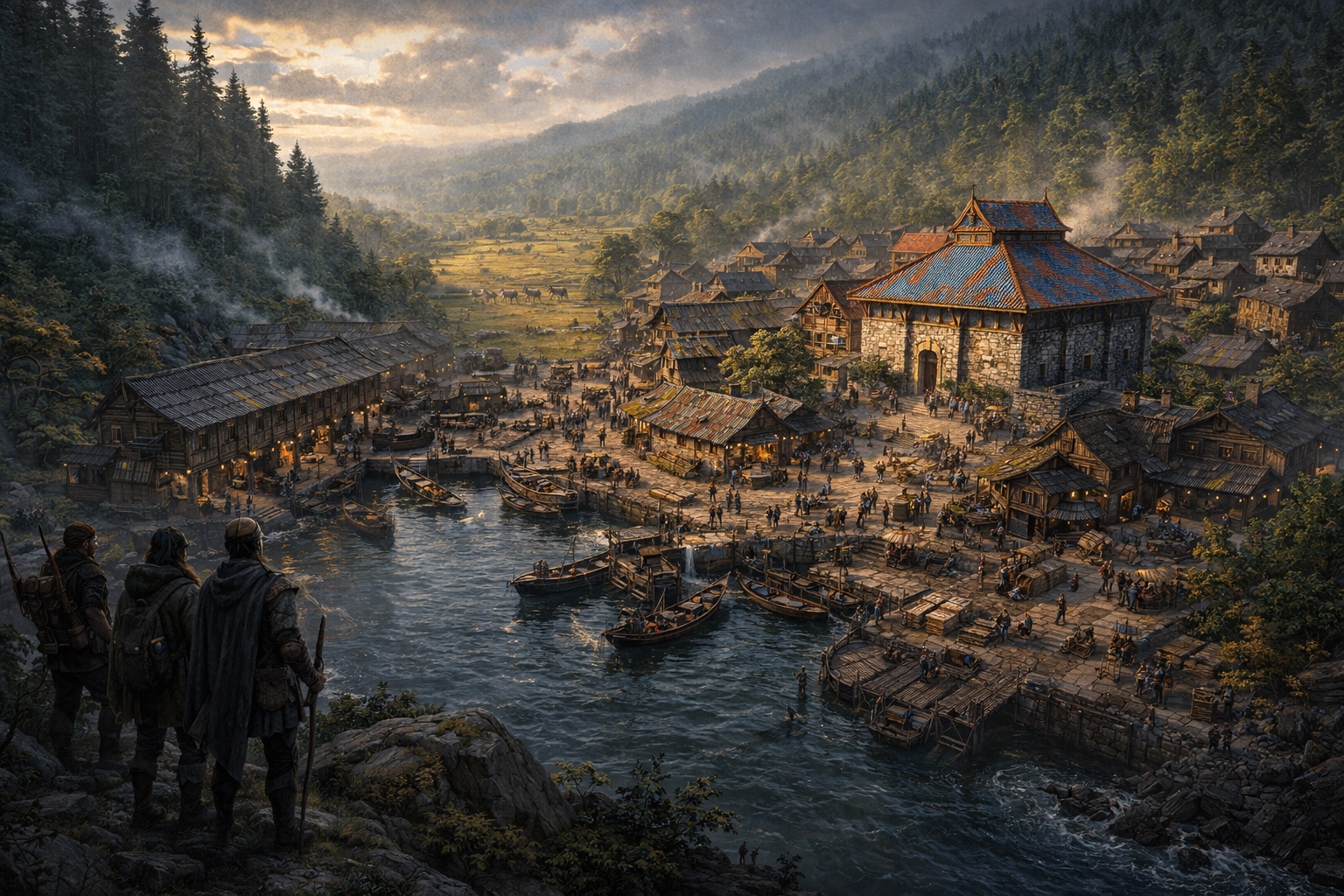
Shilder's Outpost smells like fish, bread, and the particular resinous perfume of ironbark timber: the scent of the Kenner Woods that has been worked into every original structure and lingers in the grain of the Hall of Stone like memory. It is a small town by any continental standard and makes no apologies for it. The buildings are solid, variously aged, and in aggregate give the impression of a place that has been added to thoughtfully over time rather than planned comprehensively at once.
The Hall of Stone is the center of everything: literally, in that it anchors the town's layout, and practically, in that most of the town's important conversations happen either inside it or within earshot of it. Its azure-and-garnet roof tiles catch the morning light in a way that seems improbable for a building this far into the Second Lands, and they are the first thing returning adventurers look for when they come back from the Kenner interior.
The docks are modest but functional, sheltered from the Durack's storms by a covered harbor that Marla Orensdottir's family built three generations ago and maintains with proprietary thoroughness. The town's mood is characteristically practical: attentive to the outside world, unimpressed by credentials, and genuinely warm to those who demonstrate they know what they're getting into.
Geography & Setting
The Outpost sits at the mouth of the Durack River where it meets the northeastern coast, with the Kenner Woods rising at its back and the sea at its front. It is, by the geography of the Second Lands, about as defensible as it sounds, which is to say, not enormously, and the town's survival across centuries has depended less on walls than on reputation, relationship management with the Kenner's indigenous inhabitants, and the specific deterrent effect of being a settlement that everyone who travels the northeastern coast needs.
The Kenner Woods provide timber, game, and the ongoing promise of Avalar. The Durack provides fish and the freshwater the town depends on. The coast provides connection to the wider world, the supply ships from Funta and the occasional continental expedition that uses Shilder's Outpost as a staging point.
The climate is temperate and wet. The Durack floods in heavy rain seasons; Marla's covered harbor was built partly for this reason.
The People
Demographics
Shilder's Outpost has the most genuinely mixed population of any Second Lands settlement. Shilder's original crew was diverse, Farid's Jazirah arrivals added a dwarven architectural tradition, and the subsequent generations have maintained that heterogeneity through a culture that values practical competence over origin. Nella Faridsdottir's dwarven lineage holds the headwomanship; a Smaling runs the inn; a gnome manages the fishery logistics; an elf family operates the glassblowing trade that developed from the ironbark-processing operation.
Outsiders arrive regularly: adventurers heading into the Kenner, scholars chasing Avalar, the occasional Second Lands enthusiast who has been told this is the least likely place to die on the continent. They are received with the matter-of-fact hospitality of a town that has been processing arrivals for centuries and has efficient systems for it.
Economy
The Outpost's economy runs on three engines: Marla's fishery, Warrick's farm, and the adventurer-support industry that Nella manages with the precision of someone who understands that hope is a renewable resource.
The fishery produces dried and salted bluefin, bream, and snapper that reach coastal markets on the mainland. The farm (Mira's original patch, expanded beyond recognition across generations) produces enough to feed the town and export surplus maize and apple harvest. Adventurer services (equipment, guides, accommodation, map reproductions, and the particular expertise that comes from generations of proximity to the Kenner) constitute a significant portion of cash income.
Primary Exports
- Dried and salted fish: Particularly bluefin, which reaches Funta markets and is considered the highest-quality preserved fish from the Second Lands coast
- Ironbark timber and worked ironbark goods: The Kenner's ironbark is exceptionally durable and commands premium prices on the continent; limited harvesting is permitted by standing agreement with the Kenner's edge communities
- Agricultural produce: Surplus maize, dried apple, and cultivated antelope products (meat, hide)
Primary Imports
- Iron tools and weapons: The Outpost has no smithing capacity for heavy metalwork; tools and arms come from the mainland
- Medicines and alchemical supplies: The Kenner produces its own hazards; remedies for them largely don't grow nearby
- Cloth and finished textiles: Local production covers basics; anything more requires import
Key Industries
- The Durack Fishery: Marla Orensdottir's fleet operation, covering the full Durack stretch and the coastal waters; the largest employer in the Outpost
- Warrick's Consolidated Farm: Mira's descendants have turned a Smaling widow's vegetable patch into a working agricultural operation with diversified production
- Adventurer Services: Equipment supply, guide rental, map reproduction, and the Rusty Fork Inn's function as an expedition staging point; economically diffuse but collectively significant
Food & Drink
The Outpost eats well by Second Lands standards. The Durack provides fresh fish daily; Warrick's farm provides vegetables and fruit in season and preserved goods year-round; the antelope herd means meat is available regularly. The cooking style is an evolved hybrid of the Jazirah influence Farid's settlers brought and the practical frontier adaptations of a community that has been feeding itself creatively for centuries. Cardamom and local jungle spice appear in dishes that would be recognizable to no single culinary tradition but are reliably excellent.
The Rusty Fork Inn's house specialty is bluefin chowder with ironbark-smoked bread: a combination that has been on the menu since Silana took over from Tomlia, and that adventurers who have eaten it in the field, in the rain, after a difficult week in the Kenner, describe with a feeling in their voice that exceeds mere culinary appreciation.
Culture & Social Life
Life in Shilder's Outpost is lived in proximity: it's a small town on a frontier, and the social fabric is accordingly dense. People know each other's business; they assist with each other's difficulties; they also argue with considerable specificity. The Hall of Stone functions as town meeting hall, communal dining space, celebration venue, and emergency shelter simultaneously, which gives it an emotional weight that the building itself seems to carry in the quality of the firelight.
The founding story is not mythologized here so much as simply known: children grow up understanding that Shilder arrived with a bedroll and a walking stick, that Farid said "the bones are good," that Mira's argument with the rocks of her first farm field lasted three months and she won. These are family stories as much as history.
Outsiders are assessed practically: not where you're from, but what you're here for, whether you can handle the Kenner, and whether you'll owe the Rusty Fork money when you leave. Most are found acceptable.
Festivals & Traditions
The Founding Walk
Annual, in the month corresponding to Shilder's landing. The town walks the original path from the beach to the site of the first camp to the site of the first wooden building to the Hall of Stone, in that order. Nella leads; everyone participates. It takes about two hours. Newcomers are invited; adventurers passing through often join without being asked and are welcomed. Afterward, there is a meal in the Hall. The point, as Nella explains it to anyone who asks, is to remember that it started with five people and a tent.
Avalar Night
Informal, whenever the weather permits late autumn gathering. Not a formal festival: more an institution. When the conditions are right and the Kenner's mists thin, the Outpost climbs the cliffs above the harbor at dusk to look eastward, toward where the towers of Avalar are said to be visible. Stories are told. Theories are proposed and argued. No one has ever confirmed seeing the towers, but several people are fairly sure. Newcomers are always invited. Nella provides cider.
Music & Arts
The Outpost has a musical tradition that leans toward the communal rather than the performative: work songs, drinking songs, the round-form compositions that half-orc druids brought in a later wave of settlers and that have merged with the Jazirah melodic tradition into something genuinely distinctive. No formal performance space; the Hall of Stone serves. On Avalar Night, someone always brings an instrument.
The ironbark-working craft has produced a small tradition of carved goods (tools, decorative items, the occasional piece of furniture) that are recognized on the continent as distinctly Second Lands work.
Religion
Primary Faith
Thulgard holds the primary devotion of Shilder's Outpost, in the pragmatic fashion of a fishing and seafaring community that understands the relationship between weather, tide, and commerce. The shrine is a modest building near the harbor, maintained by whoever currently considers themselves the most devout, which rotates among the senior fishing families. Prayer is practical: ask for fair weather, thank for safe return, offer something when the bluefin are running. The theology is uncomplicated and the observance is genuine.
Gramil, deity of ancient growth, temporal endurance, and the patient permanence of forests, is the other primary faith of Shilder's Outpost, though "faith" is perhaps too formal a word for how most residents experience it. The Kenner Woods stand at the Outpost's back the way the ocean stands at its front: immovable, ancient, and possessed of a patience that makes human timescales feel provisional. Shilder himself was said to have listened to the Kenner with "the measured attention of a man cataloguing rather than fearing"; that disposition, passed down across generations of guides and residents who live at the forest's edge, is Gramil's practice by another name. The ironbark workers whisper thanks to the Kenner's oldest trees. The guides leave something at the treeline. The awareness is constant and the formality is minimal, which is entirely consistent with Gramil's own nature.
Secondary / Minority Faiths
Raphma (a deity associated with travelers, wanderers, and those who seek) has a small following in the Outpost drawn from the adventurer community and the guides who lead them into the Kenner. A carved marker at the trailhead leading into the woods serves as an informal shrine; people leave coins and requests before heading in.
Oruka, deity of beasts, hunting, predation, and the sustainable harvest of the wild, is closely observed by the hunters and fishing families alike. The Outpost has always fed itself by reading the Durack River and the Kenner edge: understanding which fish run in which season, where the game moves when the weather turns, what the bluefin will do when the sea temperature shifts. This knowledge is practical and it is sacred; Oruka is the acknowledgment that the food chain is a relationship, not a resource. Marla Orensdottir's fishing fleet observes Oruka's festival before the start of each season's serious fishing, a tradition her father began and that has become one of the Outpost's most consistent observances.
Nesara, deity of freshwater, rivers, springs, and floods, is honored at the Durack's edge with the quiet regularity of people who know what their river means. The Durack feeds the Outpost, waters the farm, anchors the fishery, and floods with seasonal unpredictability that has threatened the harbor more than once, and Nesara is addressed in all of these moods. Warrick's farm maintains the most formal Nesara observance, with small offerings left at the irrigation channels at the start of the growing season; the fishing families observe it more informally, but no one launches a boat on the Durack without some acknowledgment of whose river it is.
Caldrin, deity of roads, crossroads, safe passage, and hospitality-to-strangers, receives particular attention in the Outpost because the Outpost's entire economy depends on strangers arriving safely and being treated well. Every expedition that stages from here is Caldrin's business; every supply ship that comes in on schedule is a prayer answered. The Rusty Fork Inn maintains a small Caldrin token above its door: not out of unusual piety, but in the practical understanding that an inn's livelihood is Caldrin's portfolio made daily.
Dwarven religious traditions are observed privately within the dwarven families and the Masons' tradition Farid established; these practices are respected without being incorporated into broader civic religious life.
Secret or Forbidden Worship
Nothing formal. There are individuals in the Outpost who have spent too much time in the Kenner and developed religious opinions about whatever the ruins between the Durack and Roper rivers contain. These opinions are diverse and sometimes contradictory and are discussed freely over drinks at the Rusty Fork rather than in secret, which makes them a colorful feature of the town's intellectual life rather than a security concern.
History
Founding
The Outpost was founded in 1876 ME by the explorer Shilder and a small company of companions (Malik and Jasper, Iris of Canta, and Tannir) who established the first camp on the northeastern shore and did not leave when the Second Lands suggested they might consider doing so. Elira the elven carpenter built the first wooden structure. Farid of Jazirah built the Hall of Stone. The full account is preserved in the Outpost's founding chronicle. See Shilder's Outpost (Chronicle).
Key Events
The Hall of Stone (Year of Founding + 7)
The construction of the Hall of Stone by Farid, Shilder, and Elira in the Outpost's seventh year: the moment the settlement stopped being a camp and became a town. The Hall still stands. Farid's original stonework has never required structural repair.
The Fishery Expansion (approximately 400 years post-founding)
The transition from Oren's single boat operation to Marla's fleet represents the settlement's most significant economic transformation, enabling reliable supply connections to mainland markets and sustaining the population growth that brought the town to its current size.
The Antelope Domestication (approximately 200 years post-founding)
When Warrick Mira's-great-grandson decided to stop chasing antelope and start breeding them, he was widely thought to be optimistic. He was correct. The domesticated antelope herd has been one of the farm's signature features ever since.
Current State
Shilder's Outpost is as stable as it has ever been. Nella Faridsdottir's administration is well-regarded; the fishery and farm both had good seasons; and the Kenner continues to produce both revenue and casualties in approximately the expected proportions. The griffon breeding proposal is pending a vote in the Headwoman's Council. Warrick is in favor; the fishing families are uncertain.
The only ongoing concern is the recurring question of what to do with the increasing number of adventurers who return from the Kenner convinced that they found Avalar, gave detailed accounts that are internally consistent and mutually contradictory, and would like to organize a follow-up expedition.
Leadership & Governance
The Headwoman's Council: Overview
Nella Faridsdottir governs as Headwoman: a title the Outpost has used since its second generation, when it became clear that a formal decision-making structure was necessary and that "whoever Shilder trusts" was not going to scale. The Headwoman holds executive authority on operational matters; the four-member Guild Council (representing fishing, farming, trades, and services) holds voting power on significant community decisions and budget matters. The arrangement works because it has worked for a long time and because Nella is good at it.
Nella Faridsdottir: Headwoman
Dwarf, Female: appears to be in her late sixties; has held the office for twenty years
She has Farid's breadth of shoulder and his talent for looking at something and immediately identifying what it needs. She is not warm in any conventional sense: she is honest, practical, and consistently fair, which in the Outpost is worth more than warmth. She knows the name of every permanent resident and a significant number of the regulars.
She wants the griffon project approved because she believes air patrol capability would change the town's defensive calculus. She is patient about it because she has been patient about most things.
Marla Orensdottir: Fishery Master
Gnome, Female: apparent age indeterminate; gnome longevity makes this somewhat irrelevant
Oren's daughter, in the sense of direct descent and in the sense of professional philosophy. She runs the fishery fleet with the attention to detail of someone who understands that weather, fish behavior, and hull integrity are each individually capable of ending someone's day permanently. She is the most economically powerful figure in the Outpost behind Nella, and she knows it, and she uses the fact judiciously.
Guard & Militia
The Outpost has no standing guard force. What it has is a militia rotation (every resident contributes to perimeter watch on a scheduled basis) and a small core of experienced fighters who maintain readiness on a more permanent footing. The latter are informally led by a half-orc named Daggerstone, who has been in the Outpost for thirty years and whose reputation in the Kenner means that most things that come out of the forest looking for trouble have been advised in advance to look elsewhere.
Law & Order
The Outpost's legal tradition is pragmatic and direct: disputes are brought to Nella, she hears both sides, she decides. On matters affecting the whole community, the Council votes. There is no jail: the town is too small for formal incarceration to function, and the practical punishment for serious offense is exile, which in the Second Lands has a fairly certain long-term outcome. The town's laws are few, known by everyone, and enforced without drama.
Notable Figures
Silana: Innkeeper, Rusty Fork Inn
Elf, Female: The Rusty Fork, center of town
Tomlia's daughter; has been running the Rusty Fork for long enough that she is considered a fixed point of the town's geography. She is relaxed, unhurried, and constitutionally incapable of pretending she finds you interesting if she doesn't, which makes her approval, when you get it, unambiguous. She knows who is in the Kenner, who came back, and who hasn't. She tracks this information without being asked and will share it if the asking is respectful.
Warrick: Farm Overseer
Smaling, Male: Mira's Farm, eastern edge of town
Mira's great-grandson; has spent his entire life on ground his ancestor argued out of the Second Lands' possession and considers this the most interesting thing about his situation. He is patient and methodical and has opinions about agricultural practice in frontier conditions that visiting scholars find more useful than they expected. The griffon idea is his, and he has documentation for it.
Daggerstone: Militia Lead
Half-Orc, Male: Wherever the perimeter needs attention
Arrived thirty years ago, stayed, and has never explained why. He is large, minimally communicative, and carries the specific authority of someone who has survived the Kenner long enough to have stopped finding it surprising. He trains the militia rotation with the patience of a teacher and the efficiency of a professional. What he knows about the Kenner's current behavior pattern would be worth a great deal to several parties.
Iris Inkwright: Scholar, Third Generation
Human, Female: The Hall of Stone, archive corner
Descendant of Iris of Canta, the original founding scholar. She maintains the Outpost's archive with the specific obsessiveness of someone who has read the founding documents enough times to know what they don't say. She is currently convinced that Avalar is real, that it is not where people are looking, and that the key to its location is in an annotation in Shilder's original journal that everyone else has dismissed as a water stain.
Key Locations
Seat of Power
- The Hall of Stone: Farid's original construction, now centuries old and structurally unchanged. The Hall functions as community meeting space, Nella's office, emergency shelter, and the town's primary social venue simultaneously. The azure-and-garnet roof tiles are the original installation.
Houses of Worship
- Thulgard's Shrine: Near the harbor, modest in scale, maintained with practical devotion by the fishing families. A carved anchor above the door; candles in the windows on nights when boats are out.
- Raphma's Marker: A carved stone at the Kenner trailhead. Not a formal structure; more a recognized point of supplication. People leave coins, notes, small offerings before heading in.
Inns & Taverns
- The Rusty Fork Inn: Two floors, a bar that has been in continuous operation since Tomlia built it, and Silana behind the counter. The best fish chowder on the northeastern coast. Rooms are clean and not expensive. Do not leave your pack unattended in the common room.
Shops & Services
- Enzo's Emporium: Dorian's expansion of Enzo's original Provisions. Rope, lanterns, iron spikes, healing supplies, preservation canisters, maps, three different kinds of rope, and one locked cabinet that Dorian will open if you explain what you need and why.
- Aldra's Blades: The town's smith, who works primarily in repair and maintenance rather than original fabrication. Can duplicate most standard adventuring equipment given time and materials.
- The Temple of Mercy: Sister Sarai's successors maintain the town's healing center, which functions as both religious space and practical medical facility. Open to all; healing magic provided without cost for residents, at modest cost for visitors.
The Market
- The Harbor Market: Operates daily at the dock, dawn to midmorning, as the fishing boats come in. Fish, obviously, but also the exchange point for goods arriving from supply ships and the informal commerce of the adventurer community. The most social space in town at 7 in the morning.
Other Points of Interest
- The Avalar Cliffs: The high ground above the harbor from which, on clear evenings, the towers of Avalar are said to be visible. Whether this is true is a matter of ongoing local debate. The view of the coast is excellent regardless.
- Mira's Farm: Warrick's operation covers significant ground east of town; the original fence Tomlin built is long gone, replaced by proper stone walls. The apple orchard is open for picking in season.
Guilds & Organizations
- The Durack Fishers' Cooperative: Marla Orensdottir chairs. Coordinates the fleet's operations, negotiates supply contracts with mainland buyers, manages the harbor infrastructure.
- The Kenner Guides' Association: Informal organization of the Outpost's licensed guides into the Kenner Woods. Members share intelligence about current conditions, maintain the trail markers, and have established protocols for when an expedition goes missing.
Secrets, Rumors & Hooks
- Iris Inkwright's annotation theory is correct. Shilder's original journal contains, in what appears to be water damage on page forty-seven, a rough map drawn in a substance that is not water. The archive has the original. Iris hasn't told Nella yet because she isn't certain and doesn't want to start something she can't finish.
- The Kenner's indigenous edge communities have been sending representatives to Daggerstone for the past year with information about movement deeper in the woods: large-scale movement, the kind that precedes territorial shifts. Daggerstone has been documenting this and deciding when it becomes Nella's problem.
- Three expeditions in the past two years returned from approximately the same grid reference in the Kenner interior with similar accounts: a stone structure, intact, possibly inhabited, that did not match any description of Avalar in the literature. None of the three have compared notes with each other. Silana knows all three are in her guest register.
- Warrick's griffon breeding proposal has a secondary motivation that he hasn't disclosed to the Council: he found a nest in the eastern edge of the Kenner three seasons ago. He has been leaving food.