Sir Mordin's Port - Settlement Profile
Sir Mordin's Port: Where the Rules Are Suggestions
"No law, no gods, no pretense. Every port in the world tells you what you can't do here. Mordin's Port is the only one honest enough to tell you what you can."
Wily Jack, address to an unspecified gathering, year unknown
At a Glance
| Continent | The Second Lands |
| Region / Province | Southeastern coast; Too Bay |
| Settlement Type | Port Town |
| Population | ~820 permanent residents; significant transient population |
| Dominant Races | Human (55%), Half-Orc (15%), Smaling (12%), Zerren (8%), Other (10%) |
| Ruler / Leader | Wily Jack |
| Ruling Body | Wily Jack's informal authority, maintained through manipulation, reputation, and selective enforcement |
| Primary Deity | None formal; Ryujin and Martus among sailors and gamblers; Thulgard among older residents |
| Economy | Smuggling, Piracy, Black Market Trade |
| Known For | No questions asked; everything for sale; no bounty collection permitted; the only port where every navy in the world will not follow you |
First Impressions
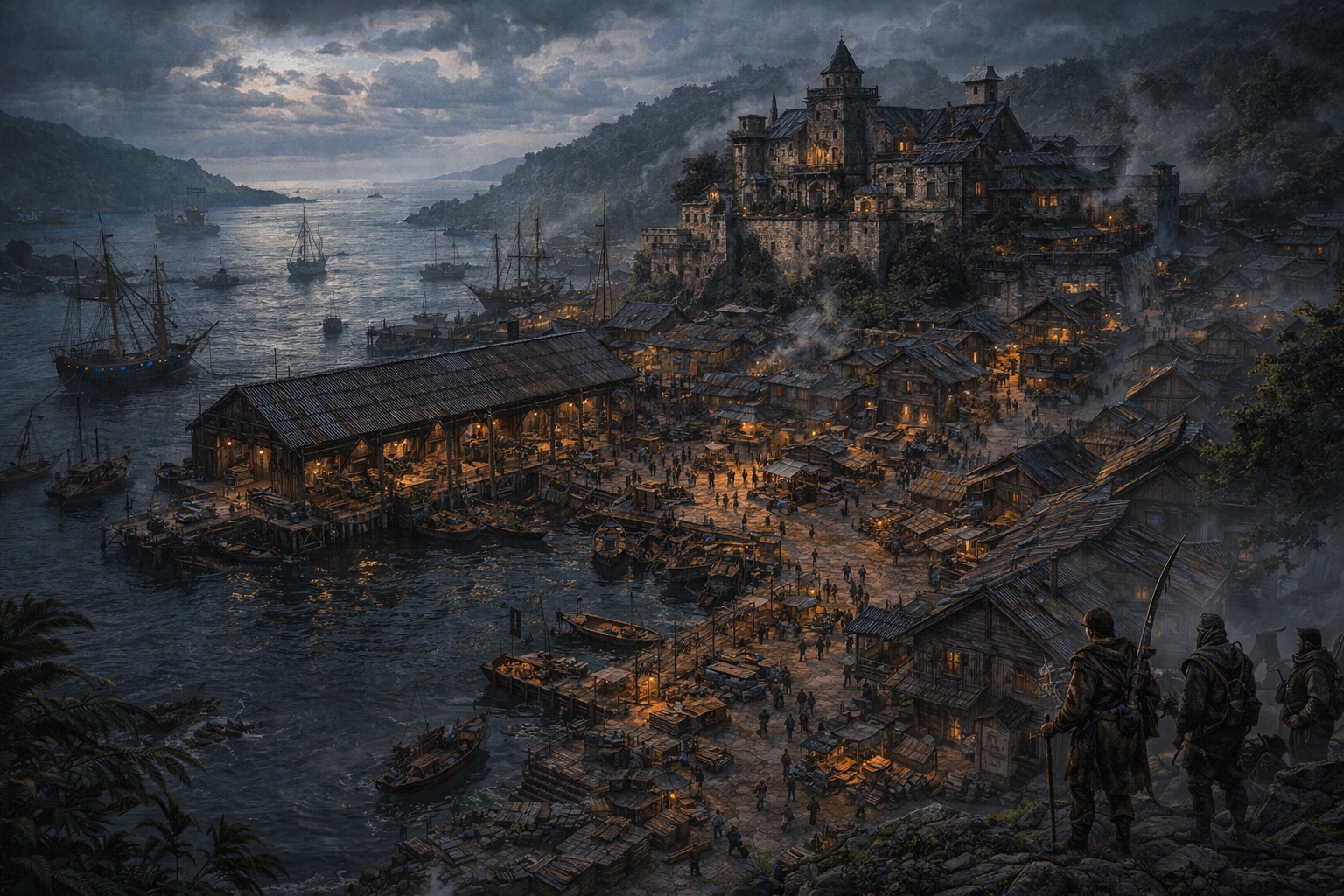
The smell reaches you before the docks come into view: salt water and tar and smoke and the particular sour richness of a port where the garbage has always had somewhere else to be. Sir Mordin's Port is not a beautiful settlement, and it is not trying to be. Its buildings are solid in the way of things built by people who value function over form and who have replaced sections when they rotted rather than maintaining them with any particular plan. The governor's mansion, what remains of it, is the most imposing structure on the waterfront and has been Wily Jack's operational center for twenty years. The architecture around it has grown inward and outward from that point with no evident organizing principle.
The docks are busy at all hours. Ships arrive and depart with the urgency of people who have not come here for the amenity and do not intend to stay longer than the business requires. Occasionally a vessel will remain for weeks, which means its crew is either broke, hiding, or both.
The street life is dense and purposeful. People in Sir Mordin's Port are generally going somewhere or waiting to go somewhere; aimless wandering is for visitors, who are identifiable by the way they look at things. Locals look at each other.
Geography & Setting
Sir Mordin's Port sits on the southeastern coast of the Second Lands, in the protected waters of Too Bay, the geography that made it attractive to Sir Mordin's original expedition and has made it attractive to every illegitimate enterprise since. Too Bay's configuration provides shelter from the open sea storms that make most of the Second Lands' coastline hostile to shipping. The bay's depth accommodates significant vessels. The surrounding terrain is scrub coast: not the interior's jungle, not open water, but a navigable buffer zone that makes approach by land arduous enough to deter most organized military action.
This is the whole of the Second Lands that the port's inhabitants care about. The interior is not their concern.
The People
Demographics
Sir Mordin's Port has no demographic policy and no interest in developing one. Its population is the natural result of two centuries of attracting people who need a port that does not ask questions: those fleeing justice in their home nations, those engaged in commerce that does not bear documentation, those who simply prefer to live outside any structure that imposes obligations. The resulting population is diverse by necessity and tolerant by pragmatism.
The half-orc presence traces to Captain Blackscar's original crew and their descendants, who form the port's oldest continuous community. The zerren population is recent and growing: apparently the port's specific combination of legal nonexistence and commercial opportunity is appealing to them, or at least to the ones who found their way here. Smalings cluster around Wily Jack's network and the commercial middlemen functions that network requires.
Economy
The port's economy is organized around three functions: dock fees (everything that comes in pays Wily Jack's tithe), transactional commerce (everything that's sold here involves someone who isn't Wily Jack taking a cut of something), and the market, which is Sir Mordin's Port's most significant feature and the reason ships come here specifically rather than going somewhere more comfortable.
The port produces nothing. It facilitates everything.
Primary Exports
- Smuggled goods of all categories: The port's primary function is moving things that cannot be moved through legitimate channels. If it has value and it's complicated, it comes through here
- Illicit services: Hired fighters, hired specialists in various capacities, information, and accommodations of needs that the port's five guidelines don't prohibit
- Anonymity: The port collects no records, maintains no registries, and has no formal relationship with any continental authority. The absence of documentation is itself a product with real market value
Primary Imports
- Everything: The port produces nothing locally and imports everything it consumes. Supply ships from the continent arrive regularly; the port overpays for staples and underpays for luxuries and everyone knows this and comes anyway
Key Industries
- The Market of Shadows: The port's informal market operates throughout the back districts with no fixed schedule and no catalog. Things appear; buyers find them. Wily Jack takes a percentage of everything
- Dock Operations: The waterfront's primary official economy: berthing, repair, chandlery. Blackscar's operation controls the shipyard. Wily Jack taxes the berthing
- Information Brokerage: Whisper's network and several competing operations trade in the knowledge that is Sir Mordin's Port's most valuable and most dangerous commodity
Food & Drink
The port eats whatever arrived on the last supply ship and does not complain about it. The tavern and inn kitchens are competent to the extent that their ingredients permit and no further. The notable exception is the Salted Mast, which has a cook who was, at some point in her life, substantially better positioned than her current circumstances suggest, and who applies that background to whatever the supply ships have brought. The results are unpredictable and occasionally excellent.
Drink is not the port's problem. The port has more drink than any ten establishments need, because drink sells in places where the alternative is sobriety, and nobody comes to Sir Mordin's Port looking for sobriety.
Culture & Social Life
The culture of Sir Mordin's Port is the culture of people who have opted out of other cultures. It has rules, but they are the rules of practicality rather than morality: don't interfere with commerce, don't make trouble that costs more than it's worth, don't assume that the person you're underestimating has nothing behind them. The genuine social currency is reputation: not the respectable kind, but the kind that says you can be relied upon to do what you've said you'll do and leave alone what you've said you'll leave alone.
Wily Jack is the primary expression of this culture at scale. His reliability within his own framework is legendary; his ability to punish those who violate it is demonstrated regularly enough to maintain relevance. The port functions as well as it does because enough people have decided that Wily Jack's version of order is preferable to no order.
Festivals & Traditions
None
Sir Mordin's Port does not have festivals. It has days when business is better than others and days when there was a fight, and it regards these as distinct categories.
An exception: the anniversary of the original pirate takeover is celebrated annually by whoever is currently in charge of the governor's mansion, in whatever manner they see fit. Wily Jack's version is a private dinner with Captain Blackscar the Tenth and Whisper, at which the port's accounts for the year are reviewed. He considers this adequate observation of the occasion.
Music & Arts
The port has musicians in the same way it has everything else: people arrived, they play, they get paid, they move on. The music in the taverns is loud and functional. There is one exception: a bard named Terevon who has been at the Salted Mast for four years now, who plays quietly in the corner and is the only person in the port whose performances actually stop conversations. Nobody is certain what his actual business is.
Religion
Primary Faith
Sir Mordin's Port has no organized religious presence. What it has is older sailors who observe Thulgard in the private, practical way of people who have been at sea long enough to have strong opinions about what can kill you and a corresponding opinion about the value of appropriate deference.
Ryujin, deity of the saltwater seas, tides, currents, ocean depths, and safe passage, is the closest Sir Mordin's Port comes to a broadly held faith, and it is expressed almost entirely without ceremony. Every captain in this harbor depends on the sea for every advantage they possess, and every captain knows it. Sailors leave small offerings at the carved anchor on the harbor wall (coins, scraps of rope, a tooth) in the unorganized but consistent practice of people who take the sea seriously. Captain Blackscar the Tenth, who has survived storms that killed other captains, maintains the most deliberate Ryujin observance in the port, though she would describe it as professional habit rather than devotion.
Secondary / Minority Faiths
The zerren community maintains their own devotional practices, which they observe privately and without invitation to observe.
Martus, deity of luck, chance, fortune, and risk and reward, is worshipped informally but constantly throughout Sir Mordin's Port: in the dice games that run in every back room, in the silent prayer before a major transaction, in the fatalistic shrug with which the port's inhabitants accept whatever outcome arrives. Every pirate captain who has sailed on probability alone is a Martus devotee in practice if not in name. The port does not have a Martus shrine because Martus doesn't need one: every table where coin changes hands is a shrine, and the port is nothing but such tables.
Dolen, deity of sorrow, longing, homesickness, estrangement, and domestic handcrafts, maintains a quiet presence in the port's back streets, among the permanent residents who have made Sir Mordin's Port their home while holding some piece of themselves reserved for elsewhere. Port towns always have Dolen's people: the sailor's wife who has been counting ships for twenty years, the exile who left somewhere they cannot name publicly, the person who arrived young and discovered that home had become an abstraction. The port does not honor Dolen openly, but the domestic practices she governs (the weaving, the mending, the careful preservation of small personal items) are visible in the back-street households of those who have decided this is where they live even though it was never where they meant to end up.
Gramil, deity of ancient growth and the patient permanence of forests, is essentially absent from Sir Mordin's Port: the interior is not the port's concern, and the Second Lands' defining spiritual presence has found no purchase among people whose world begins and ends at the waterfront. The one exception is the occasional veteran of the interior who arrives at the port having spent too much time in the Second Lands' forests and carries something of Gramil's quiet watchfulness in the way they look at things. These individuals are identifiable and tend to be avoided by people who understand that the interior changes you.
Secret or Forbidden Worship
This question assumes the port has standards about what is forbidden, which it does not. Several cults operate openly. The one that is actually secret is the one Wily Jack runs, in the sense that nobody knows he's running it, and it is not clear that "worship" is the correct description for what it involves.
Amnyth, deity of death, poison, vengeance, torture, and the dark knowledge of the dead, finds no better home in the Second Lands than Sir Mordin's Port: a place where hired killers work openly, where poison is a commercial product with a buyer's market, and where the line between religion and professional practice has never been clearly drawn. The port's assassins and the vendors who supply them maintain devotion to Amnyth with a matter-of-factness that would be shocking anywhere else. It is not called secret because it is hidden; it is called secret because no one discusses their professional activities here regardless of deity.
Amador, deity of love, desire, passion, and the breaking of social boundaries through connection, has a small and genuinely hidden following in the port: not because the port is sexually conservative (it is not), but because Amador's transgressive dimension goes deeper than physical liberty. The Amador cult in Sir Mordin's Port involves people who have fallen genuinely, dangerously, across lines that even the port's minimal social order does not sanction: affiliations between those who should be enemies, loyalties that compromise professional arrangements, the kind of connection that Wily Jack would consider a security risk if he knew about it. He suspects some of this exists. He has not yet identified the specific cases.
History
Founding
Sir Mordin's Port began as an Irna expeditionary base camp: inadequately resourced, poorly supported, and governed by Sir Mordin, a human official of genuine vision and insufficient infrastructure. The camp was taken by pirates within months of establishment. Irna sent an investigation; the investigation ship was sunk. Irna lost interest.
The full account is preserved in the port's chronicled history. See Sir Mordin's Port (Chronicle).
Key Events
The Blackscar Succession
The port passed through multiple iterations of pirate control before Wily Jack's consolidation: most significant among them the Blackscar line, which has provided successive captains across ten generations. The current Captain Blackscar is the most diplomatically sophisticated of her line, which is what makes her a useful partner to Wily Jack rather than a threat.
Wily Jack's Consolidation
The event that defines the port's current operation. The orchestrated downfall of two rival captains, the installation of the five guidelines, and the establishment of the tithe system: achieved over approximately fifteen years and attributed to Wily Jack by everyone who has thought about it for more than a few minutes, though attribution has never been formally established.
Current State
Sir Mordin's Port is as stable as it gets, which means Wily Jack is managing the competing interests effectively, the guidelines are being observed, and the tithe is flowing. Three captains are currently in harbor with ships whose combined cargo would constitute a diplomatic incident on the continent. Wily Jack is aware of this. He considers it Tempsday.
The one ongoing complication is a continental navy (which navy is unclear; Whisper has three different intelligence reports pointing at three different flags) that has been probing the approaches to Too Bay. Not entering, not yet, but watching. Wily Jack is watching back.
Leadership & Governance
Wily Jack's Arrangement: Overview
Sir Mordin's Port has no formal government. What it has is Wily Jack, who maintains authority through a combination of universal knowledge of where the bodies are buried (figuratively and occasionally literally), the reputation of a man who keeps his word and collects on breaches with specificity, and the five guidelines that protect the economic interests of everyone who uses the port.
The guidelines are enforced by Wily Jack's personal security force: small, professional, and operating on the understanding that their effectiveness is what keeps them employed. Captain Blackscar the Tenth provides backup capacity when matters require more than Wily Jack's force can address unilaterally.
Wily Jack: Port Master
Smaling, Male: late forties
See the full profile in the port's chronicle. The summary is: he is the most intelligent person in any room he occupies, he knows it without making it obvious, and he has built a sustainable arrangement out of materials (competing pirate interests, absent civic infrastructure, the Second Lands' general hostility to permanence) that should not have produced one. He has been doing this for twenty years and shows no signs of fatigue.
He wants the naval probing to stop before it becomes a naval visit, which would be bad for business and worse for diplomacy. He is working on it.
Captain Blackscar (The Tenth): Shipyard Master
Orc, Female: forties
The current bearer of the name that began the port's pirate history. She is the most capable captain currently operating out of Sir Mordin's Port and the only one whose relationship with Wily Jack is based on genuine mutual respect rather than managed mutual threat. She controls the shipyard and the deep-water berths; nothing significant arrives or departs without her knowing. She is physically imposing, strategically sophisticated, and entirely clear on what her interests are.
Whisper: Intelligence Network Anchor
Zerren, Female: apparent age early thirties
Primarily visible as a barmaid at the Anchor's Rest and an occasional street performer. Actually the center of Sir Mordin's Port's most comprehensive intelligence operation. She knows who came in when, what they were carrying, who they spoke to, and what they said. The limit of her knowledge is whatever happened in conversations that everyone present agreed to have somewhere quiet, and she considers this limitation professionally intolerable and works to address it continuously. She and Wily Jack have a working arrangement that benefits them both and that neither would describe as a friendship.
Guard & Militia
Wily Jack maintains approximately forty personal security personnel: professionals, not militia. They wear no uniform and are identified by their demeanor and by the fact that they appear when something is happening rather than before. Their presence is most visible at the warehouse (guideline two) and the dock (guideline three). Captain Blackscar's crew provides supplementary capacity when requested, which is rare and taken seriously when it occurs.
Law & Order
The five guidelines function as the port's complete legal code. Violations are addressed by Wily Jack's security; the response is calibrated to the severity of the violation and the violator's standing. First violations are expensive. Second violations result in expulsion. Third violations are theoretical, because second violations are thorough.
The guidelines do not cover most categories of activity, which is deliberate. What happens between consenting parties in their own space, commercial transactions that both parties agree to, and the full range of human behavior that most legal systems prohibit: these are not the port's concern. The port's concern is that the guidelines hold and the tithe flows.
Notable Figures
Redd: Weapons Dealer
Human, Male: The back market, unspecified location
He doesn't have a shop; he has a location that changes regularly and that everyone who needs him knows how to find. He sells weapons, which in Sir Mordin's Port is a category that includes things continental smiths don't produce, Second Lands materials with interesting properties, and items of recovered provenance that he declines to discuss. He is careful, professional, and has never been found holding anything that belonged to someone in the current harbor, a self-preservation instinct that Wily Jack respects.
Terevon: Bard, the Salted Mast
Half-Elf, Male: The Salted Mast, back corner
Has been at the Salted Mast for four years. Plays quietly. Stops conversations. Nobody knows why he's here or what he's actually doing, which in Sir Mordin's Port is either a disguise or a genuine mystery. Wily Jack has Whisper watching him. Whisper's current assessment is that he is the most relaxed person in the port and that this is suspicious.
Harrow: Physician
Human, Female: Third street back, blue door
The port's only reliable physician. She asks no questions, which is the primary requirement of her position, and she is sufficiently skilled to handle most categories of damage that the port produces. She charges what the patient can afford and has a system for determining this that is accurate enough to be mildly unsettling. She has no particular loyalty to anyone in the port and is treated with corresponding care by everyone who might need her services.
The Fence, name unknown: Antiquities
Species unclear: Market of Shadows, intermittent
An entity of uncertain origin who appears irregularly in the Market of Shadows to purchase items of Second Lands origin: specifically items recovered from the interior, specifically items with magical properties, specifically items that other buyers have declined to touch. Payment is immediate and substantial. Nobody has successfully followed the Fence after a purchase. Nobody has successfully identified where the purchased items go. Wily Jack has been trying to understand this operation for three years.
Key Locations
Seat of Power
- The Governor's Mansion: What Sir Mordin built and Blackscar the First took. Now Wily Jack's operational center: his meeting space, his records (such as they are), his primary secure location. Not open to uninvited visitors.
Houses of Worship
- None: A carved anchor on the harbor wall serves as the informal Thulgard marker. People leave coins when they feel like it.
Inns & Taverns
- The Anchor's Rest: The largest establishment in the port's middle district. Whisper's primary operational base. Drink, rooms, food that is adequate. The clientele is the port's full spectrum.
- The Salted Mast: Quieter, better food, Terevon in the corner. Preferred by those who want to conduct business without being overheard, which means Whisper's secondary operational base.
- The Bilge: Not a name; a description. The cheapest drink in the port. Not recommended for anything except the drink, which accomplishes its purpose.
Shops & Services
- The Shipyard: Blackscar's operation. Full repair capability; no questions about how the hull got that way; discretion maintained; expensive. The only facility of its quality on the southeastern coast.
- The Warehouse: The port's shared goods storage, protected by guideline two. Managed by a dwarf named Stump who has been in his current position since before Wily Jack's consolidation and whose institutional memory is comprehensive.
- Everything Else: Sir Mordin's Port does not have named shops. It has people who sell things from locations that the relevant buyers know about. Ask Whisper.
The Market
- The Market of Shadows: Operates throughout the back district on a schedule that is best described as "when there's something to sell." Not a physical location; a network. Everything that cannot be bought elsewhere can be found here at a price that reflects the difficulty of finding it.
Other Points of Interest
- The Original Docks: Sir Mordin's original construction, now expanded beyond recognition but with the original stone work still visible under the additions. Blackscar the First's crew used these docks to take the port; Blackscar the Tenth's crew still berths here by tradition.
Districts & Neighborhoods
- The Waterfront: Docks, warehouses, shipyard, dockside taverns. The port's commercial core; operates at all hours; no one who isn't here on business.
- The Middle District: Inns, entertainment venues, the better-quality market operations. Where business is conducted that requires a table and a drink.
- The Back Streets: Food businesses, general stores, living quarters. The port's residential layer; the people who live here rather than pass through.
The Criminal Element
Sir Mordin's Port is the criminal element. This section is therefore the entire document.
Secrets, Rumors & Hooks
- The continental navy probing Too Bay approaches is working from information that could only have come from inside the port. Someone sold access. Wily Jack doesn't know who yet, but Whisper is close to finding out, and Wily Jack has already decided what happens when she does.
- The Fence is not an individual. It is an organization, connected to one of the continental scholarly institutions, that has been systematically acquiring Second Lands artifacts with magical properties for a purpose that has not been disclosed. Three of the items purchased in the past year are connected to the same source location in the Second Lands interior.
- Captain Blackscar the Tenth has been in contact with a representative of the Irna Empire, the same empire that originally lost the port, about terms for a conditional arrangement that would give Irna intelligence on port traffic in exchange for an understanding about naval interference. She has not told Wily Jack. He suspects something; he doesn't know what.
- Terevon the bard can hear conversations he shouldn't be able to hear from where he's sitting. This is not a magical talent. It is an architectural feature of the Salted Mast that he discovered accidentally and has been deliberately exploiting for four years. The information he has accumulated is extensive. He hasn't decided what to do with it.